Tag: ai news

  • Stop Ignoring Vulnerabilities: Automate Security Updates and Testing

    Stop Ignoring Vulnerabilities: Automate Security Updates and Testing

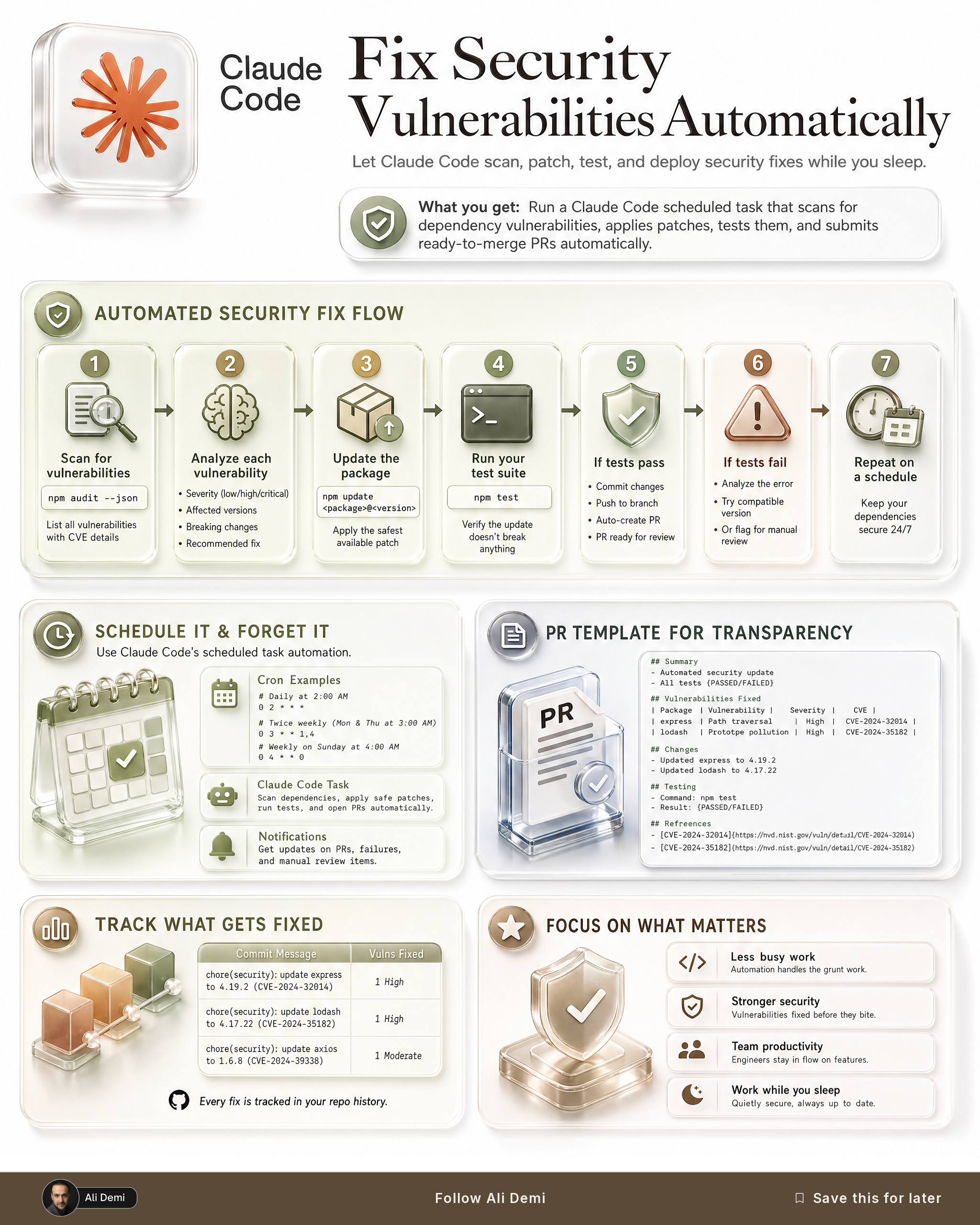
    Security vulnerabilities pile up because fixing them is friction-heavy: scan, understand the CVE, update the package, run tests, debug failures, rinse and repeat.

    Claude Code scheduled tasks can do all of that for you.

    Set up a daily or weekly task that runs `npm audit –json`, parses the vulnerabilities, updates each package, runs your test suite, and if tests pass, auto-commits and pushes a PR. If a test fails, Claude analyzes why and either tries a compatible version or flags it for manual review.

    The result: your dependencies stay current, your security debt shrinks, and your team’s attention goes where it actually matters – code review, not dependency roulette.

    The workflow is hands-free once set up. Cron fires it nightly. You wake up to a stack of security fix PRs, pre-tested and ready to merge.

    ——

    Book your free AI clarity call, NOW!
    https://buff.ly/TpWy277

    ——

    Repost this. Thanks.

  • Your Codebase Should Answer Questions: Build an AI Assistant

    Your Codebase Should Answer Questions: Build an AI Assistant

    Here’s the problem: a junior engineer joins your team and spends two days figuring out why the transaction system works the way it does. A teammate leaves and their architectural decisions live only in git history nobody reads. You answer the same architecture question three times a month.

    Your codebase already knows the answers. It just can’t talk.

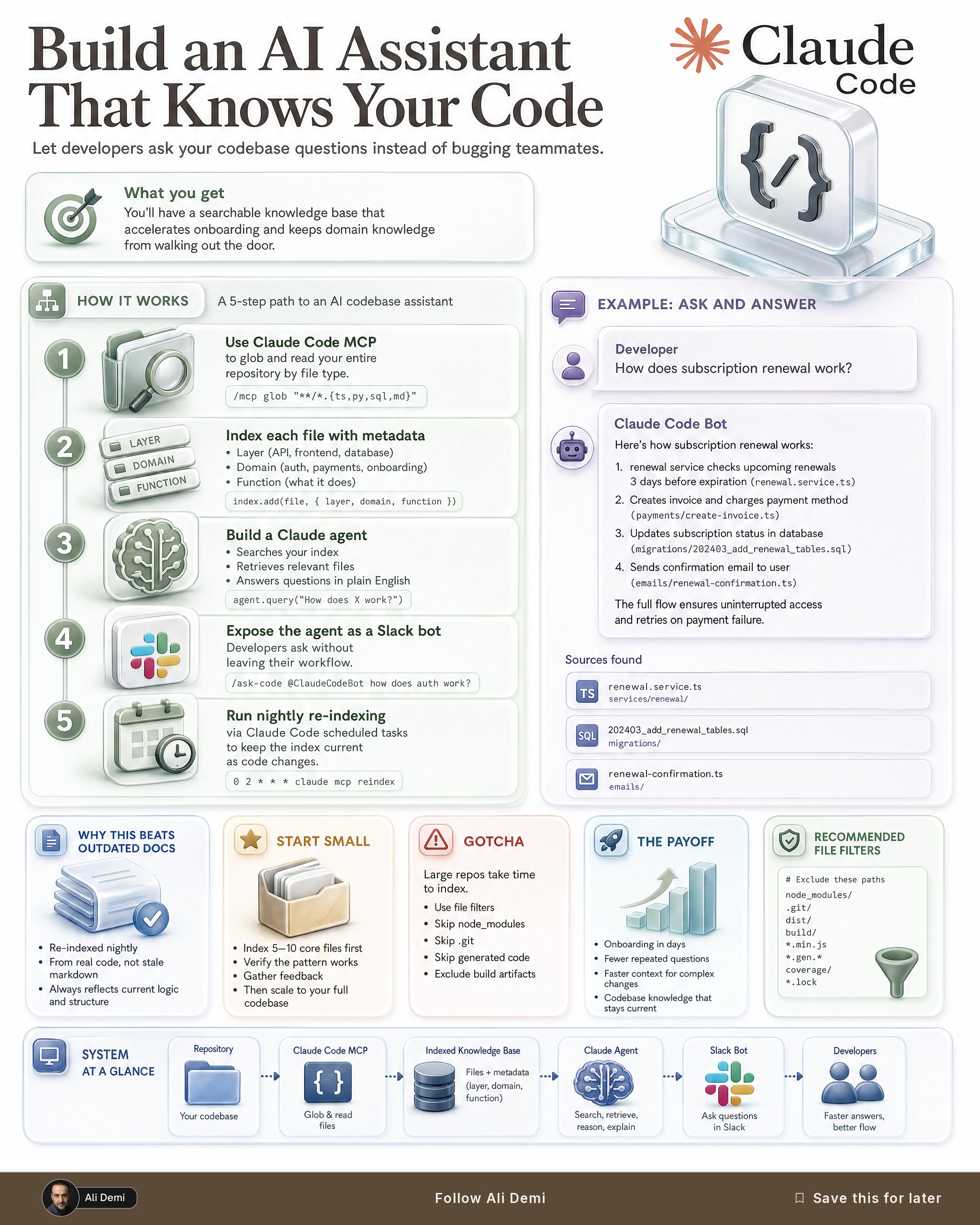
    Claude Code can fix that. Build an AI assistant that indexes your repo and lets developers ask it questions in plain English.

    What you’re building:

    1. Use Claude Code MCP tools to glob and read files by type (controllers, models, migrations, schemas).
    2. Index the structure: each file gets tagged by layer (frontend, API, database), business domain (auth, payments, reports), and functionality.
    3. Build a Claude agent that searches your index, reads relevant files, and synthesizes answers to natural language questions.
    4. Wire it as a Slack bot, CLI, or internal web tool so your team can ask it without leaving their workflow.
    5. Run a scheduled task nightly to re-index; Claude finds new files, renamed patterns, changed architecture, and updates the index.

    Real-world example: A developer asks, “How does the subscription renewal process work?”. The agent finds your subscription service, the renewal cron, the database migrations that track billing state, and the email notifications. It synthesizes: “Here’s the flow, here’s the code path, here’s where it can fail, and here’s how we handle retries.” Boom. Onboarding cut by hours.

    Why this beats traditional docs: Your README gets stale in weeks. This assistant re-reads your codebase nightly. When you rename a module, move a file, or refactor an algorithm, the assistant knows. Developers ask current questions; they get current answers backed by the real code.

    The gotcha: Indexing a large repo takes time and tokens. Start with your core services (5-10 key files), verify the pattern works, then scale. Use file filtering to skip node_modules, .git, and generated code.

    Make it sticky: Wire it into Slack so developers use it without friction. Add a “cite sources” feature so answers include file paths and line numbers. Let anyone on the team update the index with a single command.

    The result: onboarding in days instead of weeks, fewer repeated questions, and institutional knowledge that doesn’t depend on any one person staying.

    ——

    Book your free AI clarity call, NOW!
    https://buff.ly/TpWy277

    ——

    Repost this. Thanks.

  • Your CSS Isn’t Broken, Claude Just Can’t See It

    Your CSS Isn’t Broken, Claude Just Can’t See It

    Your CSS looks fine in the mockup.

    You tell Claude to build it.

    Claude builds it.

    You click the link and… buttons are cut off, the form is off-screen, the footer overlaps content.

    Claude’s code parses fine, so what changed?

    Nothing.

    Claude just built it blind.

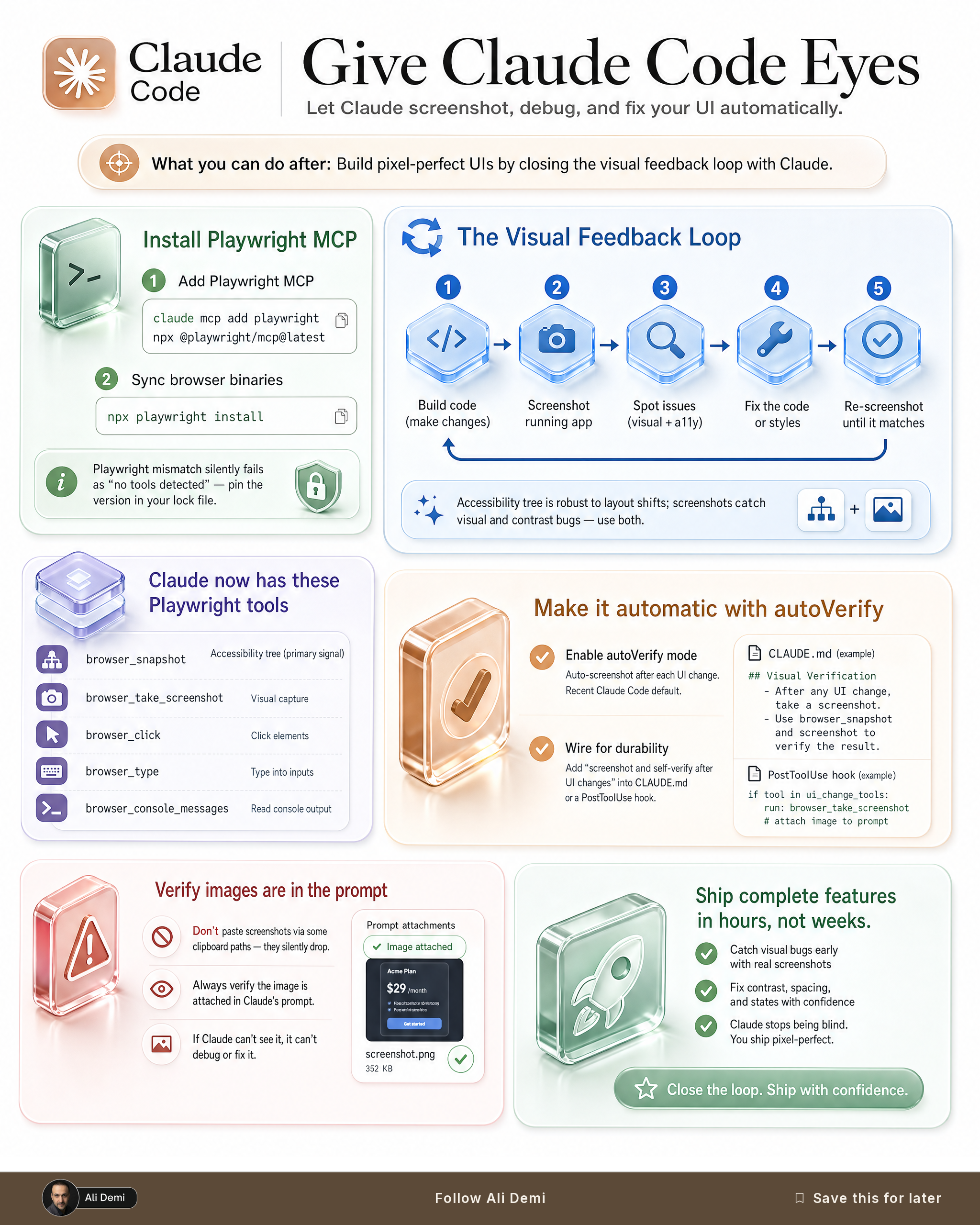
    Here’s the thing: Claude writes HTML and CSS flawlessly – syntax is perfect, logic is sound. But it can’t see what it creates. It has no idea the buttons are cut off or the z-index is wrong or contrast fails.

    You take a screenshot, paste it back, and say “nope, try again.” Three rounds later, you’re done.

    With visual feedback, Claude sees its own work and fixes it automatically.

    Give it a browser.

    Then it stops being blind.

    Playwright MCP is the hook. It lets Claude Code see what it built – snapshots of the DOM structure, screenshots of the running app, the ability to click and type, access to browser console errors. Claude can now navigate to localhost, screenshot the page, compare it to your mock, spot what’s broken, edit the code, and verify again. The loop closes.

    The result: pixel-perfect UIs built in a single conversation. No “take a screenshot for me” back-and-forth. No guessing at CSS fixes. Claude sees the same pixels you do and corrects them before you ever load the page.

    ——

    Book your free AI clarity call, NOW!
    https://buff.ly/TpWy277

    ——

    Repost this. Thanks.

  • Stop Guessing: Use AI to Diagnose Flaky Tests

    Stop Guessing: Use AI to Diagnose Flaky Tests

    Flaky tests are a silent killer. You rerun CI, tests pass. You merge, they fail in production. Your team spends 2.5% of productive time chasing false failures and patching over symptoms instead of fixing root causes.

    The problem is diagnosis. Most flaky test tools just detect (reruns pass/fail ratio) or retry (and mask the bug). They don’t tell you WHY a test is non-deterministic: Is it a timing issue? Shared state? Race condition? Mocked service that sometimes fails?

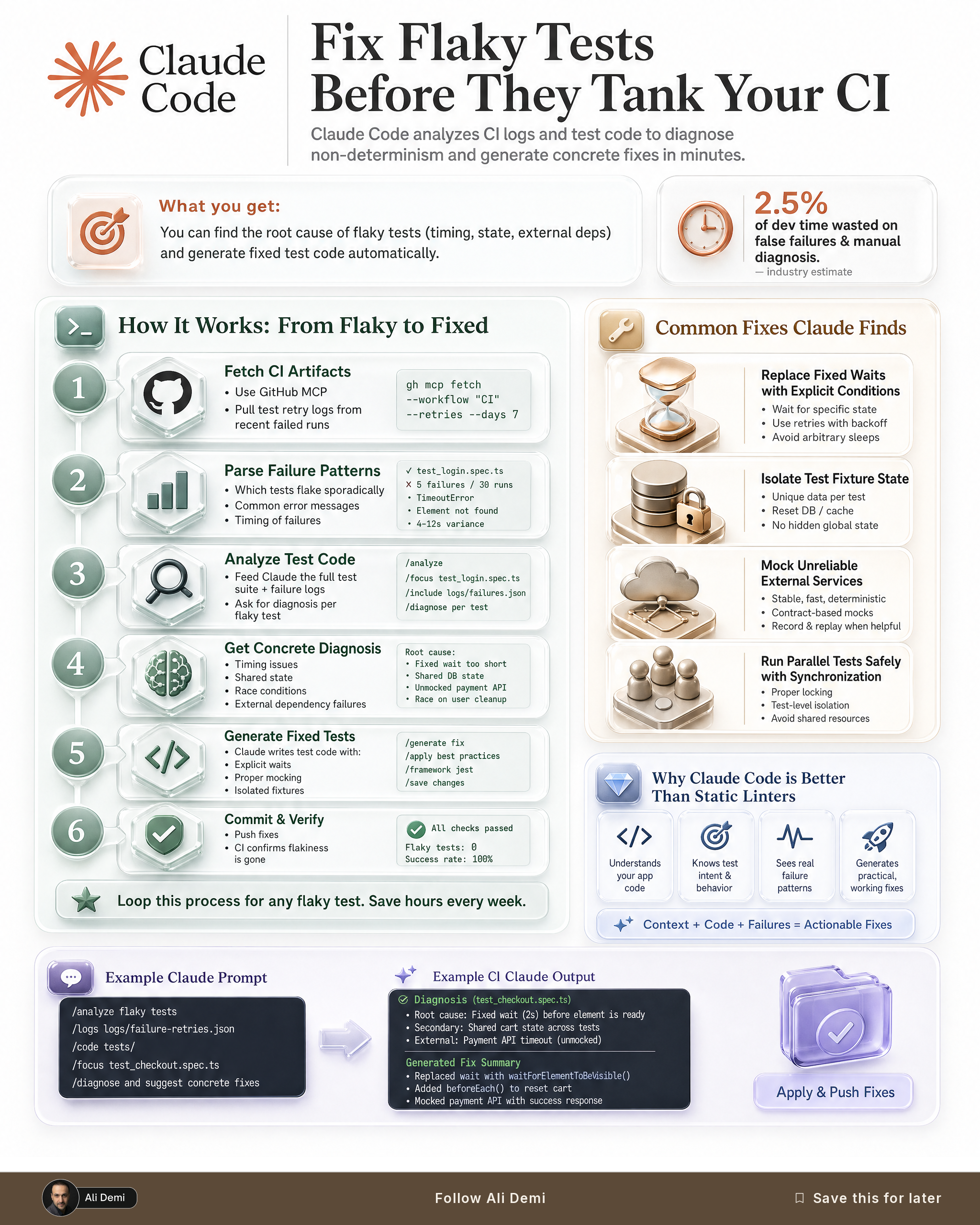
    Claude Code reads test code and CI logs together to find the answer.

    The workflow:

    1. Pull test retry history from your last 20 CI runs (GitHub Actions artifacts, GitHub API).
    2. Parse failure patterns: which tests fail sporadically, what errors do they log, are the failures time-correlated or environment-specific.
    3. Read the test source code. Ask Claude: based on this code and these failure patterns, what’s the non-deterministic behavior.
    4. Generate fixed test code: add explicit waits, isolate fixture state, mock external calls, parallelize safely.
    5. Commit, push, let CI verify the fix works.

    Why Claude is better than static analyzers for this:

    A linter flags “setTimeout in test” as risky. Claude reads the test, the app code it exercises, the CI logs, and the failure mode, then tells you: “This test times out only on slow CI runners. Replace the fixed 500ms wait with an explicit wait for the modal to be visible.” Same problem, concrete fix.

    The commands you’d use:

    Use the GitHub MCP to fetch CI run artifacts and logs. Feed the full test suite and a sample of flaky test runs to Claude with a prompt like: “Analyze these tests and CI failure logs. Which tests are flaky, what’s the likely root cause of each (timing, state isolation, race condition, external dependency), and what’s the concrete fix.”

    Claude returns a ranked list of flaky tests, diagnosis for each, and fixed test code you can commit directly.

    What you save:

    Investigating a flaky test manually takes an hour: dig through CI logs, trace the failure, read the test code, hypothesize, build a fix, iterate. Claude does it in 2 minutes. On a team with 3-5 consistently flaky tests, that’s 5-10 hours a week back in your pocket.

    ——

    Book your free AI clarity call, NOW!
    https://buff.ly/TpWy277

    ——

    Repost this. Thanks.

  • Stop Reading Contracts by Hand: Extract Key Terms Automatically

    Stop Reading Contracts by Hand: Extract Key Terms Automatically

    Contracts are just PDFs full of dense text, tables, and fine print. Your team spends hours scanning each one, hunting for payment terms, renewal dates, liability caps, and who’s actually responsible if things break.

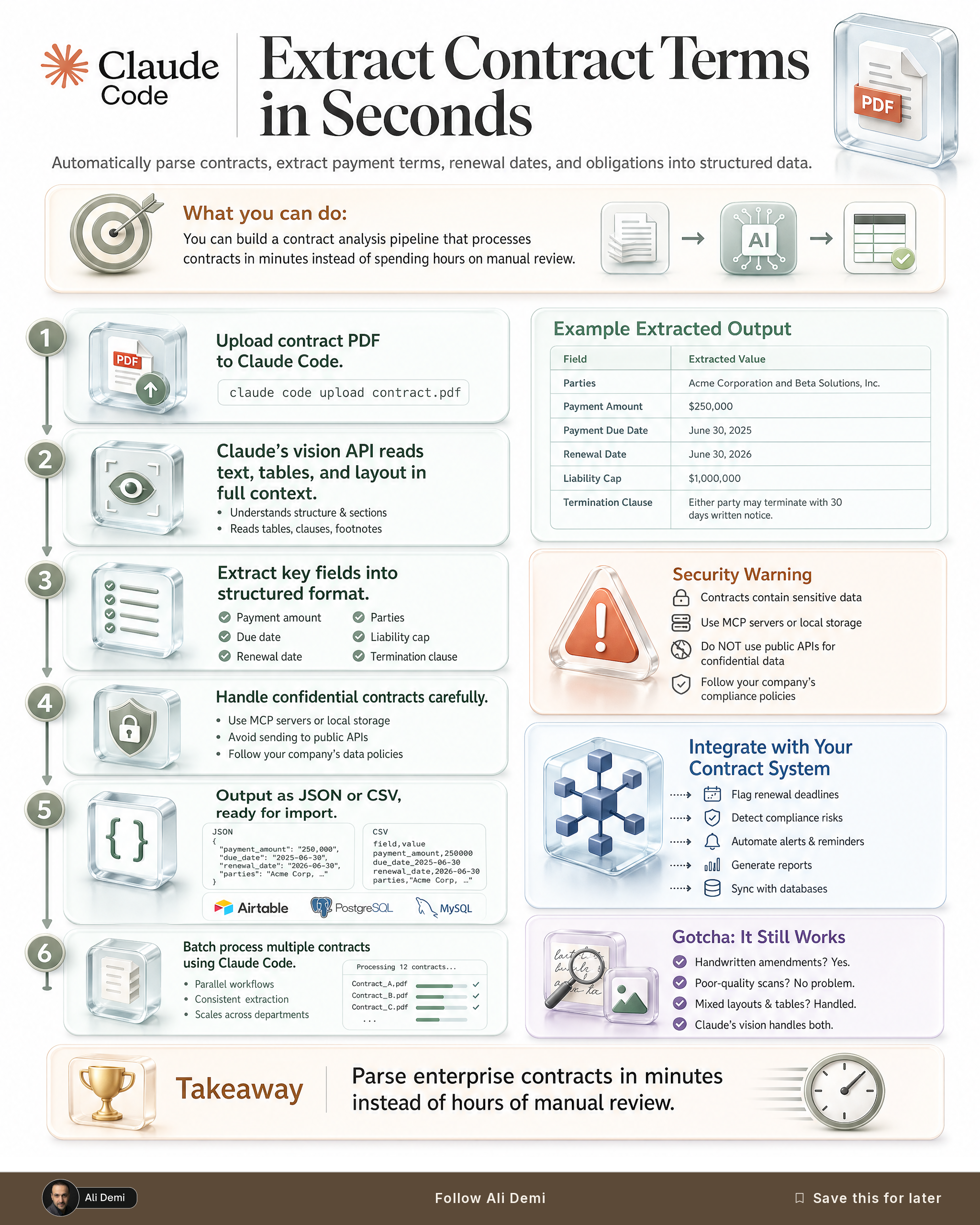
    Claude Code + vision changes that. Upload a PDF contract and Claude reads the entire document-text, tables, signatures, everything. Extract what matters into clean JSON. Feed it straight into your contract management tool or database.

    Here’s what you get:

    1. Drop any contract PDF into Claude Code.
    2. Claude’s vision reads text, tables, and layout holistically (not line-by-line OCR).
    3. Extract structured data: payment amount, payment due date, renewal conditions, termination clauses, liability caps, parties involved.
    4. Output JSON that slots straight into Airtable, Ironclad, or your own contract tracking database.
    5. Batch process 50 contracts in the time it took to read 2 by hand.

    The magic: Claude understands context. It knows that “Net 30” in a payment clause is different from “30 days” in a notice section. It flags ambiguous terms. It catches redlined amendments on page 7 that change the whole game.

    No more hunting through contracts. No more copy-paste into spreadsheets. Parse, extract, sync, and move on.

    ——

    Book your free AI clarity call, NOW!
    https://buff.ly/TpWy277

    ——

    Repost this. Thanks.

  • Stop Writing Test Fixtures: Generate Realistic Test Data in Minutes

    Stop Writing Test Fixtures: Generate Realistic Test Data in Minutes

    You’re hand-writing JSON fixtures.

    They’re brittle, they never look like real data, and when your schema changes, you rewrite half of them.

    Stop.

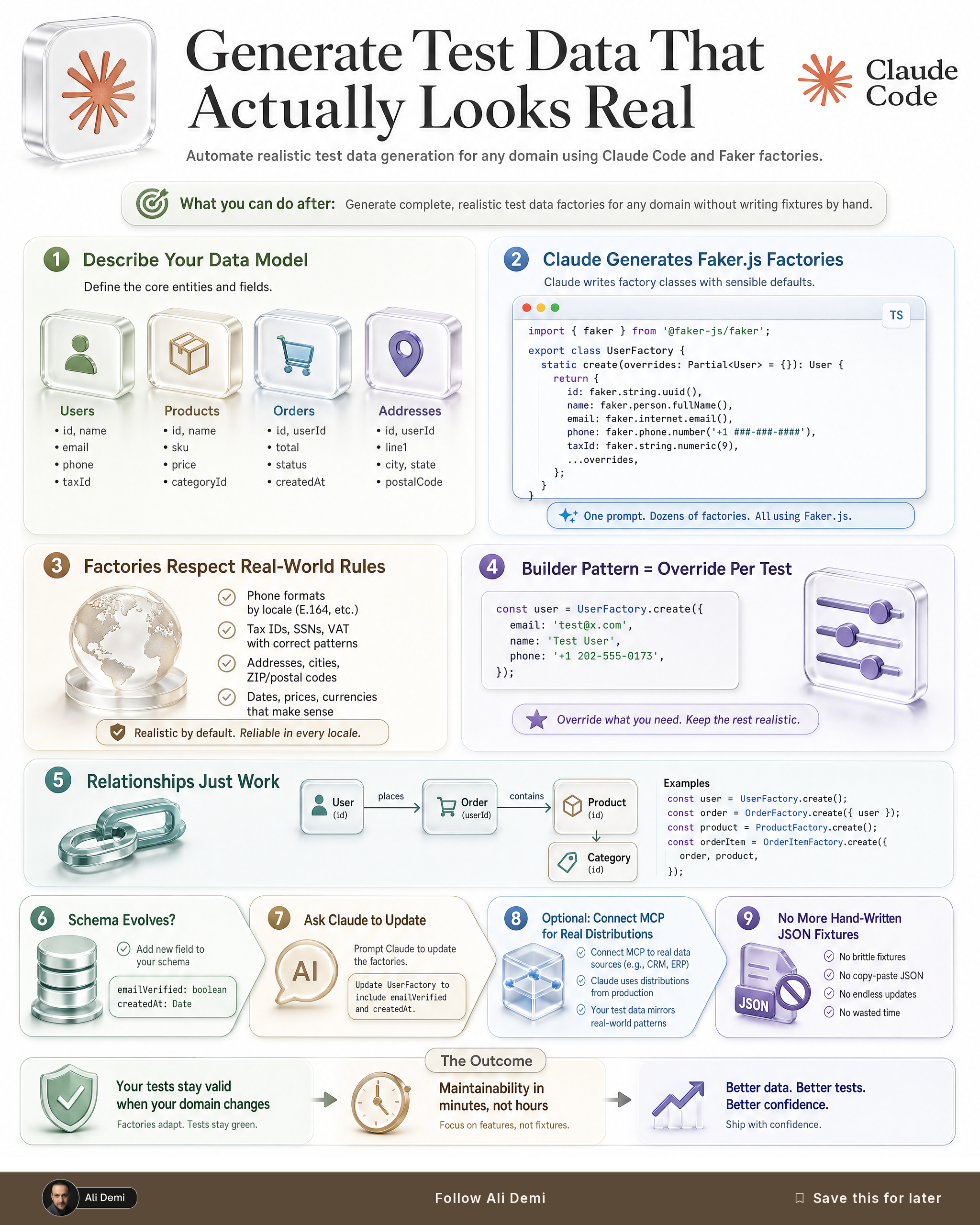
    Claude Code can generate Faker factories that build realistic test data automatically.

    Here’s how:

    1. Describe your domain (Users, Products, Orders, Addresses)
    2. Claude generates a factory module with localized, realistic data
    3. Replace hardcoded fixtures with factory calls
    4. Add new fields? Just ask Claude to update the factory
    5. Optionally connect to real data via MCP for production-like distributions

    Your factories respect real-world rules: Indian phone formats, valid tax IDs, believable addresses.

    Relationships work too – Orders know their Users, OrderItems know their Products.

    The result: maintainable test suites that don’t break when your schema evolves.

    ——

    Book your free AI clarity call, NOW!
    https://buff.ly/TpWy277

    ——

    Repost this. Thanks.

  • Extract Years of Lost Knowledge: Reverse-Engineer Legacy Systems

    Extract Years of Lost Knowledge: Reverse-Engineer Legacy Systems

    You have old code. Nobody remembers why it works that way. Original developers are gone. The business says “modernize it,” but you have no documentation of what it actually does.

    This is the hidden cost of legacy systems: institutional knowledge walks out the door. Modernization stalls because your team spends months reverse-engineering the system just to understand what it does.

    Claude Code solves this by extracting that knowledge automatically.

    The workflow:

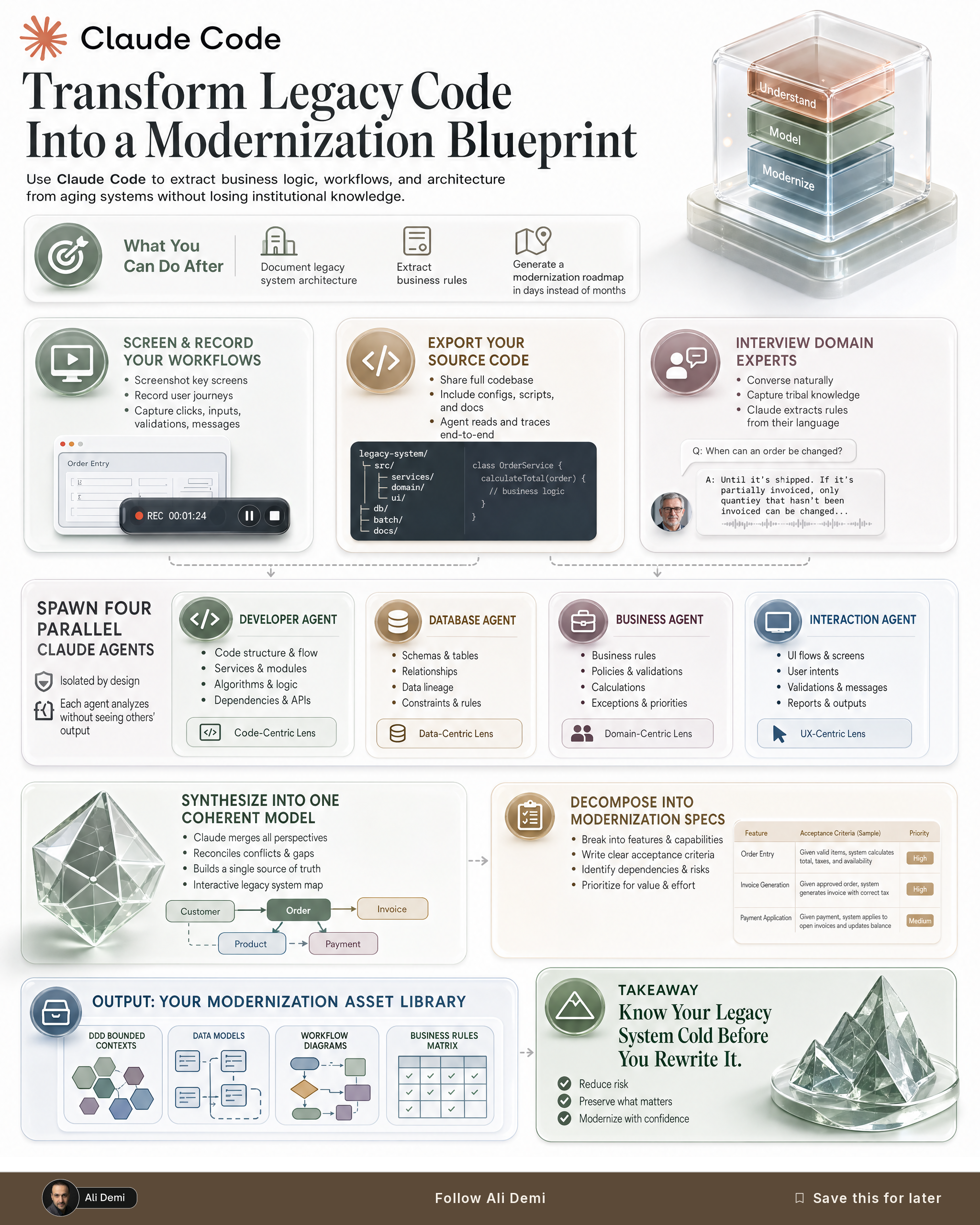
    Step 1: Gather your inputs. Collect UI screenshots (or video recordings of workflows), source code, and domain expert interviews (voice, transcript, or notes). Store them in folders: screenshots/, src/, transcripts/.

    Step 2: Analyze in parallel. Spin up four Claude agents analyzing simultaneously:

    • Application Developer reads the code, traces workflows, extracts business logic
    • Database Analyst maps your schema and data models
    • Business Analyst listens to interviews, extracts domain rules and constraints
    • Interaction Analyst maps UI flows and user journeys from screenshots

    They run in parallel. This takes hours, not weeks.

    Step 3: Synthesize and decompose. Claude synthesizes all four analyses into a living PRD: business rules, architecture diagrams (as Mermaid), feature decomposition, data models, and an interaction matrix. Each output is a separate document, ready for your modernization sprint.

    What you get: A complete understanding of your legacy system in structured form. Domain-driven design contexts. Business rule inventory. UI flow diagrams. Acceptance criteria for each modernized feature. No more guessing.

    Why this matters: Modernization teams often fail because they skip understanding and jump straight to rewriting. Claude Code compresses that understanding phase from months to hours, using your actual system as the source of truth.

    ——
    Book your free AI clarity call, NOW!
    https://buff.ly/TpWy277
    ——

    Repost this. Thanks.

  • Stop Writing Changelogs by Hand: Auto-Generate Them from Git

    Stop Writing Changelogs by Hand: Auto-Generate Them from Git

    You know the drill: release day arrives, and you’re staring at a wall of git commits, trying to figure out what actually changed.

    How do you translate “fix: race condition in token refresh” into something a customer cares about?

    Claude handles this in seconds.

    Here’s the workflow:

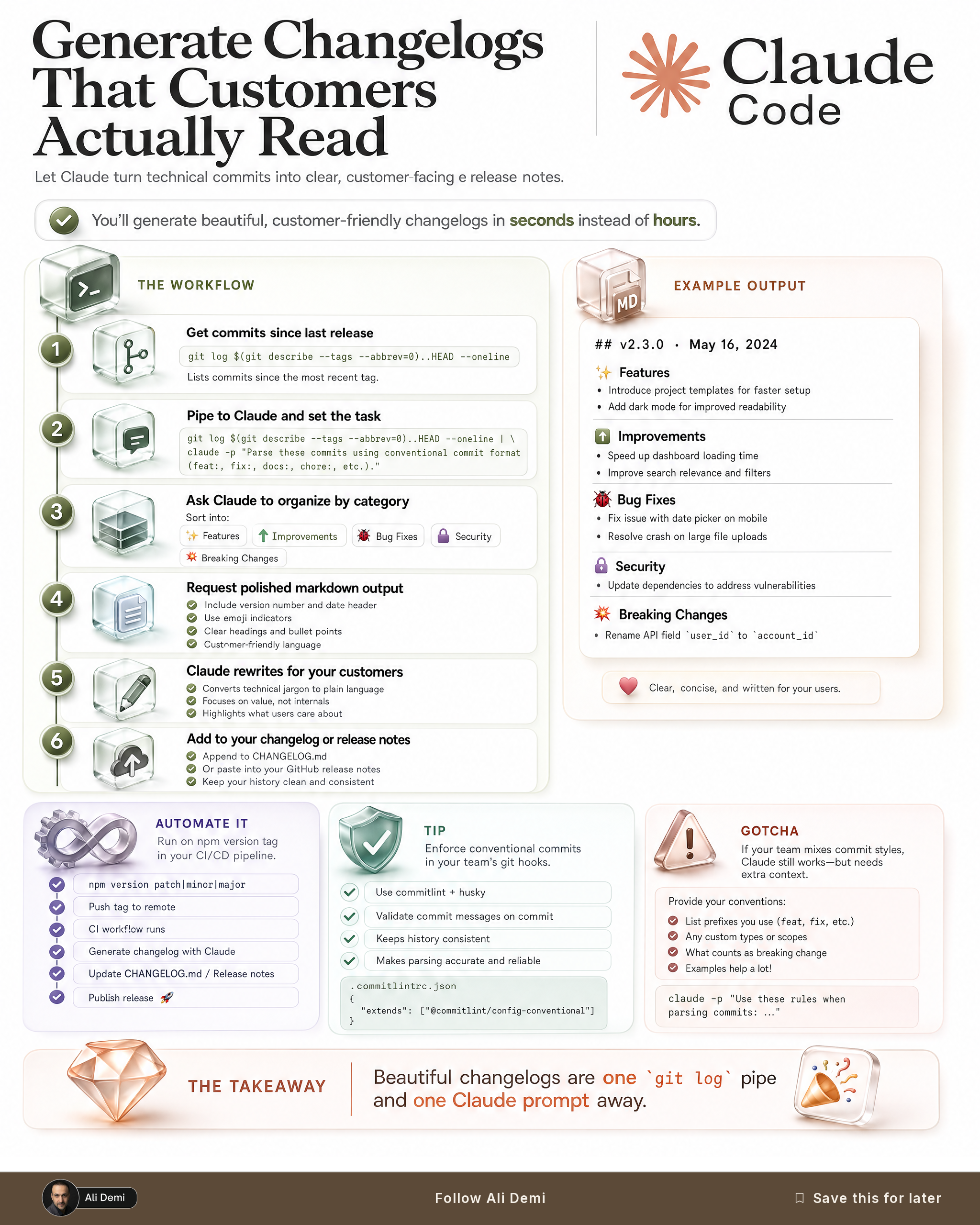
    1. Pull your commit history since the last release using `git log` with conventional commits format (feat:, fix:, docs:, etc.)
    2. Feed that log to Claude with a prompt asking it to categorize changes into Features, Improvements, Bug Fixes, Breaking Changes, and Security
    3. Claude rewrites technical language into clear, user-focused descriptions with emoji indicators
    4. Format as markdown with version header and date, ready to paste into CHANGELOG.md or your GitHub release
    5. Optional: wire it into a pre-release hook so changelog generation runs automatically when you tag a new version

    The payoff: your customers see what’s actually new instead of decoding jargon, your release day runs faster, and your changelog stays up-to-date without manual toil.

    If your team commits with conventional commits (feat:, fix:, refactor:, etc.), Claude can parse and transform that history into professional release notes in one pass.

    ——

    Book your free AI clarity call, NOW!
    https://buff.ly/TpWy277

    ——

    Repost this. Thanks.

  • Stop Shipping Insecure Infrastructure: Auto-Review Every PR

    Stop Shipping Insecure Infrastructure: Auto-Review Every PR

    Your infrastructure code is live policy. One overpermissive security group, one hardcoded secret, one missing tag, and you’ve already breached compliance or opened a hole.

    Manual review catches some of it. But by the time your engineer spots the bad security rule, it’s in the PR, someone’s inbox, and half your reviewer’s attention is split between code and tickets.

    Let Claude do the scan instead.

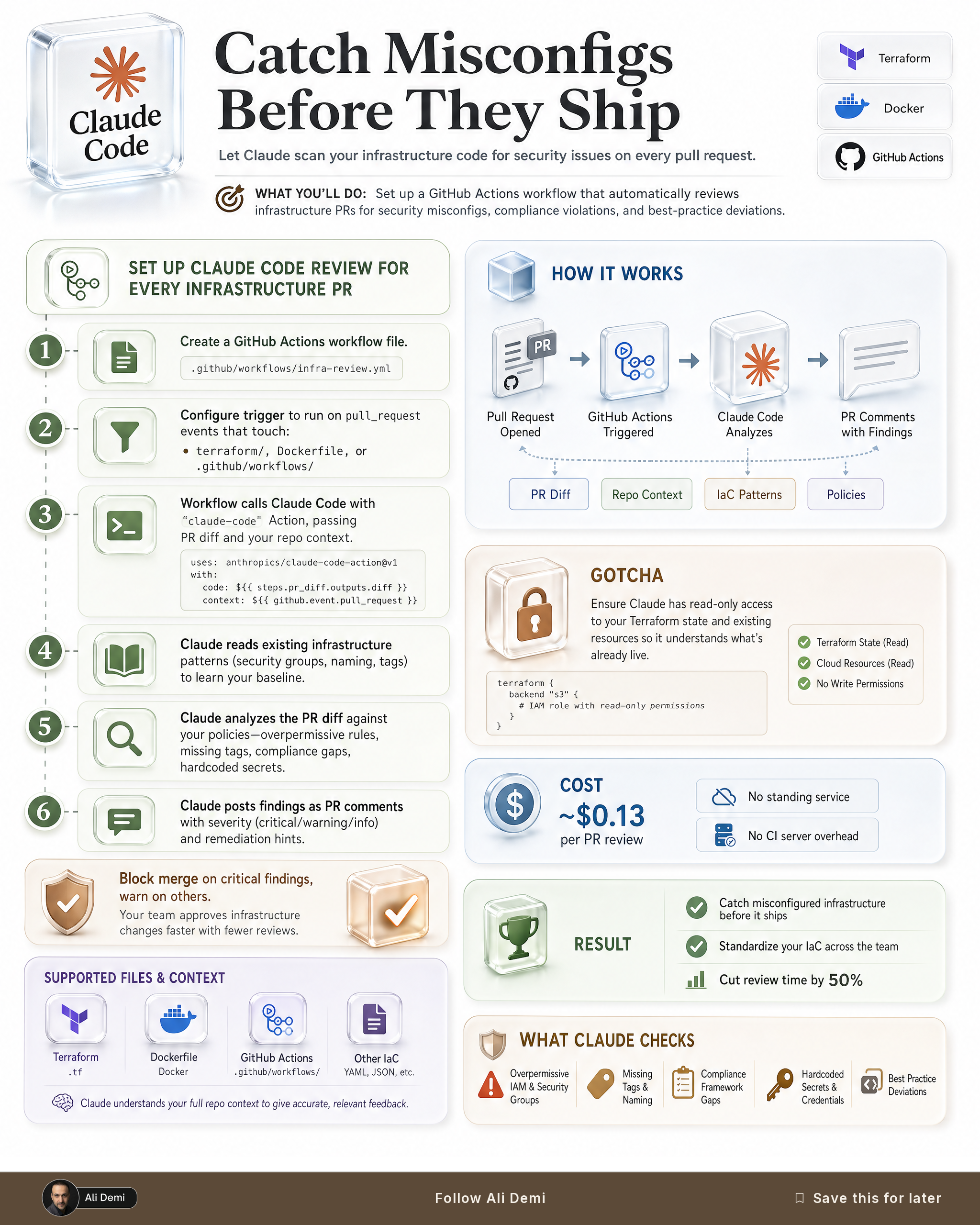
    Every time someone pushes a PR that touches Terraform, Dockerfile, or GitHub Actions workflows, Claude reads the diff, compares it against your existing patterns and security policies, and posts annotated comments with severity levels. Overpermissive security groups get flagged. Missing tags, bad naming conventions, unnecessary root privs in Docker-all surfaced. Total cost: about $0.13 per review. No standing service. No Kubernetes to run a linter on.

    The setup is one GitHub Actions workflow file. Point it at Claude Code. Give it read access to your repo. It runs on PR events.

    The workflow reads your existing infrastructure (so it learns your naming patterns and security baseline from what’s already live). When a PR comes in, Claude gets the full diff plus the context of your current state. It then reasons about the change: “This security group opens port 3306 to 0.0.0.0 but your policy requires database access to be internal only.” It posts that as a PR comment, blocks the merge if configured, or just warns-your call.

    Real teams use this to catch misconfigs that Terraform linters can’t see-policy violations, inconsistent tagging, architectural issues that need human eyes but can be screened automatically. The real value: your team reviews infrastructure faster and no misconfiguration slips through unread.

    You’re not replacing human judgment. You’re replacing the tedious part where someone has to remember every security rule, every naming convention, every compliance requirement on every diff. Claude does the bookkeeping. Your engineer approves or pushes back.

    ——

    Book your free AI clarity call, NOW!
    https://buff.ly/TpWy277

    ——

    Repost this. Thanks.
  • Automate Accessibility Audits: Catch WCAG Violations Your Team Misses

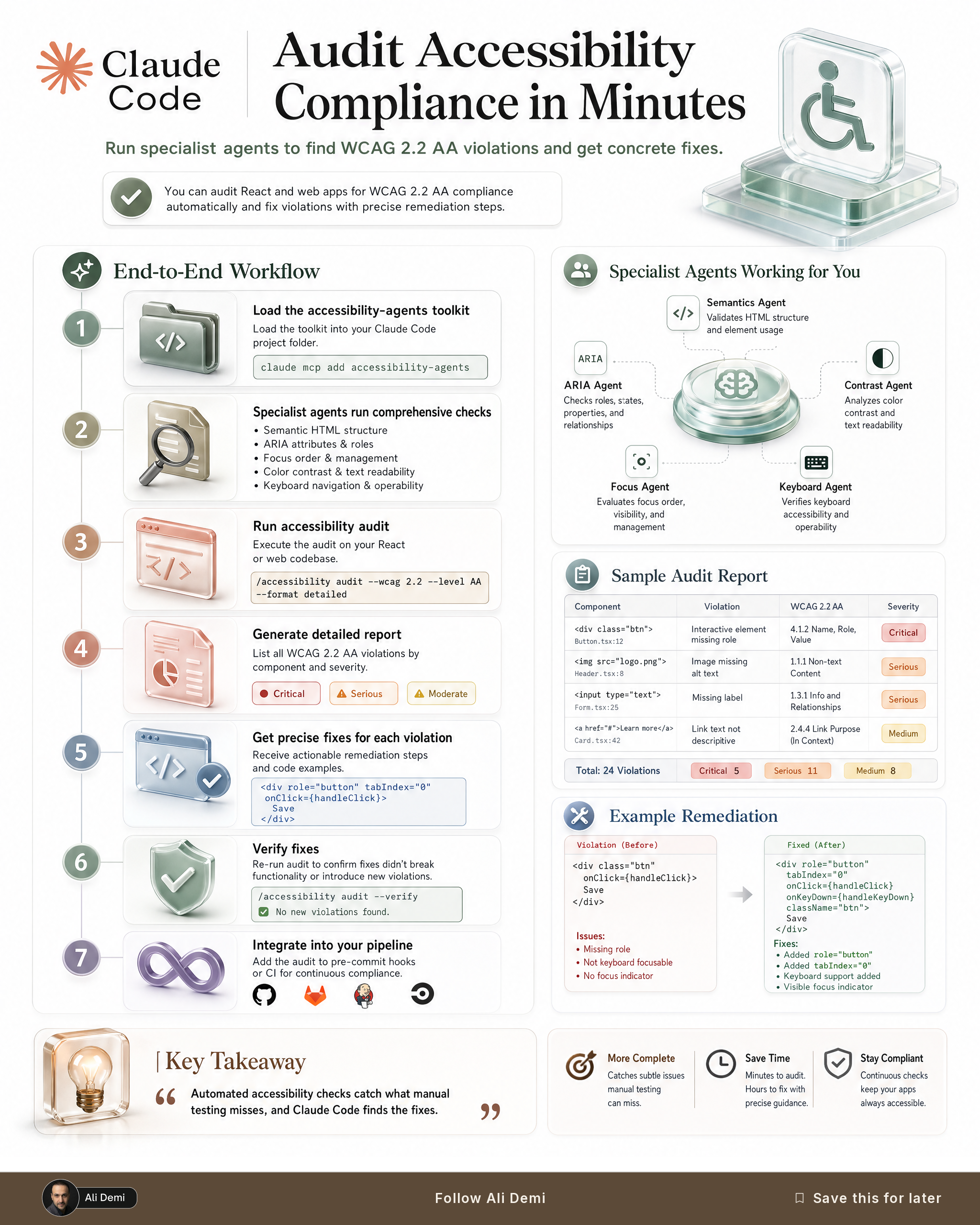
    Automate Accessibility Audits: Catch WCAG Violations Your Team Misses

    Manual accessibility audits are slow, expensive, and miss subtle violations.

    You’re shipping apps that fail keyboard navigation, color contrast, or ARIA attributes-catches never show up in code review until a user with a screen reader hits the problem, or worse, a compliance audit fails.

    Claude Code has specialist accessibility review agents that run automatically, examine your codebase for semantic HTML, focus management, color contrast, ARIA misuse, and screen reader compatibility, then report violations with exact component locations and remediation steps.

    It’s the difference between a compliance checkbox and shipping accessible software.

    ——

    Book your free AI clarity call, NOW!
    https://buff.ly/TpWy277

    ——

    Repost this. Thanks.