Tag: api

  • Stop Making Single API Calls: Find Batching Opportunities Automatically

    Stop Making Single API Calls: Find Batching Opportunities Automatically

    You make a Stripe API call to charge a card.
    Then another to delete a webhook.
    Then three more to sync customer records.

    That’s five separate API calls when Stripe’s batching API could do them in one request.

    Same story everywhere: GitHub’s GraphQL lets you fetch twenty repositories in one call, but your loop hits the REST API twenty times. Slack has a batch endpoint, but you’re calling it once per message. SendGrid supports batch sending, but your code loops and sends individually.

    You’re paying per-request for APIs built to batch.

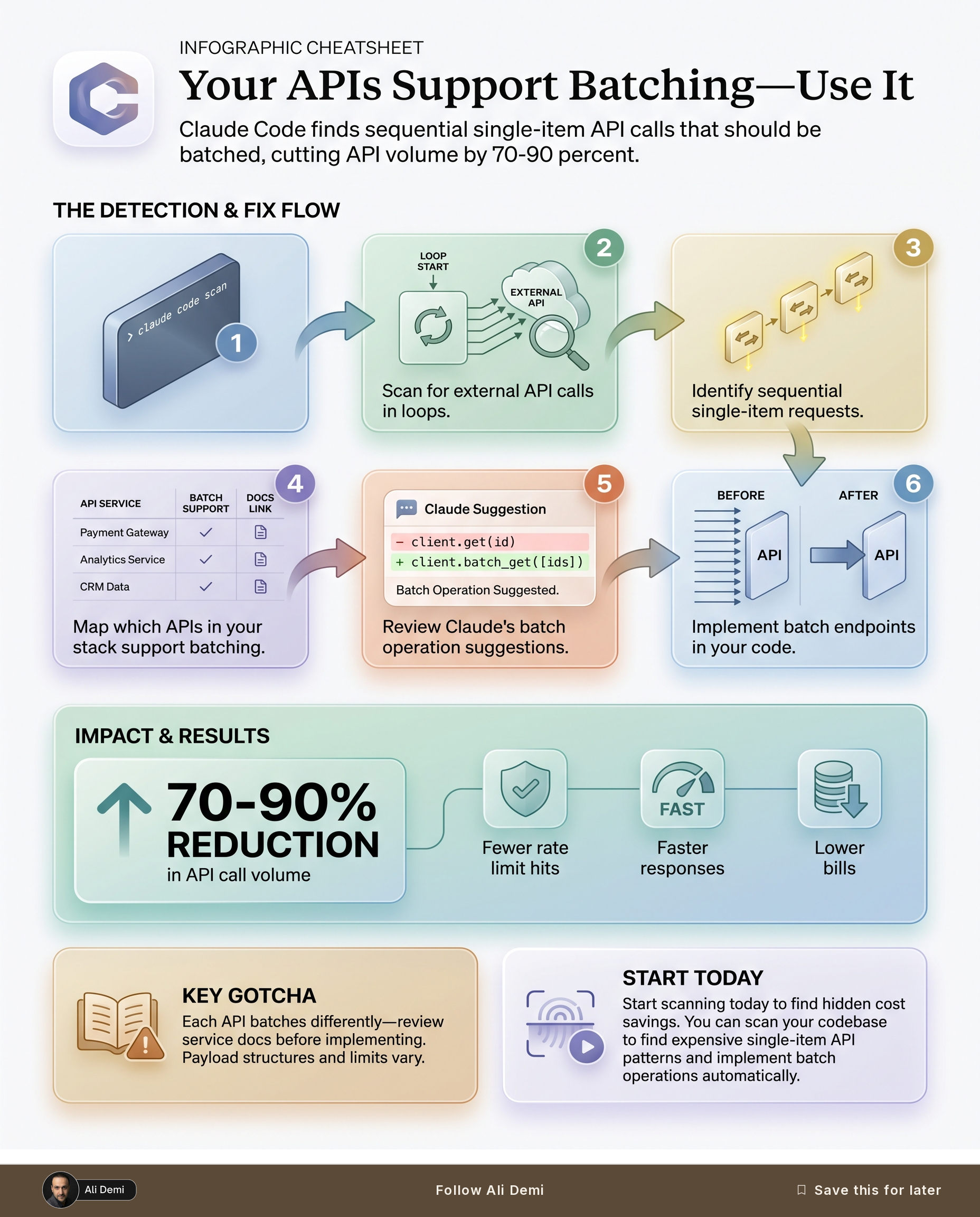
    Claude Code finds these patterns. It scans your codebase, spots loops making single-item API calls, maps which services support batching, and shows you exactly where to batch.

    The result: 70 to 90 percent fewer API calls. Your code gets faster. Your bill gets smaller.

    ——

    Book your free AI clarity call, NOW!
    https://buff.ly/TpWy277

    ——

    Repost this. Thanks.
  • Stop Writing TypeScript Types By Hand: Generate Them From APIs

    Stop Writing TypeScript Types By Hand: Generate Them From APIs

    You’re building a frontend. You need types for the third-party API. So you manually write out interfaces: userId, userName, isActive, metadata…

    This takes forever. And halfway through, you realize the API returns different shapes for different endpoints. You rewrite. You discover optional fields you missed. You rewrite again.

    Stop.

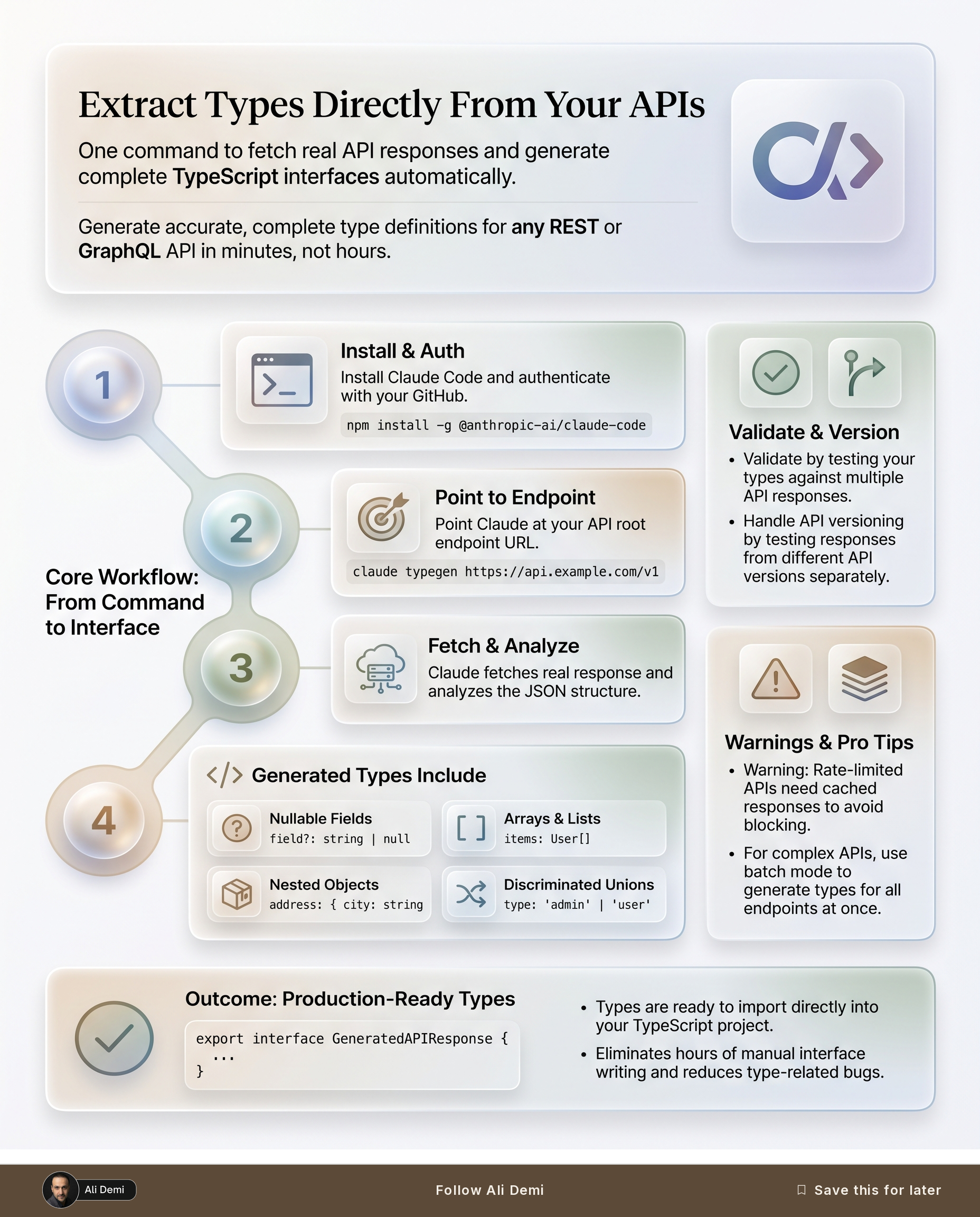
    Claude Code can fetch your API, see what it actually returns, and generate complete TypeScript interfaces in one shot.

    Here’s how:

    1. Point Claude at your API endpoint.
    2. Claude makes a real request and captures the response.
    3. Claude analyzes the structure: types, nullability, nested objects, arrays, union types.
    4. Claude generates ready-to-import TypeScript definitions.
    5. Validate against multiple responses to catch edge cases.

    The beauty: Claude sees your actual responses, not assumptions. Optional fields that appear sometimes? Caught. Discriminated unions? Handled. Deeply nested objects? Generated correctly.

    For APIs with dozens of endpoints, Claude can batch the work. Generate types for all of them in one go.

    The gotchas:

    Some APIs rate-limit. Fetch once, save the response, reuse it. Some APIs return different shapes based on query params. Test multiple variants to ensure your types are complete.

    No more hours lost to manual interface writing. No more debugging because a field was optional and you didn’t know it.

    ——

    Book your free AI clarity call, NOW!
    https://buff.ly/TpWy277

    ——

    Repost this. Thanks.
  • Stop Surprising Your API Clients: Auto-Detect Breaking Changes

    Stop Surprising Your API Clients: Auto-Detect Breaking Changes

    You refactor your API. You test it. You ship it.

    Then your customers wake up to 500 errors.

    You forgot to tell them you removed an endpoint. Or changed how the status codes work. Or you didn’t realize a parameter rename was a breaking change.

    It’s a mess. Blame gets passed around. Trust erodes.

    Claude Code can catch this before you ship. Here’s how.

    The workflow:

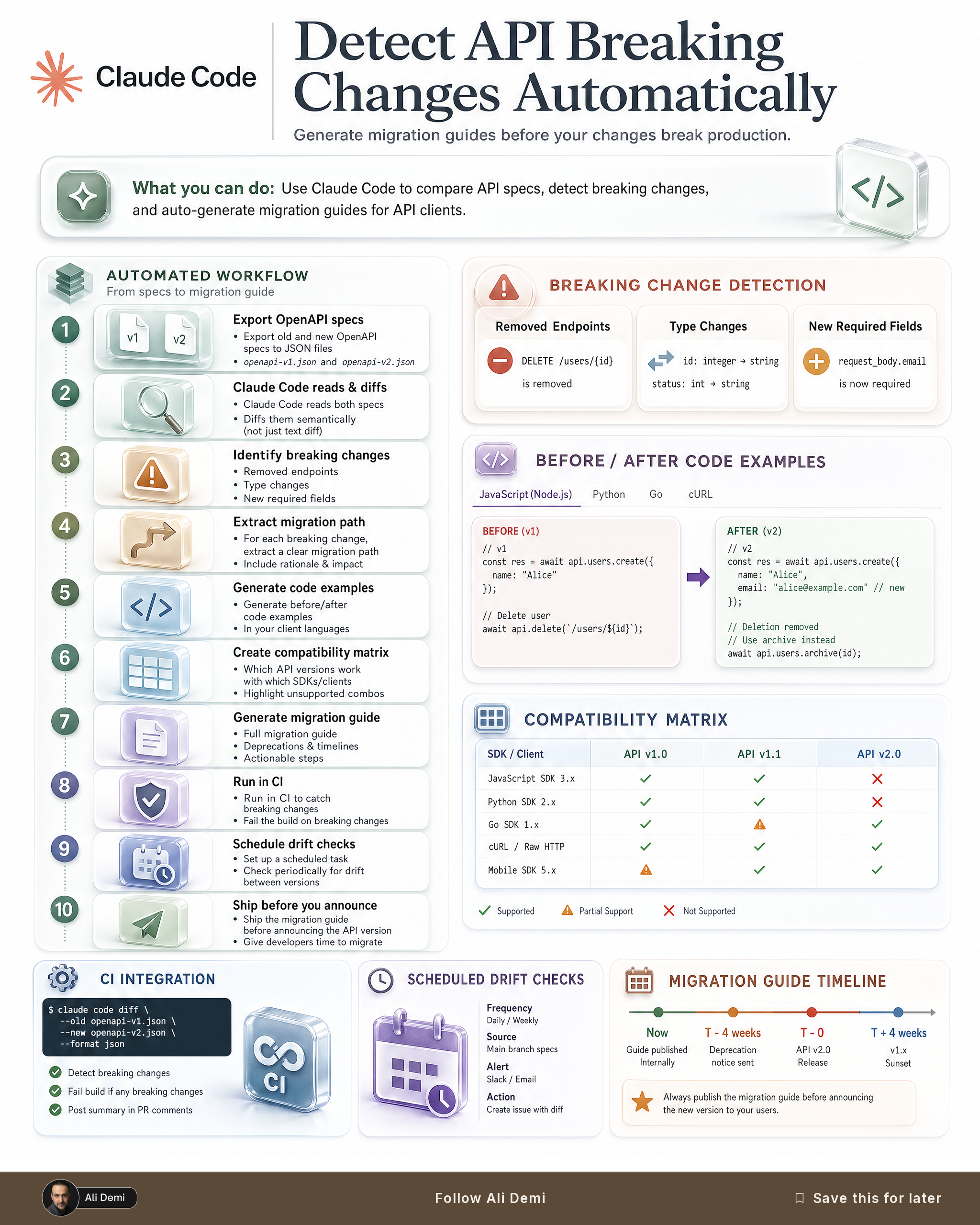
    1. Export your old and new OpenAPI specs (or Swagger JSON). Claude reads both.
    2. Claude compares them semantically, not string-by-string.
    3. It detects: removed endpoints, changed parameter types, new required fields, status code changes, authentication changes.
    4. For each breaking change, Claude generates: what broke, which clients are affected, how to migrate, before/after code examples.
    5. You get a migration guide your customers can actually follow, plus a deprecation timeline.

    What breaking changes it catches:

    • Removed or moved endpoints
    • Required fields added to request bodies
    • Response field types changed (string to int, etc.)
    • Status codes removed or their meanings changed
    • Authentication method changes
    • Rate limit changes
    • Pagination format changes

    The migration guide it generates includes:

    • Breaking change summary (what changed, when it’s live)
    • Which SDK versions are affected
    • Step-by-step migration for each change
    • Before/after code snippets in your client’s language
    • Deprecation timeline (when old endpoints stop working)
    • A compatibility matrix (which API versions work with which SDK versions)

    Pro tip: Run this in CI before you merge any API-touching PR. Let Claude flag breaking changes before code review. Your team sees the migration work required, and it might even be cheaper to fix the API than generate the docs.

    ——

    Book your free AI clarity call, NOW!
    https://buff.ly/TpWy277

    ——

    Repost this. Thanks.
  • Stop Maintaining Docs By Hand: Auto-Generate OpenAPI Specs

    Stop Maintaining Docs By Hand: Auto-Generate OpenAPI Specs

    Your API docs are out of sync again. Someone added a query parameter. A response type changed. Your docs still say the old thing. It happens every time because docs live in a separate file, divorced from the code that changes.

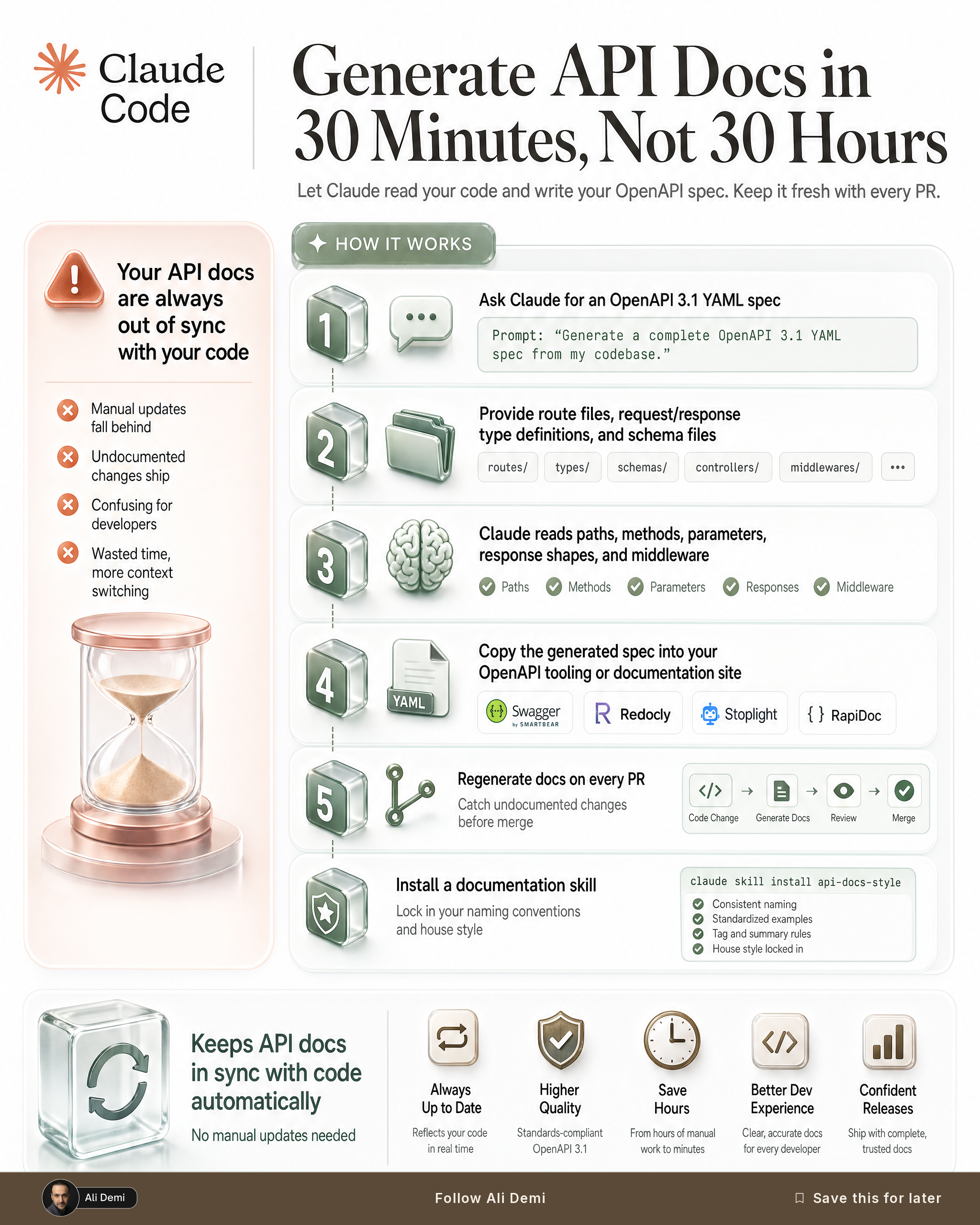
    Claude Code solves this by reading your code and writing the spec for you.

    Point Claude at your route files, request handlers, and type definitions. It extracts the path, HTTP method, request body shape, query parameters, response types, and authentication middleware. Then it writes a complete, standards-compliant OpenAPI 3.1 specification. A typical 30-50 endpoint REST API takes 8 to 20 hours to document by hand. Claude generates a first-draft spec in under 30 minutes.

    The real win is integrating this into your PR workflow. Regenerate docs on every merge. Claude catches undocumented changes and new endpoints before they ship. Documentation stops drifting because the source of truth is always the code.

    For teams running the same workflow repeatedly, install a documentation skill. It locks in your conventions (response format, error schemas, naming) so every doc Claude generates follows your house style automatically, across Claude Code, Cursor, and Codex.

    ——

    Book your free AI clarity call, NOW!
    https://buff.ly/TpWy277

    ——

    Repost this. Thanks.