You have messy code. Somewhere in your codebase, a function is nested four levels deep, packed with conditionals, and hasn’t been touched in six months. When it breaks, nobody knows why. When you need to change it, you’re terrified.
The problem: you have no idea which functions are the most dangerous.
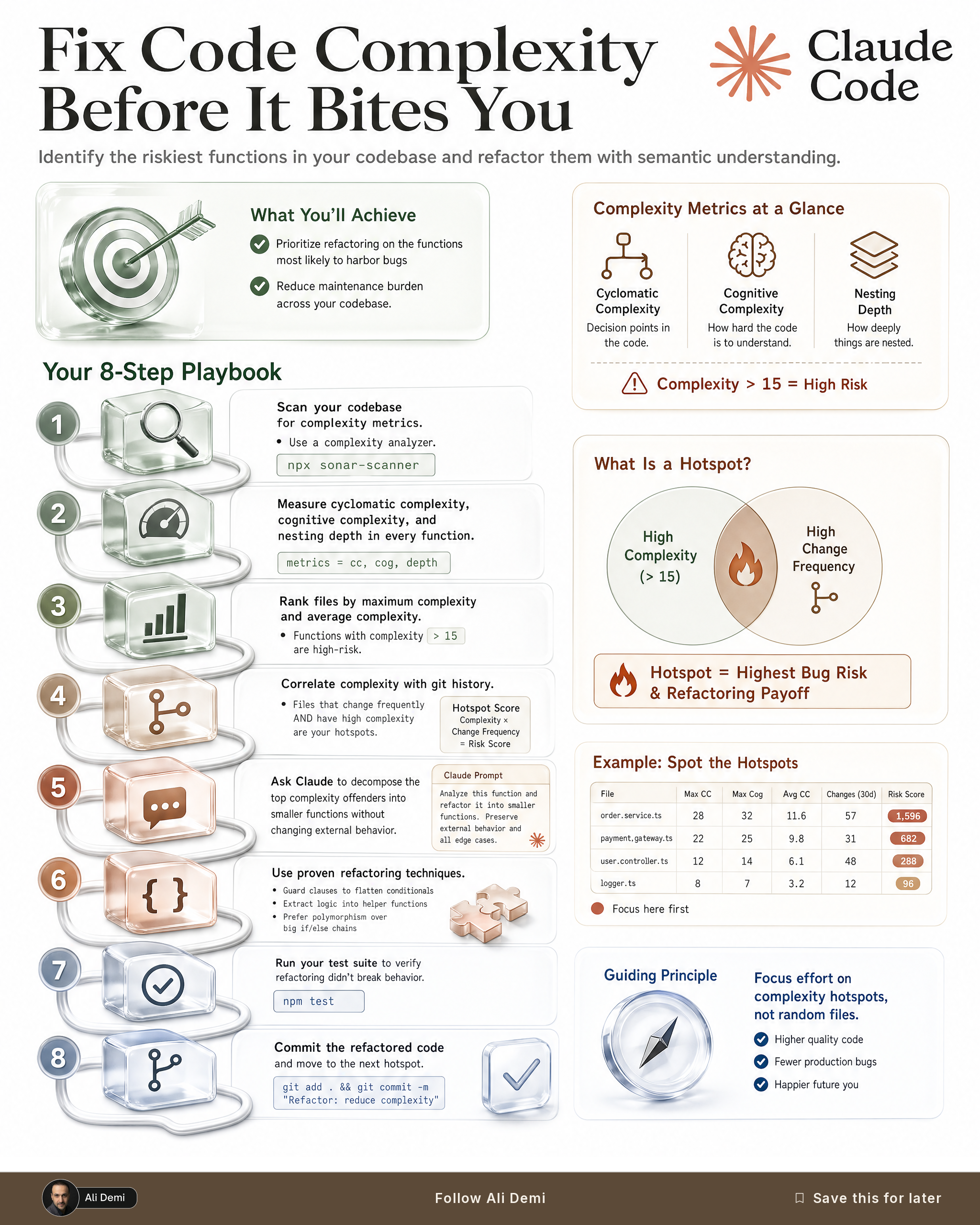
Complexity metrics tell you. Cyclomatic complexity counts decision points (if/else, loops, switches). Cognitive complexity measures how hard code is to read. Functions with complexity scores above 15 are statistically more likely to hide bugs and take longer to maintain.
Claude Code can scan your entire codebase, measure complexity in every function, rank files by risk (complexity + change frequency), and refactor the hotspots that matter most.
The process is straightforward.
Step 1: Measure complexity across your codebase. Ask Claude to run a complexity analyzer on your project. It scans every file, calculates cyclomatic complexity, cognitive complexity, nesting depth, and method length. Output ranks files by maximum complexity and average complexity per function.
Step 2: Identify your hotspots. Hotspots are files that are both complex AND change frequently. A 500-line file nobody touches is low-risk. A 30-line function with complexity 18 that your team modifies every week is a time bomb. Claude can correlate complexity with git history to find these.
Step 3: Decompose the worst functions. Take the top complexity offenders and ask Claude to refactor them. The key: refactor without changing the external interface. Break a complex function into smaller helpers, extract conditional logic into guard clauses, use polymorphism instead of big if/else chains. Claude understands the intent and preserves behavior.
Step 4: Verify and commit. Run your test suite. If everything passes, commit the refactored code. You’ve just reduced maintenance burden on the functions most likely to fail.
A real example: a 210-line Python function with cyclomatic complexity 16 was refactored into a clean 30-line function with complexity dropping to 3-6 across the extracted helpers. Same behavior, dramatically easier to maintain.
Stop guessing which code needs work. Measure it. Focus effort where it matters. Claude handles the analysis and the refactoring.
——
Book your free AI clarity call, NOW!
https://buff.ly/TpWy277
——
Repost this. Thanks.