Tag: code-review

  • Your PR Queue Is Killing Velocity: Automate Code Review Triage

    Your PR Queue Is Killing Velocity: Automate Code Review Triage

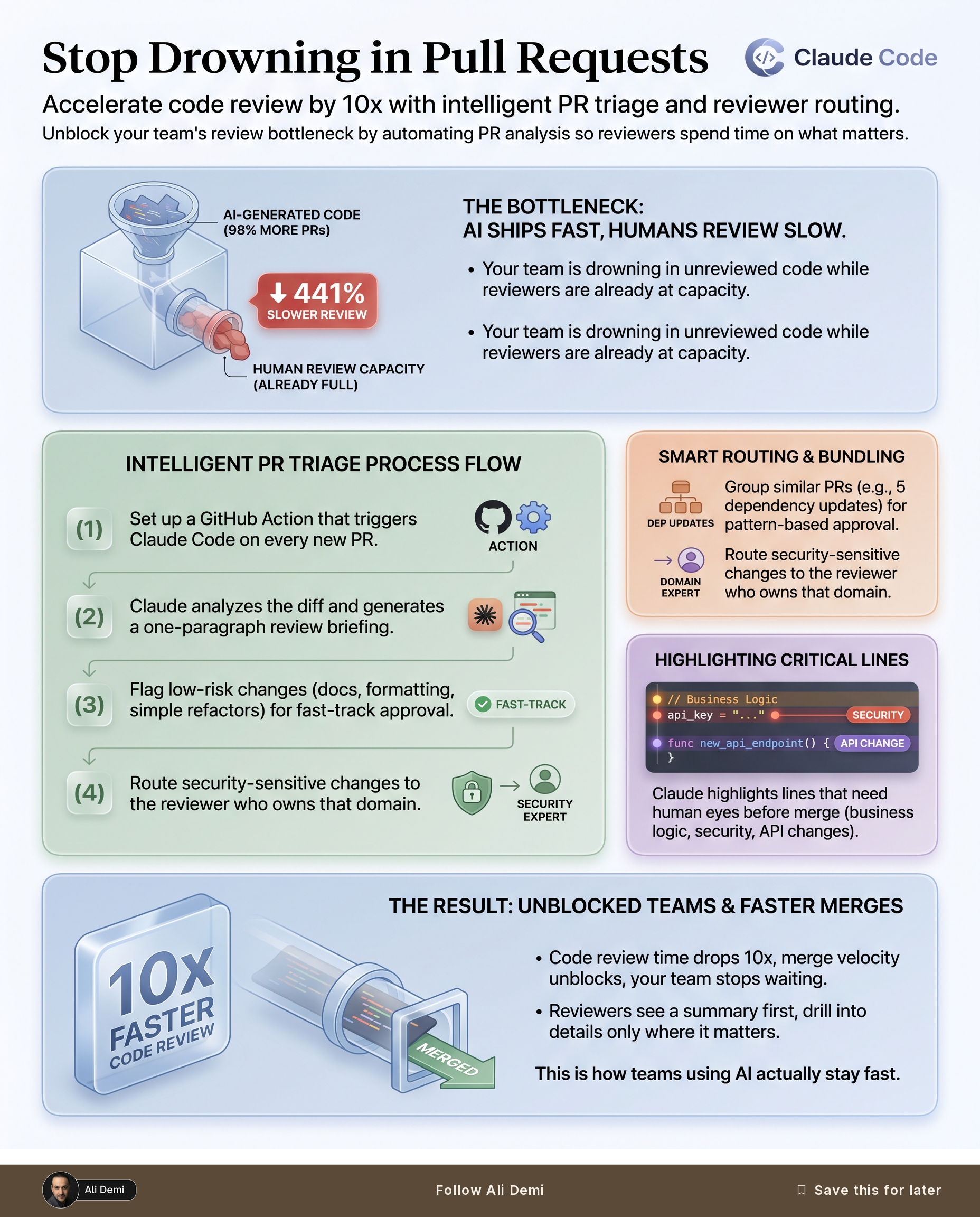
    Your team just shipped 50 PRs this week. Three reviewers.

    AI made developers 60% faster in the last year, but your review team didn’t get faster. They got slower. Your backlog isn’t growing because code is broken-it’s growing because nobody can review it fast enough.

    Here’s what’s changed: teams using Claude and Copilot now merge 98% more PRs, but code review time jumped 441%. The bottleneck moved from coding to reviewing. And reviewing AI-written code is harder-it surfaces 1.7x more issues that need careful eyes.

    Claude Code can fix this. Not by replacing review, but by making it 10x faster.

    Start with a simple GitHub Action that triggers Claude Code on every PR. Claude reads the diff and generates a **review briefing**-one paragraph saying what changed, why, and which lines need human eyes. Flag low-risk changes (docs, formatting, simple refactors) for instant approval. Route complex changes to the engineer who owns that code. Batch five similar PRs together so reviewers spot patterns instead of reading boilerplate ten times.

    The math changes immediately: instead of every reviewer reading every line, they see **only what matters**. Security-sensitive changes get a checklist. Business logic changes surface the exact data flows to verify. Dependency updates get grouped-approve the pattern, not each file.

    Your reviewers actually review again. Developers stop waiting. Merge time drops from three days to three hours.

    This isn’t optional anymore. AI accelerated the generation side. If you don’t accelerate review, you break velocity.

    ——

    Book your free AI clarity call, NOW!
    https://buff.ly/TpWy277

    ——

    Repost this. Thanks.
  • When AI Reviewers Disagree, You Catch More Bugs

    When AI Reviewers Disagree, You Catch More Bugs

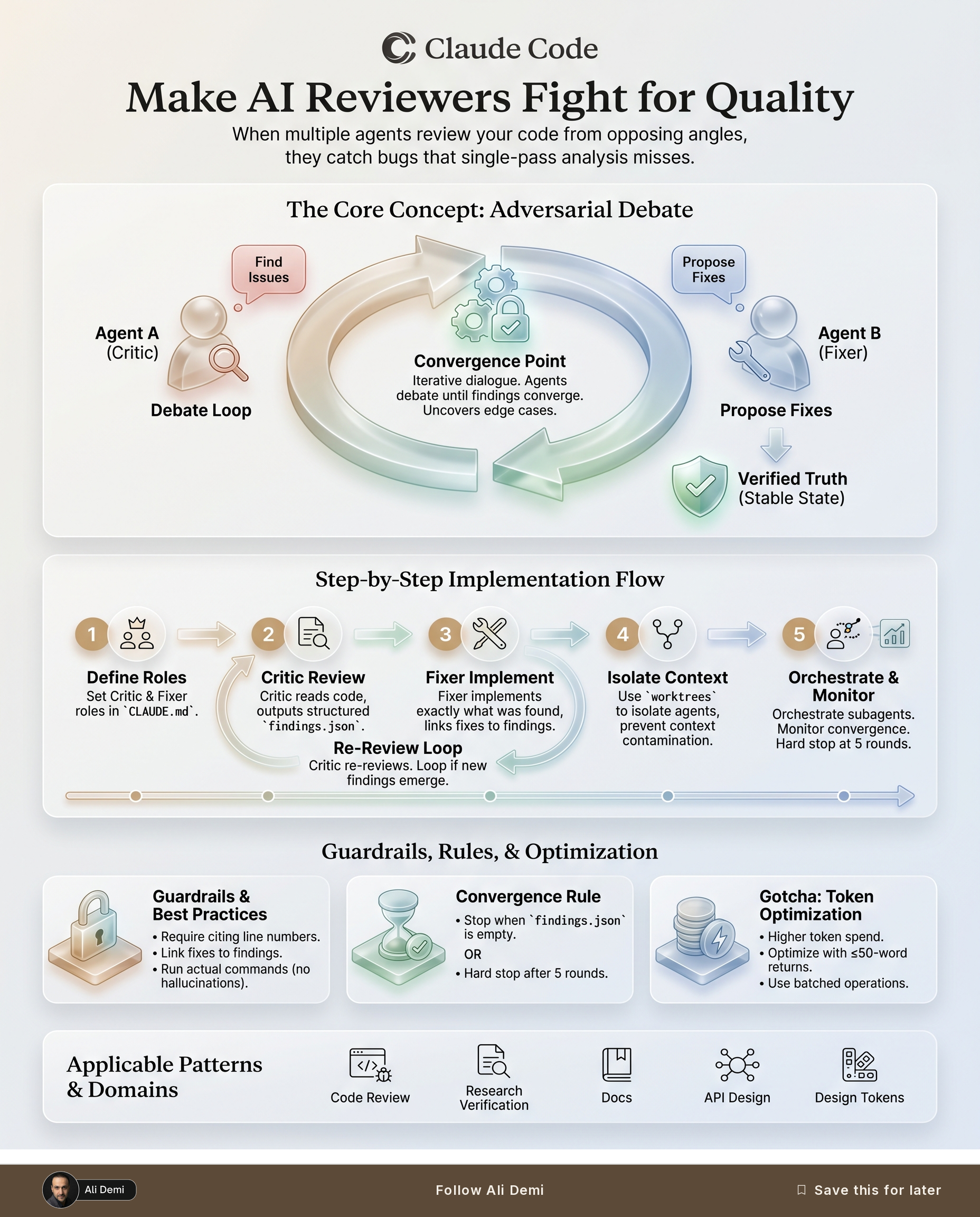
    Single-pass code review misses bugs. One AI reviewer, one pass-you get one angle, one set of blind spots.

    What if your code went to two agents with opposite jobs? One finds problems. The other fixes them. They debate until they agree.

    That’s adversarial multi-agent verification. It’s where critics and fixers loop until the findings list is empty.

    The pattern:

    1. Critic reviews code, produces structured findings (JSON)
    2. Fixer reads findings, implements fixes
    3. Critic re-reviews fixes
    4. Loop until zero new findings (convergence)
    5. Hard stop at 5 rounds to prevent infinite loops

    Real teams use this for code review, research verification, documentation accuracy, and API design. The evidence: researchers caught slide inconsistencies others missed; product teams went 4 rounds to hit feature quality targets; security reviewers caught logic flaws traditional SAST tools never find.

    Set it up:

    1. Define roles in your CLAUDE.md: one agent is critic, one is fixer, one is evaluator
    2. Use Claude Code hooks to run quality gates on pre-commit
    3. Pass findings as JSON files (findings.json from critic to fixer)
    4. Use worktrees to isolate each agent-no context bleeding
    5. Orchestrate with subagents; monitor convergence; stop when dry

    Watch the gotchas:

    Keep iterations capped. Higher token spend per feature. Enforce strict JSON handoffs so agents don’t misalign. Make critic cite line numbers. Make fixer link fixes to findings. Make evaluator run actual commands-no hallucinated results.

    Adversarial loops work on code review, research claims, documentation accuracy, API contracts, design tokens-anywhere one pass isn’t enough.

    ——

    Book your free AI clarity call, NOW!
    https://buff.ly/TpWy277

    ——

    Repost this. Thanks.