You shipped AI features and never looked back.
Then the bill arrived.
Your LLM API costs are climbing, but you have no idea which features are expensive, which prompts are bloated, or whether you’re even using the right models. Token usage data exists somewhere in your logs, but it’s scattered across providers, buried in traces, impossible to query.
Claude Code changes that.
Step 1: Instrument Your LLM Calls
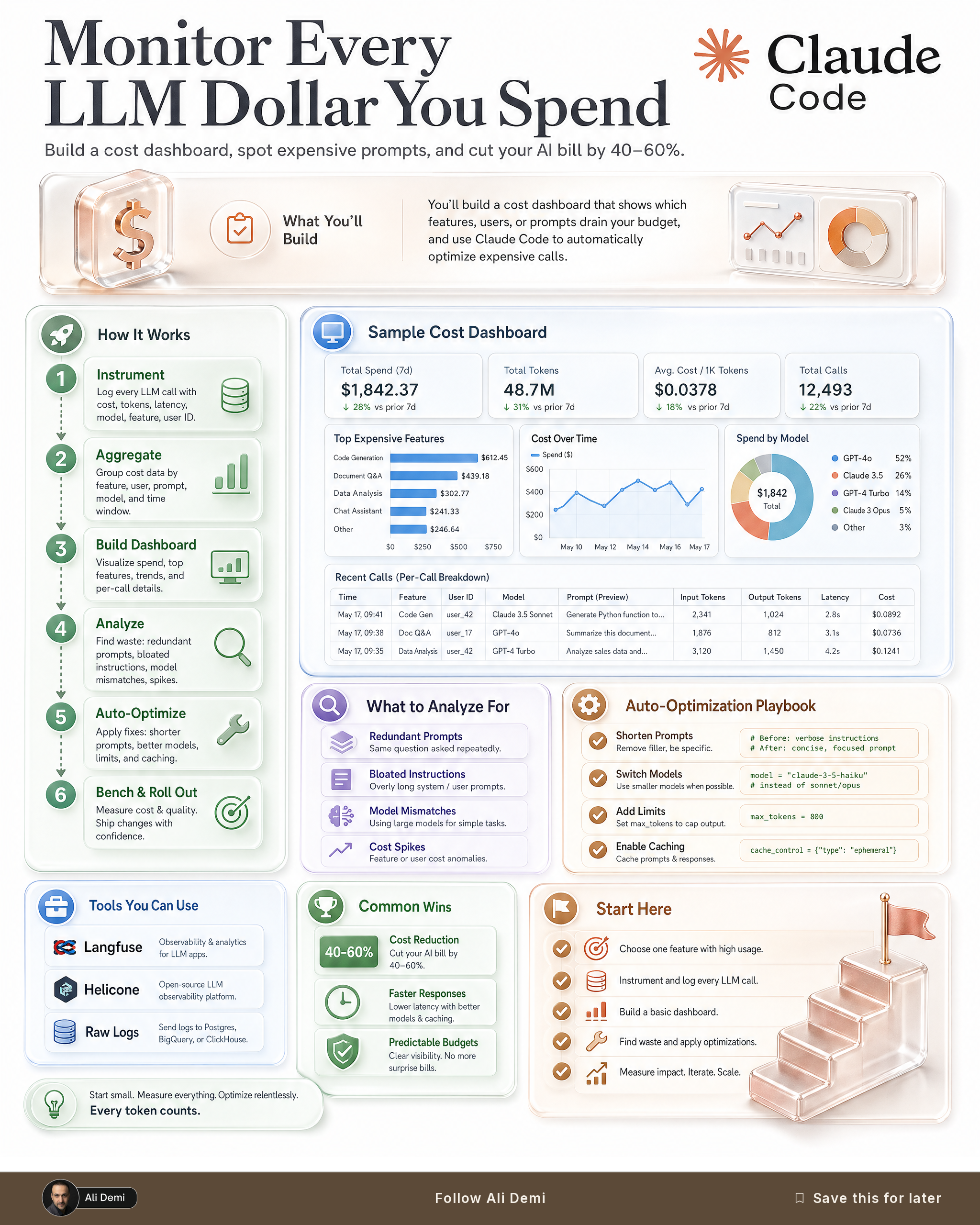
Parse your LLM API logs (Claude, OpenAI, Anthropic SDK) to extract token counts, latency, cost, and metadata. Write a simple wrapper or middleware that logs input tokens, output tokens, model, feature name, and user ID on every API call. Push these events to a structured log (JSON lines, Postgres, or a time-series DB like ClickHouse).
Step 2: Aggregate Cost by Dimension
Claude Code can analyze logs and compute: total spend by feature, cost per user, most expensive prompts, tokens per dollar efficiency, and model-to-model cost comparisons. Group by time window (hourly, daily, weekly) to spot trends and spike patterns.
Step 3: Build a Dashboard
Use Claude Code to generate a simple, self-updating HTML dashboard or integrate with Grafana, Metabase, or a lightweight charting library. Show: total spend this month, top 10 most expensive features, cost trend chart, and a list of prompts ranked by tokens-per-call. Drill down to see individual API calls.
Step 4: Spot Optimization Opportunities
Claude Code analyzes your logs to find: redundant prompts (same request, same output, waste tokens on retries), chatty prompts (100+ words when 50 suffice), models mismatched to task (using Opus for summaries when Haiku wins), and features with runaway costs. Generate a report with fixes.
Step 5: Auto-Optimize
Use Claude Code to automatically: shorten verbose prompts, switch models based on latency/cost trade-off, enable semantic caching for repeated queries, batch requests, and add max_tokens limits. Claude Code can rewrite your prompts, test them for quality, and measure cost reduction before/after.
Real Numbers
Teams using this pattern see 40-60% cost reductions by cutting token waste, switching to smaller models for simple tasks, and caching repeated queries. One team cut their bill from $18k/month to $6.8k/month in two weeks.
Why This Matters Now
LLM API spending doubled in 2024-2025. Enterprises are shipping more AI features, but most teams have zero cost visibility and no process to optimize. Your competitors are building dashboards and cutting costs. You should too.
Start Today
Pick one observability tool (Langfuse, Helicone, or parse raw logs directly), have Claude Code build the dashboard, then let it auto-optimize your prompts. Your next bill will surprise you.
——
Book your free AI clarity call, NOW!
https://buff.ly/TpWy277
——
Repost this. Thanks.