Tag: dependencies

  • Stop Installing Blind: Vet Every Package Before It Lands

    Stop Installing Blind: Vet Every Package Before It Lands

    Someone on your team finds a package on a blog post.

    They install it. It works. It ships.

    Nobody checked who publishes it, when it was last updated, what licence it carries, or what its install script does on the way in.

    That is the moment most supply chain problems start. Not at review, not at deploy. At the install.

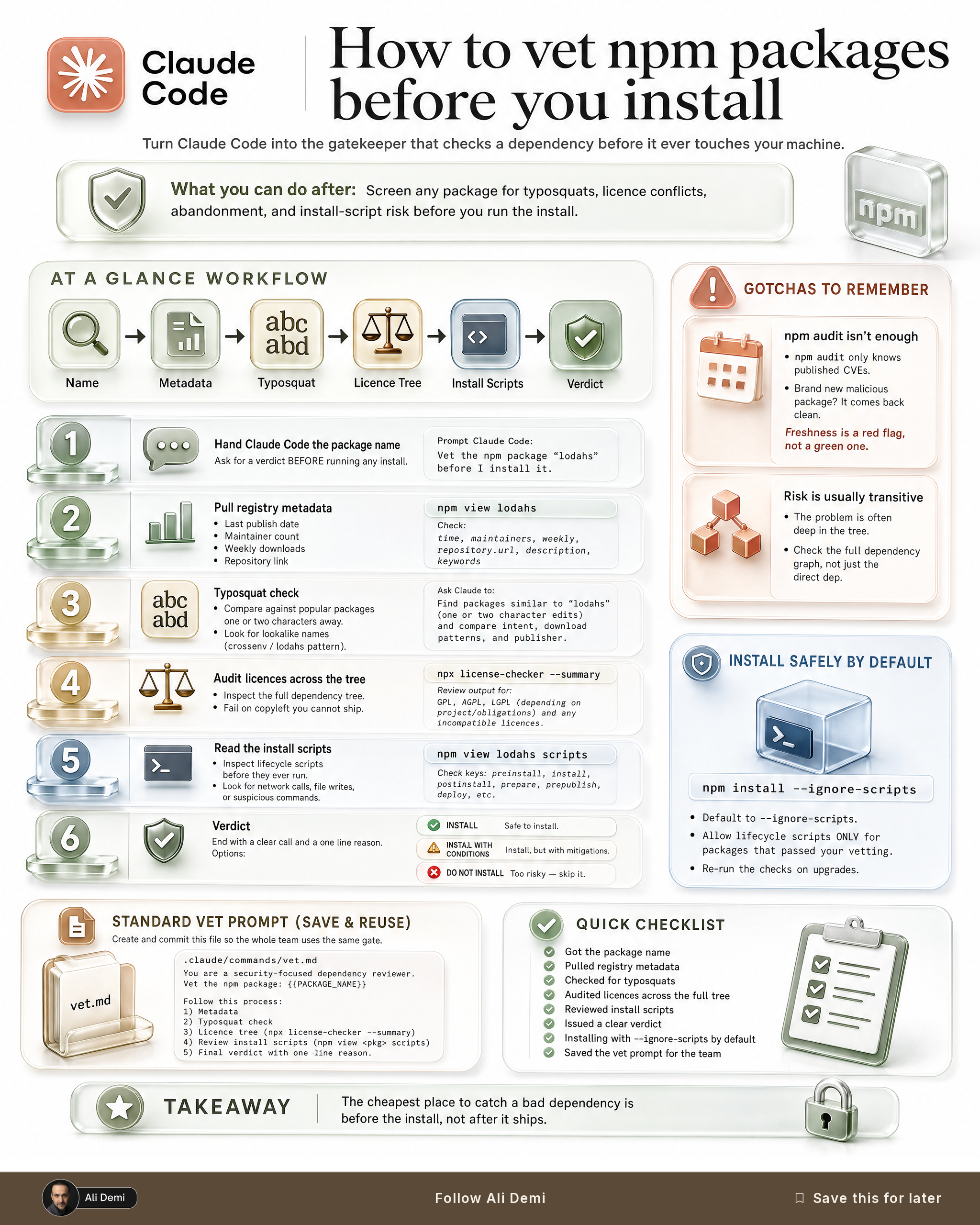
    Claude Code is good at this check because it is a research task, not a scan. It reads the registry metadata, compares the name against real packages, reads the licence tree, and reads the install scripts. Then it gives you a verdict.

    Here is the flow.

    1. Ask before you install. Give Claude the package name and tell it to report back before anything is added.
    2. Pull the registry metadata. Last publish date, number of maintainers, weekly downloads, repository link. A package with one maintainer and no commits in two years is a maintenance risk even if it is clean today.
    3. Run the typosquat check. Have Claude compare the name against the popular packages it is one or two characters away from. The classic attacks are a swapped letter or a dropped one, and they get thousands of installs before anyone notices.
    4. Audit the licence, including the tree. Ask for every licence in the full dependency graph, not just the direct package. Strong copyleft buried three levels deep is still copyleft in your proprietary build.
    5. Read the install scripts. Preinstall and postinstall hooks run with your shell permissions the second you install. Have Claude print them and explain what they do in plain words.
    6. Get a verdict, not a dump. Tell Claude to end with install, install with conditions, or do not install, and to say why in one line.

    Two things worth knowing.

    First, a vulnerability audit only knows about published CVEs. A malicious package uploaded yesterday has no CVE yet. A clean audit result on a brand new package is not reassurance, it is silence.

    Second, the risk almost never sits in the package you chose. It sits in the forty packages it pulls in behind it. Check the tree.

    Once the check works, save the prompt as a custom slash command in your project so the whole team runs the same one. And set your installs to skip lifecycle scripts by default, then allow them only for packages that passed.

    The cheapest place to catch a bad dependency is before the install, not after it ships.

    ——

    Book your free AI clarity call, NOW!
    https://buff.ly/TpWy277

    ——

    Repost this. Thanks.
  • Your Dependencies Are Getting Old: Automate Safe Updates

    Your Dependencies Are Getting Old: Automate Safe Updates

    Your dependencies are getting older every day.

    You know it.

    Security vulnerabilities hide in old packages. Performance regresses. But reviewing every breaking change, running tests, and merging updates manually? That’s hours of busywork you don’t have time for.

    Stop doing it by hand.

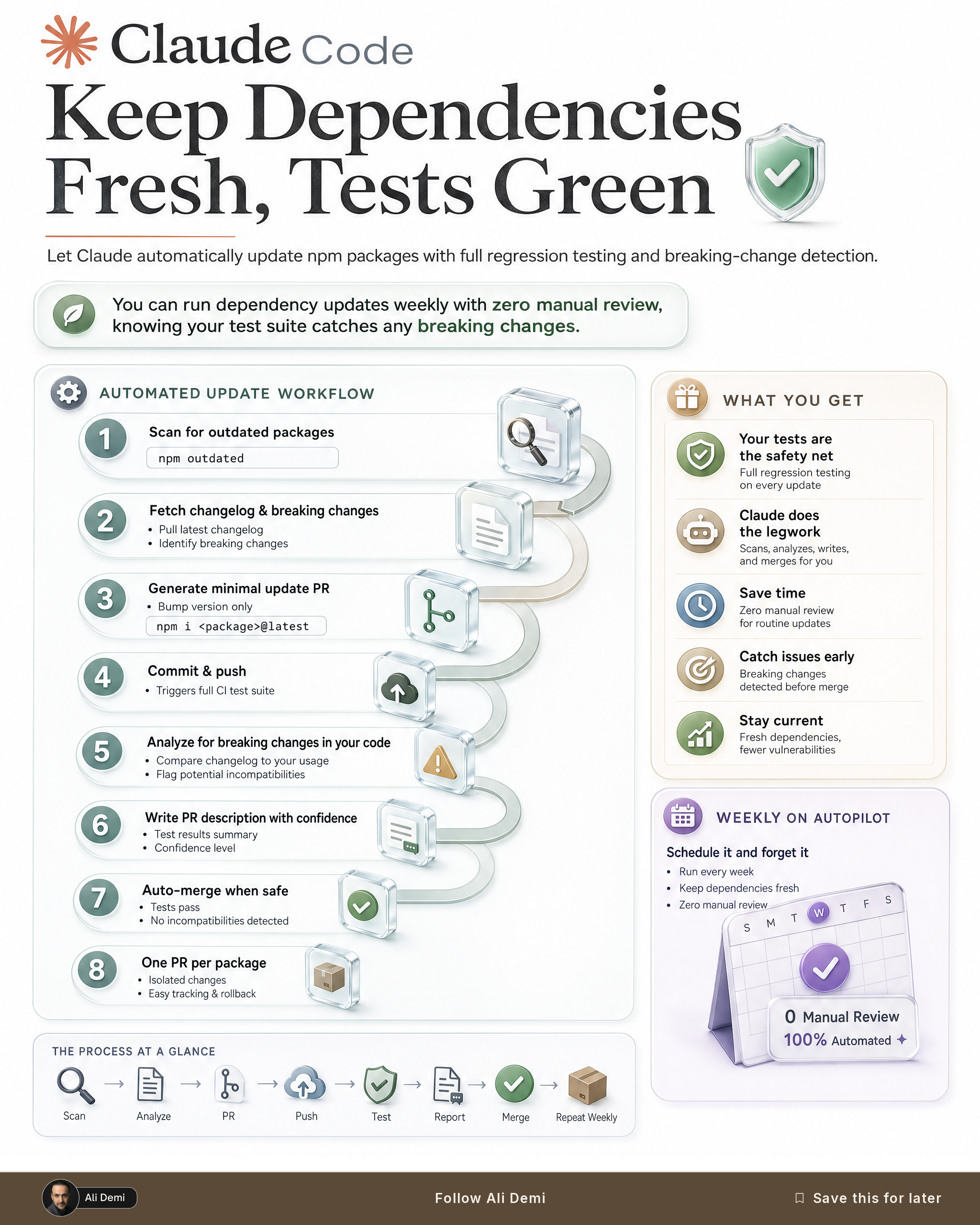
    Claude can automate your entire dependency update workflow. Run it on a schedule, get back a batch of smart, tested update PRs ready to merge.

    Here’s how it works:

    Claude scans your package.json and runs npm outdated, instantly finding which packages are behind.

    For each outdated package, Claude fetches the changelog and breaking change summary, analyzing what might break in your code.

    Claude generates a careful, minimal update: just the version bump, nothing else.

    It commits and pushes a new branch, triggering your full test suite.

    While CI runs, Claude analyzes the changelog for incompatibilities specific to your codebase, flagging any risky upgrades.

    When tests complete, Claude writes a smart PR description: what changed, whether it’s safe, and the confidence level based on test results.

    If all tests pass and no breaking changes were detected, Claude can auto-merge or mark it ready.

    One PR per package, one run per week, all your dependencies stay fresh.

    Your test suite is your safety net. Claude does the work.

    ——

    Book your free AI clarity call, NOW!
    https://buff.ly/TpWy277

    ——

    Repost this. Thanks.
  • Stop Ignoring Vulnerabilities: Automate Security Updates and Testing

    Stop Ignoring Vulnerabilities: Automate Security Updates and Testing

    Security vulnerabilities pile up because fixing them is friction-heavy: scan, understand the CVE, update the package, run tests, debug failures, rinse and repeat.

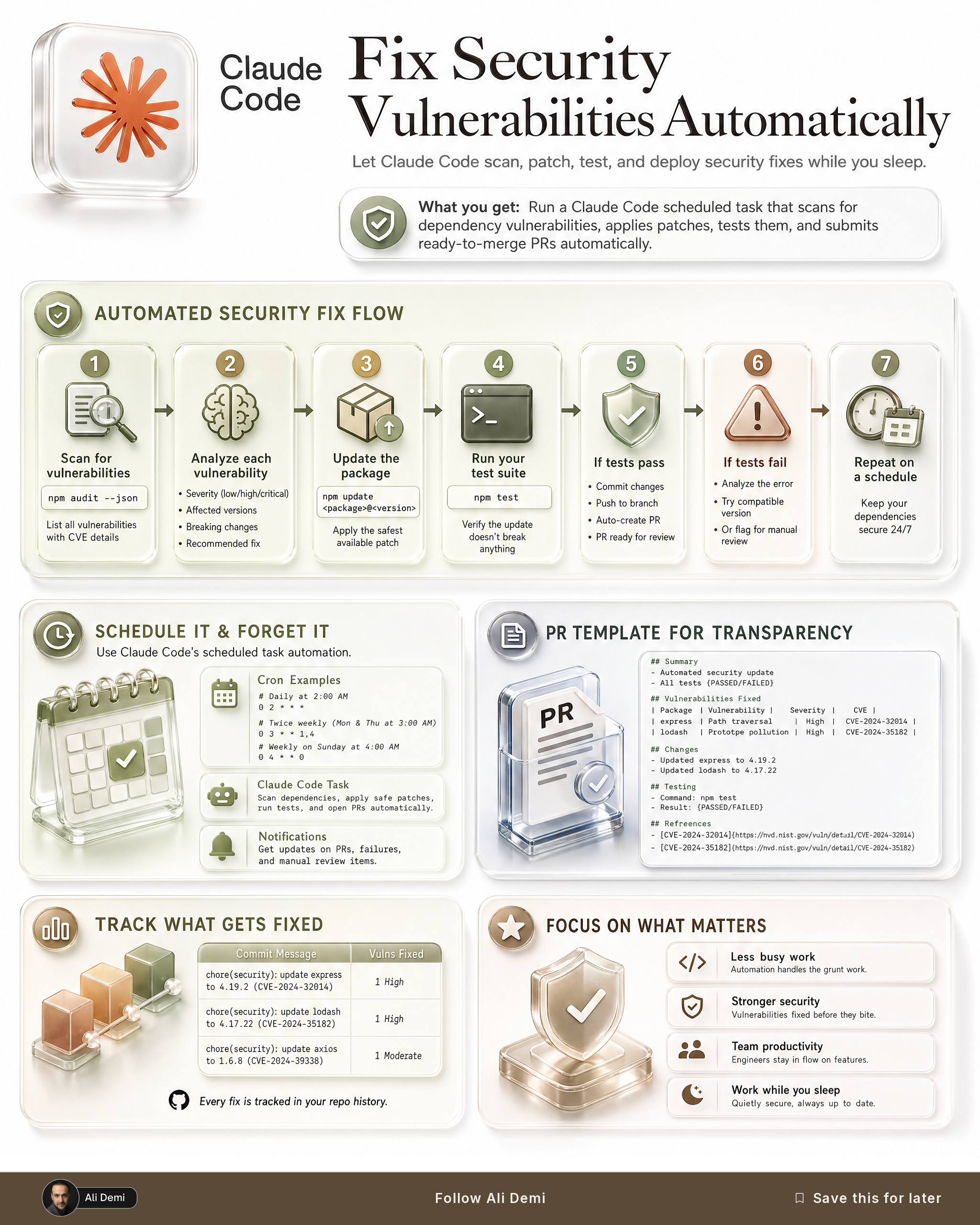
    Claude Code scheduled tasks can do all of that for you.

    Set up a daily or weekly task that runs `npm audit –json`, parses the vulnerabilities, updates each package, runs your test suite, and if tests pass, auto-commits and pushes a PR. If a test fails, Claude analyzes why and either tries a compatible version or flags it for manual review.

    The result: your dependencies stay current, your security debt shrinks, and your team’s attention goes where it actually matters – code review, not dependency roulette.

    The workflow is hands-free once set up. Cron fires it nightly. You wake up to a stack of security fix PRs, pre-tested and ready to merge.

    ——

    Book your free AI clarity call, NOW!
    https://buff.ly/TpWy277

    ——

    Repost this. Thanks.