Tag: deployment

  • Stop Shipping Broken Deploys: Automate Pre-Deploy Safety Checks

    Stop Shipping Broken Deploys: Automate Pre-Deploy Safety Checks

    Your deployments are one missed environment variable away from production meltdown.

    Most teams catch it after the page is down. Claude Code can catch it before you deploy.

    Here’s what to automate:

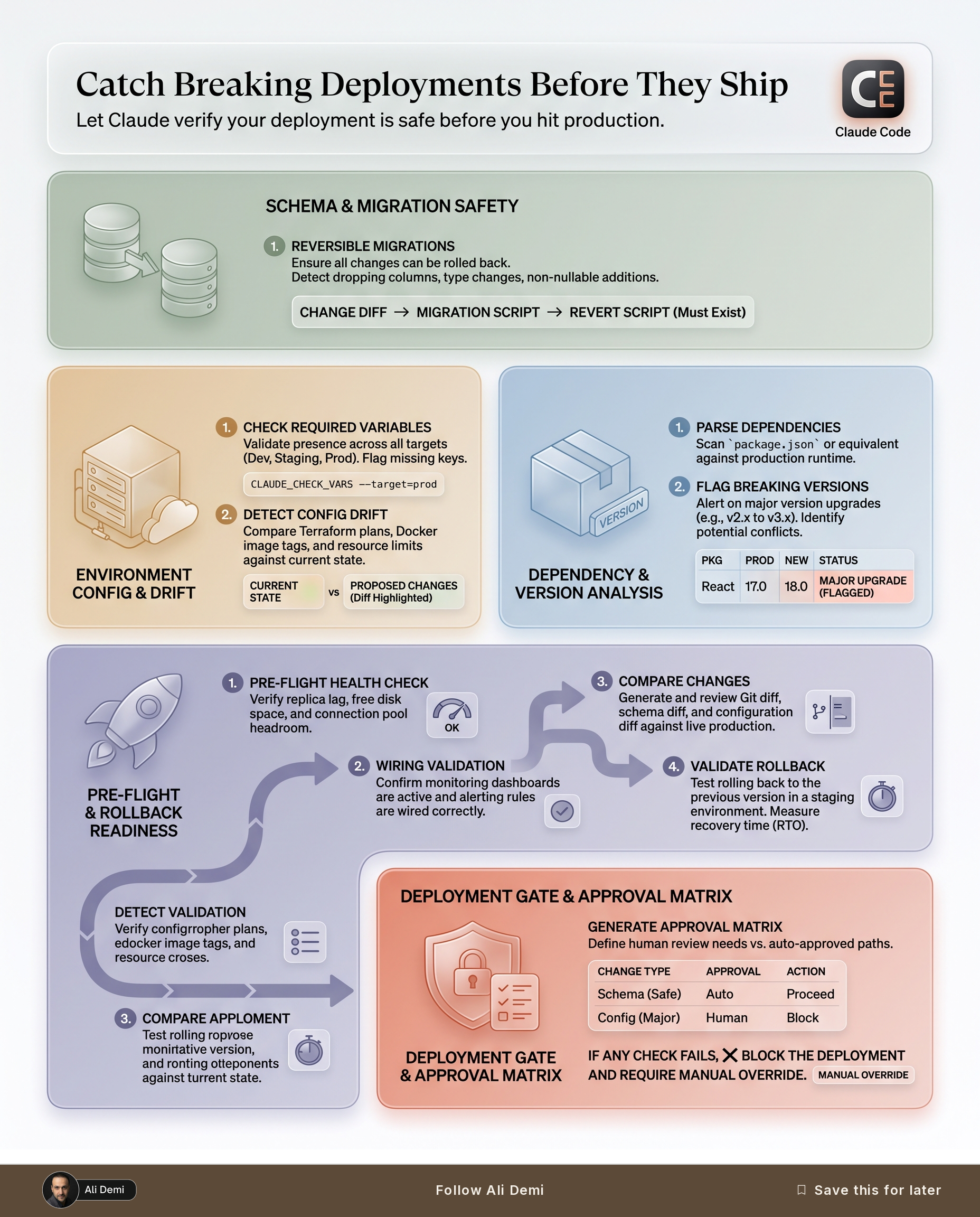
    1. Schema compatibility. Parse migrations, detect non-reversible changes (dropping columns, changing types), check against production schema. Flag breaking changes.
    2. Environment validation. Scan code for required env vars, verify they exist in target environment, type-check values, catch typos.
    3. Dependency compatibility. Compare package versions in your change against what’s running in prod. Detect deprecated APIs, breaking dependency updates, missing peer dependencies.
    4. Configuration drift. Compare your deployment config (docker-compose, terraform, helm charts) against what’s actually running. Catch accidental deletions, changed resource limits.
    5. Rollback readiness. Verify previous versions are still available, test the rollback script, confirm you can revert within SLA.
    6. Health checks. Run pre-flight database health checks (replica lag, disk space, connections), verify dependent services are healthy.

    Wire this into your GitHub Actions as a required status check. Block merging if checks fail.

    One deployment without this catches bugs that cost hours. One month without this catches bugs that cost millions.

    ——

    Book your free AI clarity call, NOW!
    https://buff.ly/TpWy277

    ——

    Repost this. Thanks.
  • Ship Risky Changes Without Breaking Prod: Feature Flags Done Right

    Ship Risky Changes Without Breaking Prod: Feature Flags Done Right

    Shipping a risky change feels like holding your breath. You hope the tests catch everything. They don’t. Manual feature flag management makes it worse – you’re juggling toggles, guessing at safe rollout percentages, and scrambling for a kill switch when things go sideways.

    Claude Code automates the hard parts: auditing your existing flags, designing staged rollouts with real blast-radius math, monitoring health metrics between stages, and generating kill-switch runbooks you can actually trust.

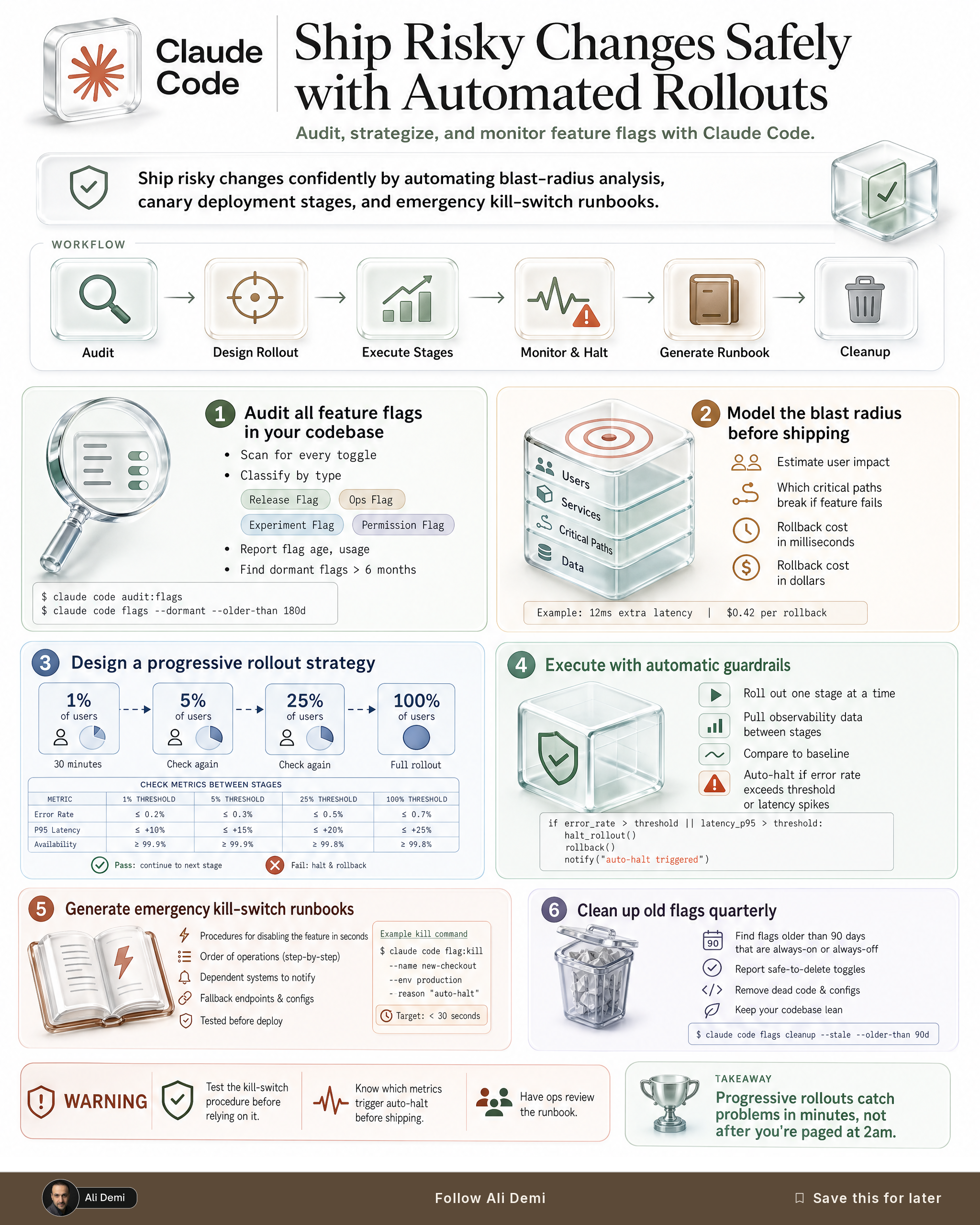
    Step 1: Audit your feature flags. Ask Claude to scan your codebase and classify every flag by type – release flags (decouple deploy from ship), ops flags (kill switches), experiment flags (A/B tests), and permission flags (entitlements). Report flag age, usage, and dormant toggles you can delete.

    Step 2: Model the blast radius. Before touching production, have Claude estimate impact – if this feature breaks, how many users are affected? Which critical paths go down? What’s the rollback cost in milliseconds and dollars?

    Step 3: Design a progressive rollout. Instead of binary on/off, Claude generates staged deployment: 1% of users for 30 minutes, check error rates and latency, 5%, check again, 25%, then 100%. At each stage, define what metrics you’re watching and what threshold triggers an auto-halt.

    Step 4: Execute with guardrails. Roll out one stage at a time. Between stages, Claude pulls your observability data, compares to baseline, and either green-lights the next stage or halts with a clear reason.

    Step 5: Generate emergency runbooks. Before you deploy, ask Claude to write the kill-switch procedure – exactly which systems to toggle, order of operations, dependencies to notify, fallback endpoints. Ops has this before anything ships.

    Step 6: Clean up quarterly. Flags older than 90 days that are always-on or always-off are cruft. Claude finds them, reports which can be safely deleted, and cleans up the code.

    The result: you move fast, you catch problems early, and when something breaks, you’re not frantically Slack-calling ops at midnight. You have a runbook and a rollback path waiting.

    ——

    Book your free AI clarity call, NOW!
    https://buff.ly/TpWy277

    ——

    Repost this. Thanks.