Tag: multi-agent

  • When AI Reviewers Disagree, You Catch More Bugs

    When AI Reviewers Disagree, You Catch More Bugs

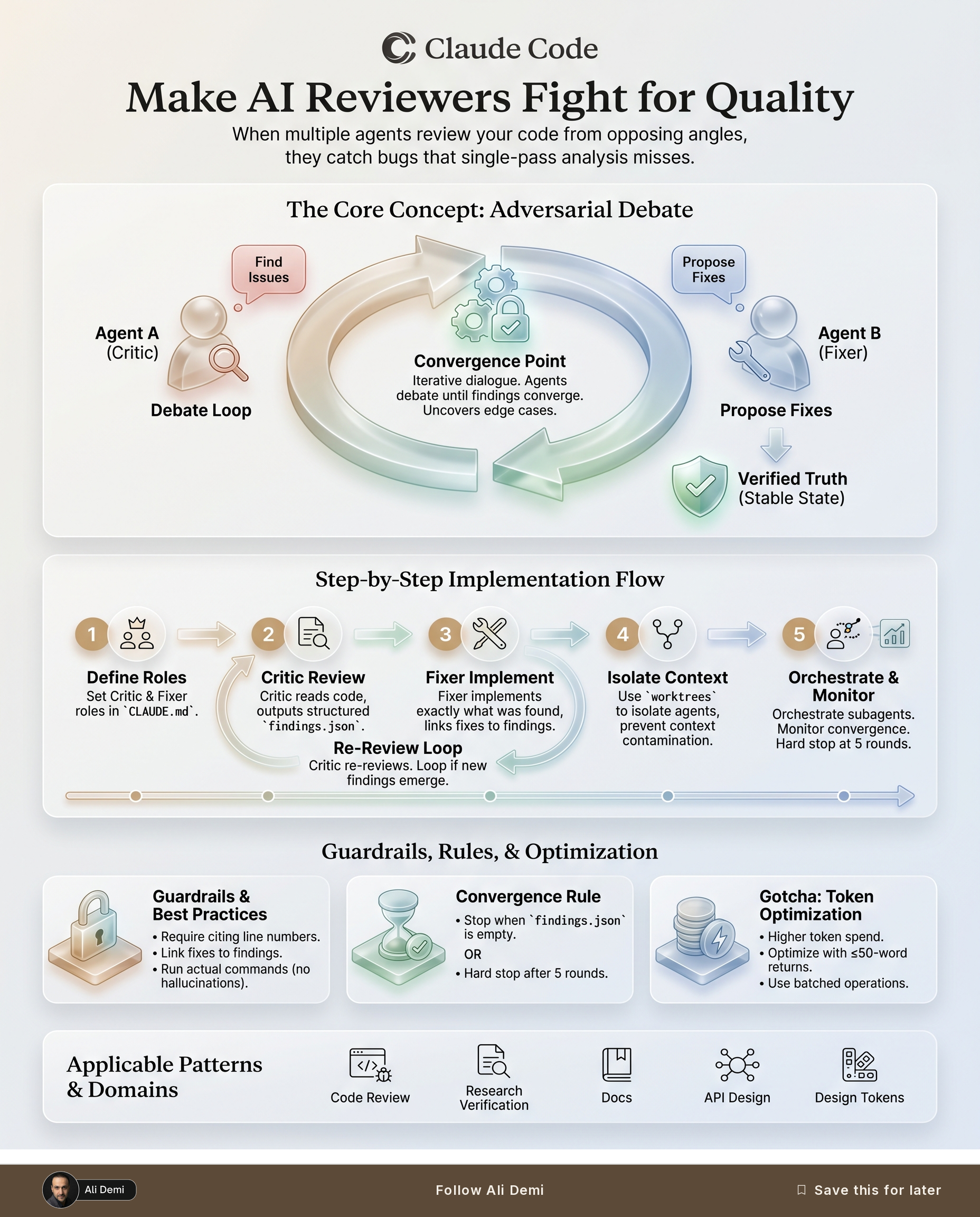
    Single-pass code review misses bugs. One AI reviewer, one pass-you get one angle, one set of blind spots.

    What if your code went to two agents with opposite jobs? One finds problems. The other fixes them. They debate until they agree.

    That’s adversarial multi-agent verification. It’s where critics and fixers loop until the findings list is empty.

    The pattern:

    1. Critic reviews code, produces structured findings (JSON)
    2. Fixer reads findings, implements fixes
    3. Critic re-reviews fixes
    4. Loop until zero new findings (convergence)
    5. Hard stop at 5 rounds to prevent infinite loops

    Real teams use this for code review, research verification, documentation accuracy, and API design. The evidence: researchers caught slide inconsistencies others missed; product teams went 4 rounds to hit feature quality targets; security reviewers caught logic flaws traditional SAST tools never find.

    Set it up:

    1. Define roles in your CLAUDE.md: one agent is critic, one is fixer, one is evaluator
    2. Use Claude Code hooks to run quality gates on pre-commit
    3. Pass findings as JSON files (findings.json from critic to fixer)
    4. Use worktrees to isolate each agent-no context bleeding
    5. Orchestrate with subagents; monitor convergence; stop when dry

    Watch the gotchas:

    Keep iterations capped. Higher token spend per feature. Enforce strict JSON handoffs so agents don’t misalign. Make critic cite line numbers. Make fixer link fixes to findings. Make evaluator run actual commands-no hallucinated results.

    Adversarial loops work on code review, research claims, documentation accuracy, API contracts, design tokens-anywhere one pass isn’t enough.

    ——

    Book your free AI clarity call, NOW!
    https://buff.ly/TpWy277

    ——

    Repost this. Thanks.
  • Build Games Like a Studio: Let Claude Coordinate Your Art, Code, and Design Teams

    Build Games Like a Studio: Let Claude Coordinate Your Art, Code, and Design Teams

    Game development needs a team. One person codes, another designs levels, another audits assets, another writes docs. Coordinating them takes discipline and time.

    Claude Code can BE your team.

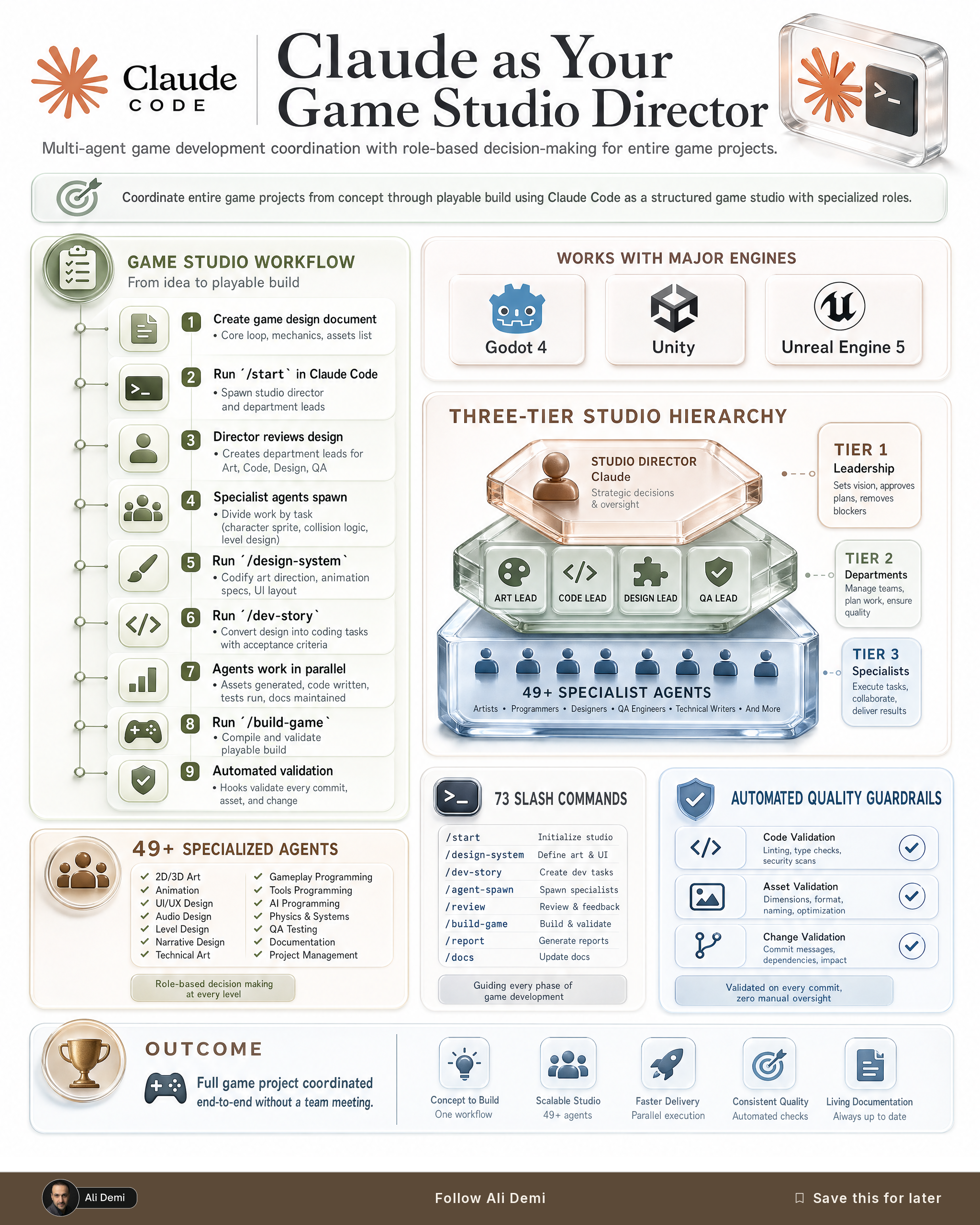
    Claude Code Game Studios is a multi-agent framework that transforms a single Claude Code session into a structured game development studio with 49+ specialized agents organized into a three-tier hierarchy: Directors guard creative vision, Department Leads own domains (Programming, Art, Design, QA), and Specialists execute tasks.

    Give Claude your game design document. It:

    • Spawns a creative director to oversee the whole vision.
    • Creates department leads for code, art, design, and quality.
    • Generates specialized agents to build systems, create assets, and validate quality.
    • Automates hooks that check every commit, asset, and change.
    • Supports Godot 4, Unity, and Unreal Engine 5.

    The workflow uses 73 slash commands that guide you through game dev phases: `/start`, `/design-system`, `/create-stories`, `/dev-story`, `/build-game`.

    Real example: one developer used it to coordinate a full 2D Godot game from concept to playable build in a week. Agents handled sprite generation, scene assembly, character logic, collision systems, and bug fixes in parallel-tasks that would normally require a team.

    Not a code generator. A studio simulator with role-based decision making.

    ——

    Book your free AI clarity call, NOW!
    https://buff.ly/TpWy277

    ——

    Repost this. Thanks.