Your Node.js app feels slow. Users complain about latency spikes. You check CPU, it’s fine. Memory, fine. Then you remember: the event loop.
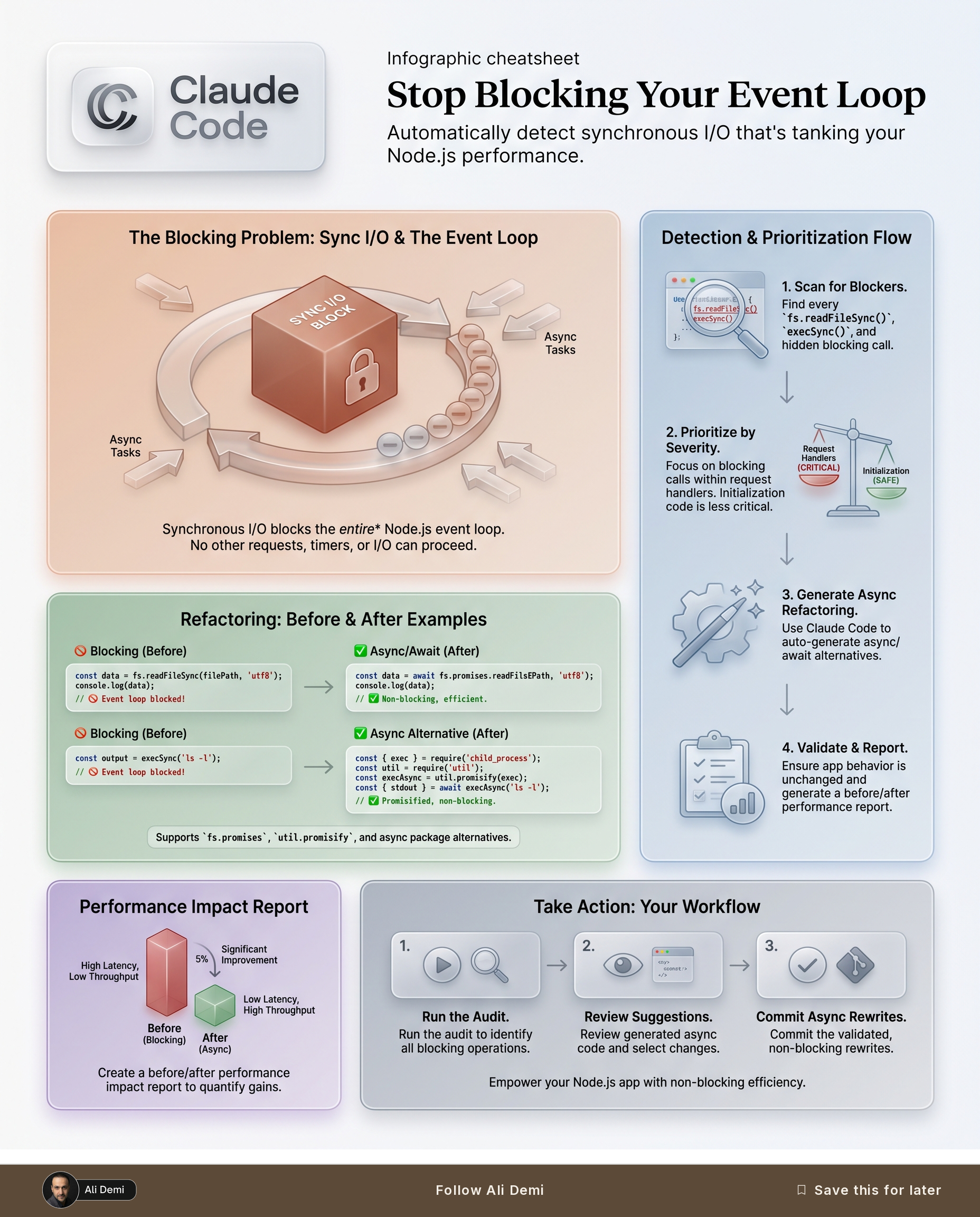
One fs.readFileSync(), one execSync(), one synchronous call hiding in middleware, and your entire application stalls. Every other request waits. But finding these is tedious, they hide in middleware, in initialization code, in third-party packages.
Claude Code scans your entire codebase semantically, finds every blocking I/O call, and generates the async rewrites for you.
What Claude finds:
- Direct blocking calls: fs.readFileSync(), execSync(), require(‘child_process’).execSync()
- Blocking in request handlers and middleware
- Synchronous operations called in event listeners or callbacks
- Blocking patterns hiding inside loops or conditionals
- Third-party packages with only synchronous APIs
What Claude generates:
- A complete audit of blocking calls ranked by severity (blocking in hot paths vs. initialization)
- Refactoring suggestions for each call with code examples
- Automated migrations to fs.promises, util.promisify, or alternative async packages
- A “Node.js Health Report” showing before/after bottleneck reduction
- Safe refactoring that validates the behavior matches the original code
The gotcha: Some blocking during startup is fine. Claude distinguishes initialization code (where blocking is acceptable) from request paths (where it’s a performance killer).
Run it, get your refactoring list, commit the async rewrites, watch your latency drop.
——
Book your free AI clarity call, NOW!
https://buff.ly/TpWy277
——
Repost this. Thanks.