Your product team gets 200 support tickets and survey responses this month. Everyone has opinions about what to build next. Nobody agrees.
By the time you sort through the noise, it’s time for the next planning meeting.
Claude Code can read all 200 responses, extract what customers actually want, score each idea by impact and effort, and rank them for you. In minutes.
Here’s the workflow:
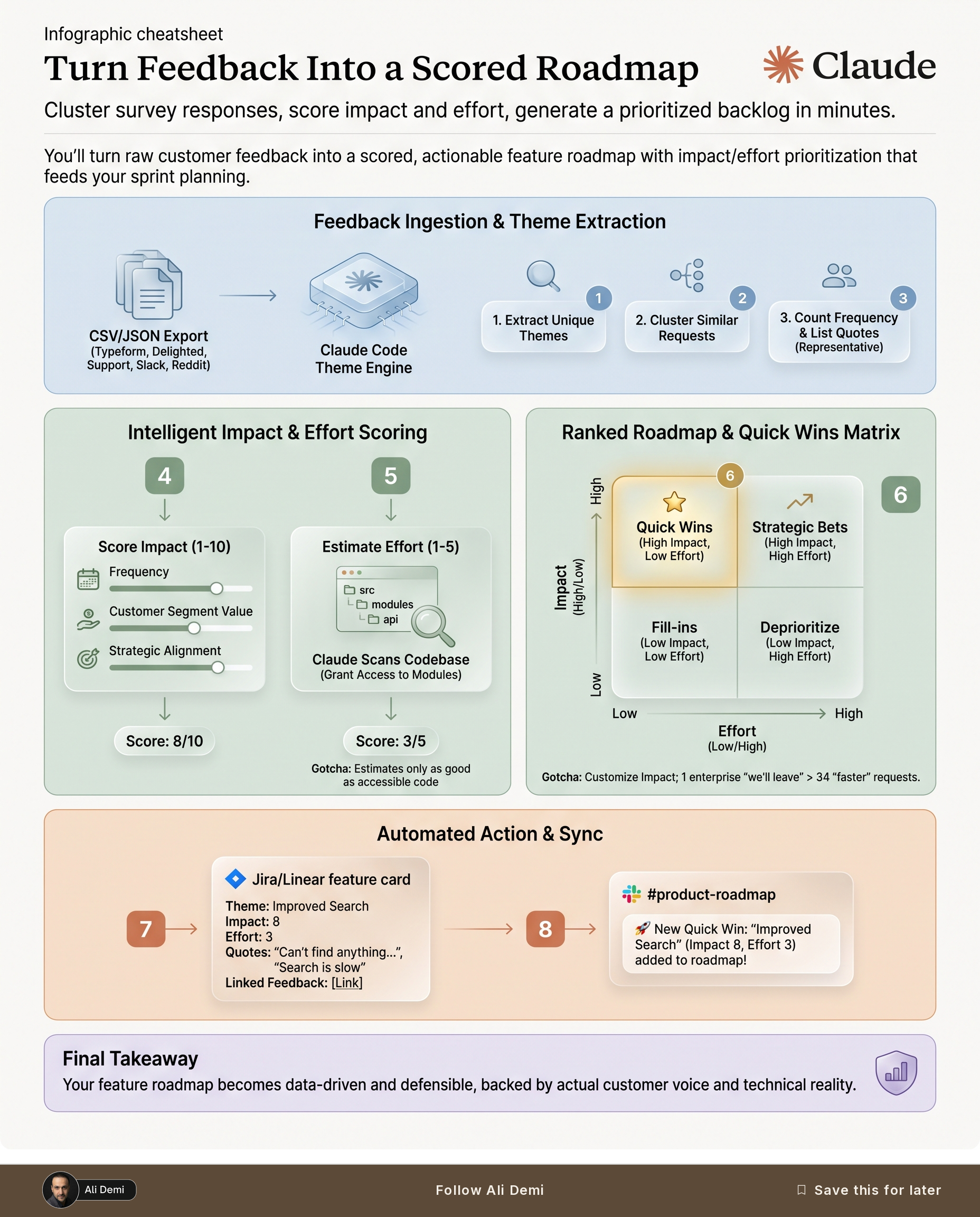
Export your feedback. Typeform surveys, Delighted responses, Slack threads, support tickets, Reddit threads, all of it. Claude reads them all at once and finds the patterns.
Claude clusters similar requests even when they’re phrased differently. Twenty people say “faster”, “slow”, “performance”, “speed up export”? Claude groups them as one theme: “export performance”. Frequency matters. If 34 people mention export speed and 8 mention bulk operations, the scores start there.
Then Claude scores impact. It looks at customer segment, complaint frequency, and how hard a customer might leave if you ignore them. It estimates effort by reading your actual codebase. How many files would change? How complex is the module? Would it need database changes, API updates, frontend work? Claude estimates LOC and technical risk (1-5 scale).
The output is a scored 2×2 matrix: impact on one axis, effort on the other. Quick wins (high impact, low effort) bubble to the top. Your next sprint plans itself.
Claude generates feature cards in Jira or Linear with the original feedback excerpts, impact score, effort estimate, and customer quotes. Post to Slack when a new Quick Win emerges. Your PM has a fact-based roadmap, not a gut call.
The gotcha: Claude needs to read your source code to estimate effort accurately. Grant it access to your repo, or at least the modules customers complain about. Generic effort scores are worse than useless.
——
Book your free AI clarity call, NOW!
https://buff.ly/TpWy277
——
Repost this. Thanks.