Single-pass code review misses bugs. One AI reviewer, one pass-you get one angle, one set of blind spots.
What if your code went to two agents with opposite jobs? One finds problems. The other fixes them. They debate until they agree.
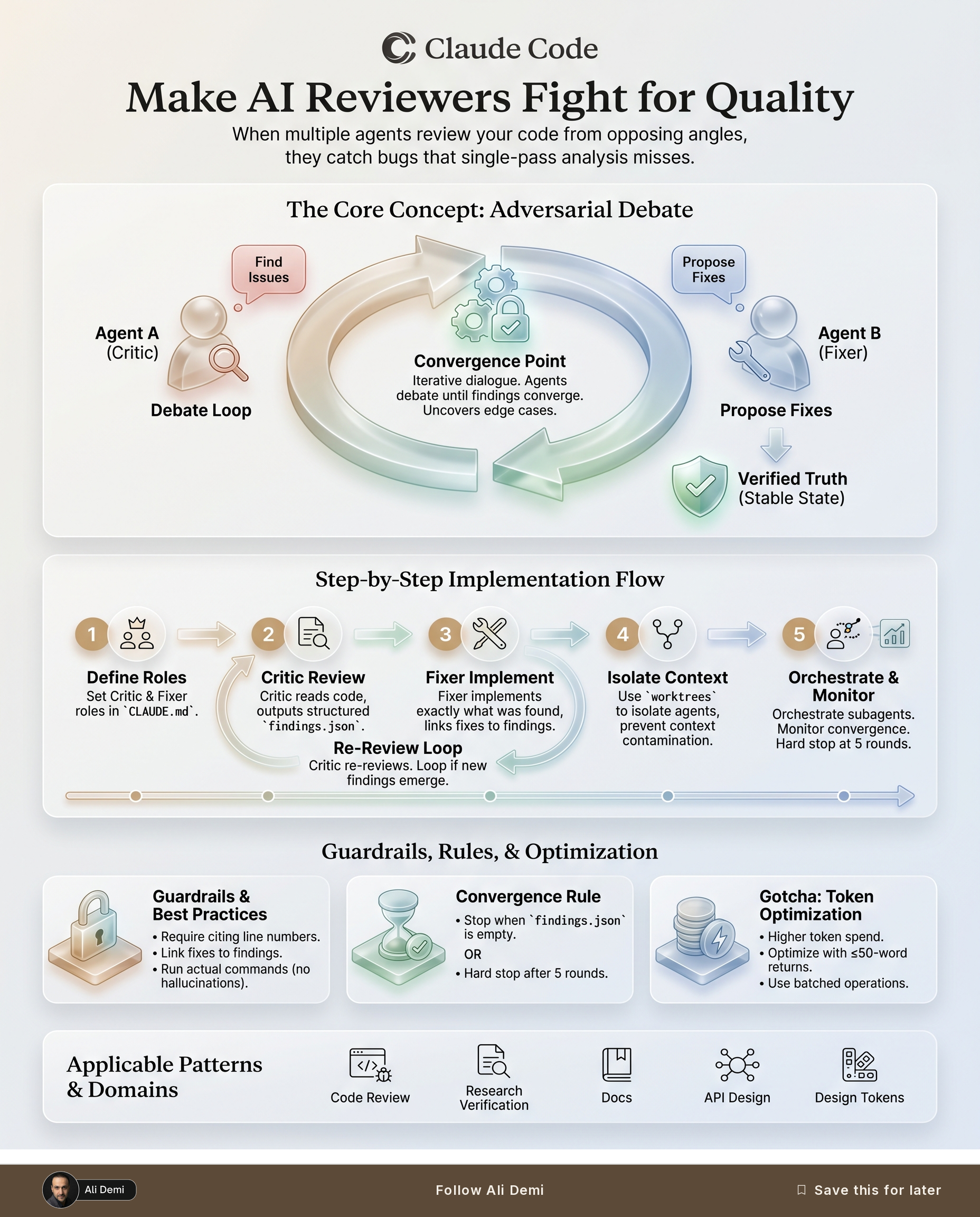
That’s adversarial multi-agent verification. It’s where critics and fixers loop until the findings list is empty.
The pattern:
- Critic reviews code, produces structured findings (JSON)
- Fixer reads findings, implements fixes
- Critic re-reviews fixes
- Loop until zero new findings (convergence)
- Hard stop at 5 rounds to prevent infinite loops
Real teams use this for code review, research verification, documentation accuracy, and API design. The evidence: researchers caught slide inconsistencies others missed; product teams went 4 rounds to hit feature quality targets; security reviewers caught logic flaws traditional SAST tools never find.
Set it up:
- Define roles in your CLAUDE.md: one agent is critic, one is fixer, one is evaluator
- Use Claude Code hooks to run quality gates on pre-commit
- Pass findings as JSON files (findings.json from critic to fixer)
- Use worktrees to isolate each agent-no context bleeding
- Orchestrate with subagents; monitor convergence; stop when dry
Watch the gotchas:
Keep iterations capped. Higher token spend per feature. Enforce strict JSON handoffs so agents don’t misalign. Make critic cite line numbers. Make fixer link fixes to findings. Make evaluator run actual commands-no hallucinated results.
Adversarial loops work on code review, research claims, documentation accuracy, API contracts, design tokens-anywhere one pass isn’t enough.
——
Book your free AI clarity call, NOW!
https://buff.ly/TpWy277
——
Repost this. Thanks.