You ship code, then your security team finds vulnerabilities weeks later in review. By then you’re locked into architectural choices. Threat modeling should happen before you write a line of code, but it’s tedious-manual, slow, and most teams skip it.
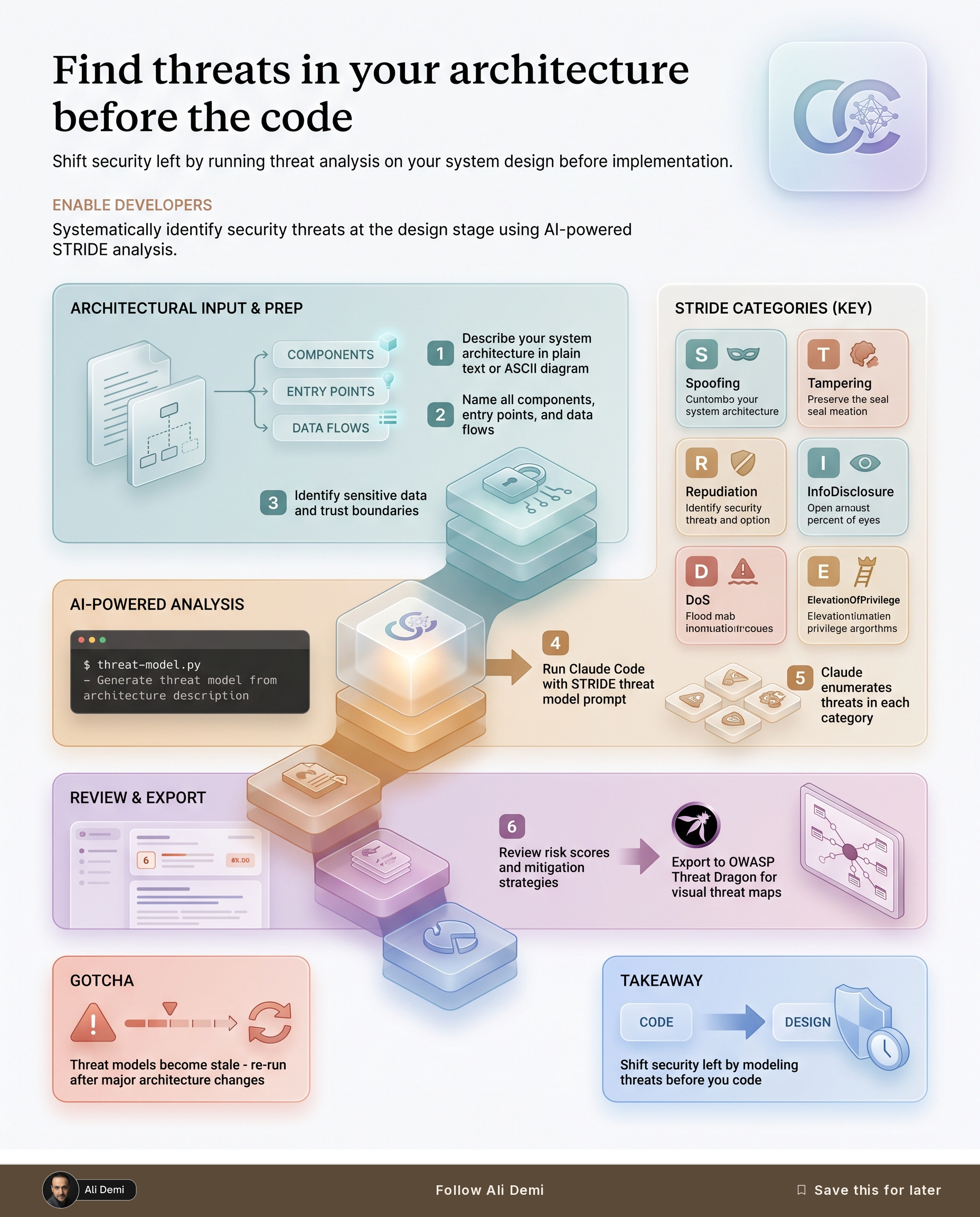
Claude Code can automate this. Describe your system architecture, and Claude generates a complete threat model using the STRIDE framework. It analyzes your components, trust boundaries, and data flows, then enumerates threats ranked by severity and suggests concrete mitigations.
The workflow is dead simple. Write out your architecture (or provide a diagram). Give Claude a prompt that names your components, entry points, and sensitive data. Claude breaks down each STRIDE category-Spoofing, Tampering, Repudiation, Information Disclosure, Denial of Service, Elevation of Privilege-and maps specific threats to your system. Every threat gets a risk score and mitigation strategy tied back to architectural changes.
Build this as a reusable workflow in Claude Code. Feed it your design docs, let it run, and review the threat model in your terminal. Export to OWASP Threat Dragon for visuals. Your security team gets an architecture-aware baseline before code review even starts.
Threat modeling is one of the highest-leverage security practices. Automating it means you can do it on every project, not just critical ones. Security becomes a design constraint, not an afterthought.
——
Book your free AI clarity call, NOW!
https://buff.ly/TpWy277
——
Repost this. Thanks.