Tag: typescript

  • Stop Guessing Your Schema: Auto-Generate Optimized SQL From Your ORM

    Stop Guessing Your Schema: Auto-Generate Optimized SQL From Your ORM

    Your TypeScript ORM models define your data structure, but your actual SQL schema lags behind.

    Composite indexes? Forgotten.

    Foreign key constraints? Sometimes. Check constraints? Never.

    N+1 queries hiding in your schema design? Guaranteed.

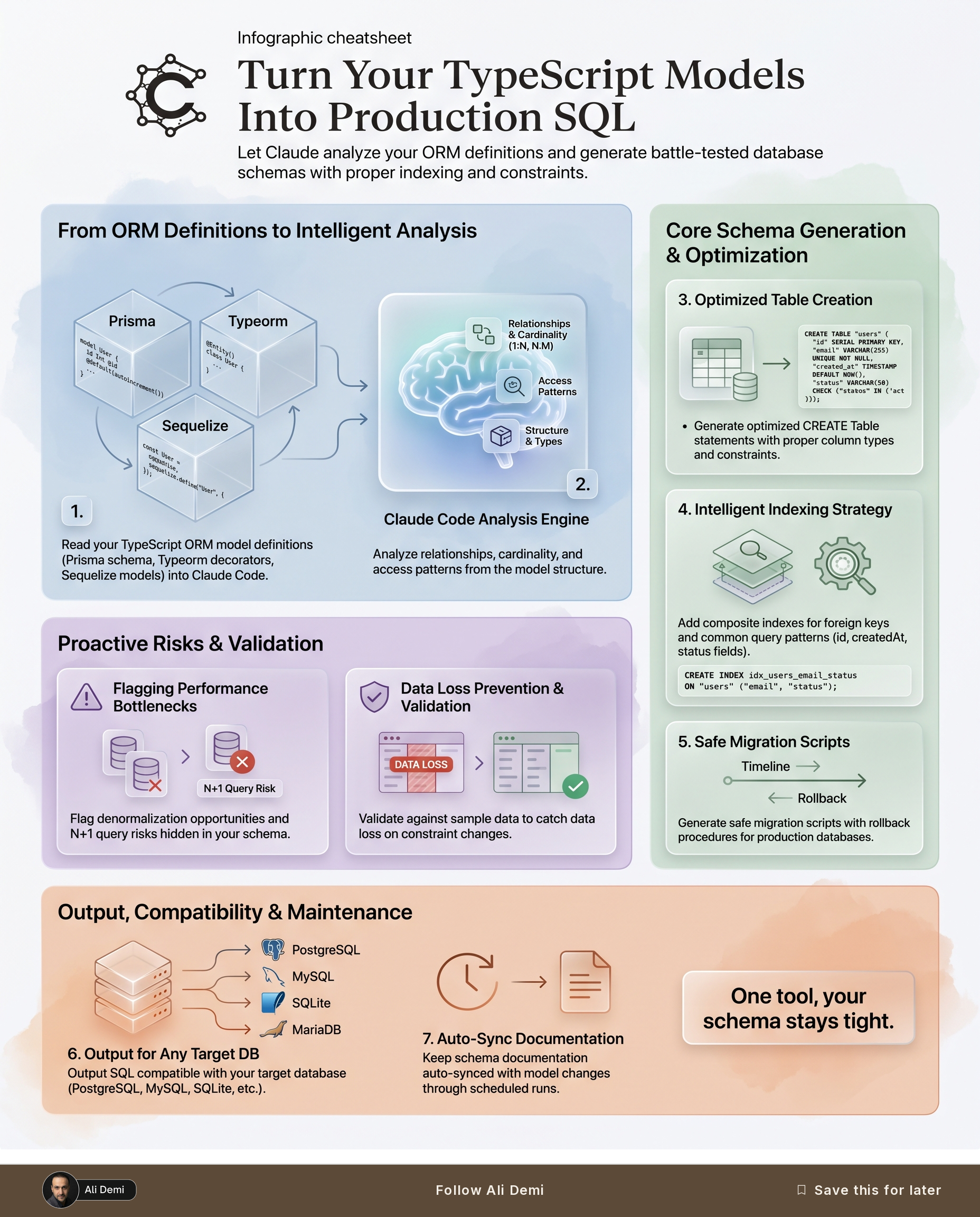
    Here’s the fix: let Claude Code analyze your Prisma, Typeorm, or Sequelize models and generate the SQL your database actually needs.

    Point Claude at your models. It reads the relationships, cardinality, and access patterns baked into your type definitions.

    Claude generates optimized CREATE TABLE statements. Composite indexes for your most common queries. Foreign keys with the right cascade rules. Check constraints that enforce invariants your code assumes. Column-level documentation that stays in sync.

    Compare with your current schema. Claude flags missing indexes, dangling constraints, and denormalization opportunities you’ve been ignoring.

    Generate safe migrations. No data loss. Claude wraps changes in transactions, tests rollback paths, and validates the migration against sample data.

    Your database schema should be as intentional as your code. Now it can be.

    ——

    Book your free AI clarity call, NOW!
    https://buff.ly/TpWy277

    ——

    Repost this. Thanks.
  • Stop Writing TypeScript Types By Hand: Generate Them From APIs

    Stop Writing TypeScript Types By Hand: Generate Them From APIs

    You’re building a frontend. You need types for the third-party API. So you manually write out interfaces: userId, userName, isActive, metadata…

    This takes forever. And halfway through, you realize the API returns different shapes for different endpoints. You rewrite. You discover optional fields you missed. You rewrite again.

    Stop.

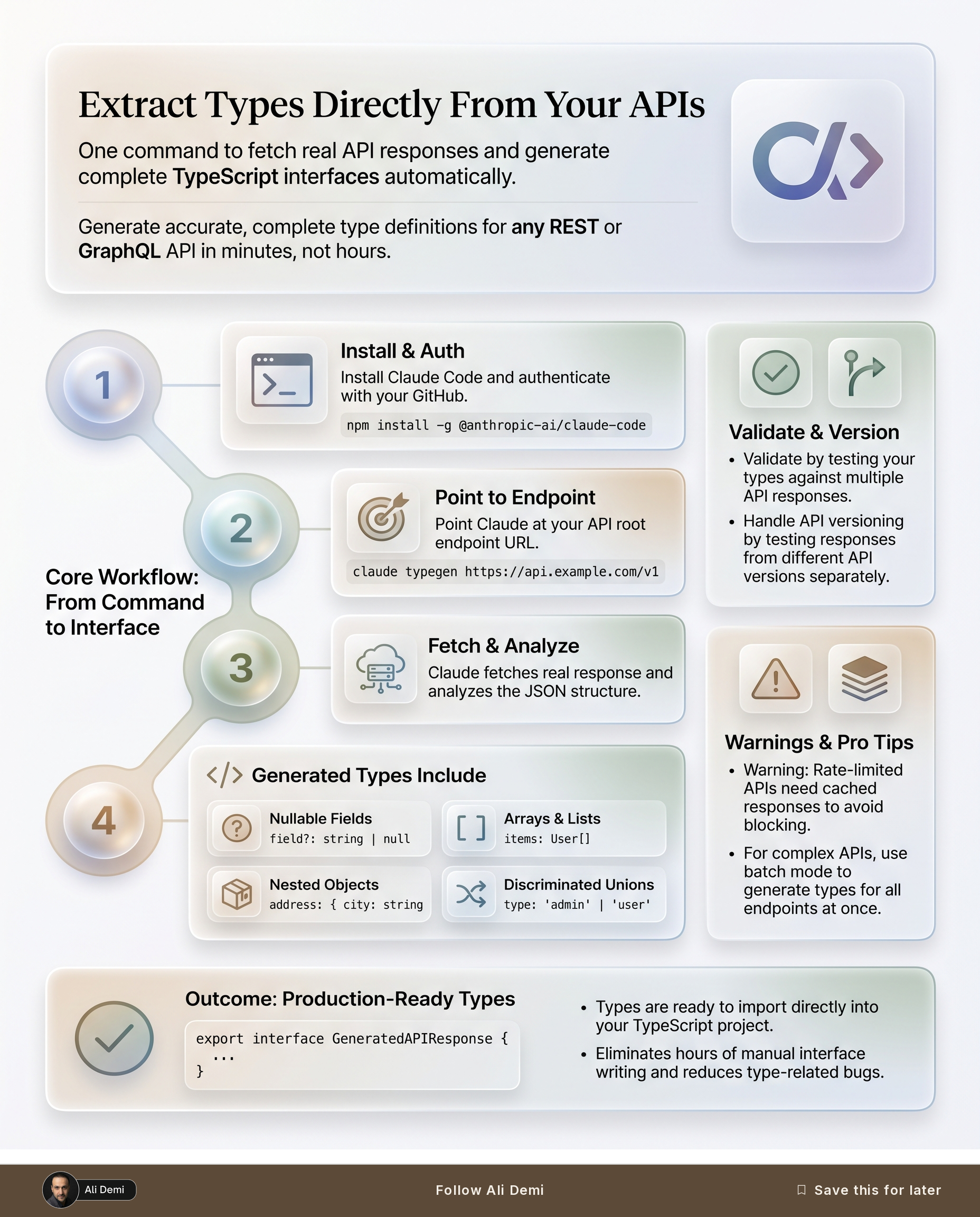
    Claude Code can fetch your API, see what it actually returns, and generate complete TypeScript interfaces in one shot.

    Here’s how:

    1. Point Claude at your API endpoint.
    2. Claude makes a real request and captures the response.
    3. Claude analyzes the structure: types, nullability, nested objects, arrays, union types.
    4. Claude generates ready-to-import TypeScript definitions.
    5. Validate against multiple responses to catch edge cases.

    The beauty: Claude sees your actual responses, not assumptions. Optional fields that appear sometimes? Caught. Discriminated unions? Handled. Deeply nested objects? Generated correctly.

    For APIs with dozens of endpoints, Claude can batch the work. Generate types for all of them in one go.

    The gotchas:

    Some APIs rate-limit. Fetch once, save the response, reuse it. Some APIs return different shapes based on query params. Test multiple variants to ensure your types are complete.

    No more hours lost to manual interface writing. No more debugging because a field was optional and you didn’t know it.

    ——

    Book your free AI clarity call, NOW!
    https://buff.ly/TpWy277

    ——

    Repost this. Thanks.
  • Migrate to TypeScript in Hours, Not Weeks

    Migrate to TypeScript in Hours, Not Weeks

    You have 5,000 lines of untyped JavaScript. TypeScript would catch bugs, but adding types manually? That’s weeks of painstaking work.

    Claude Code changes the math.

    Here’s the workflow:

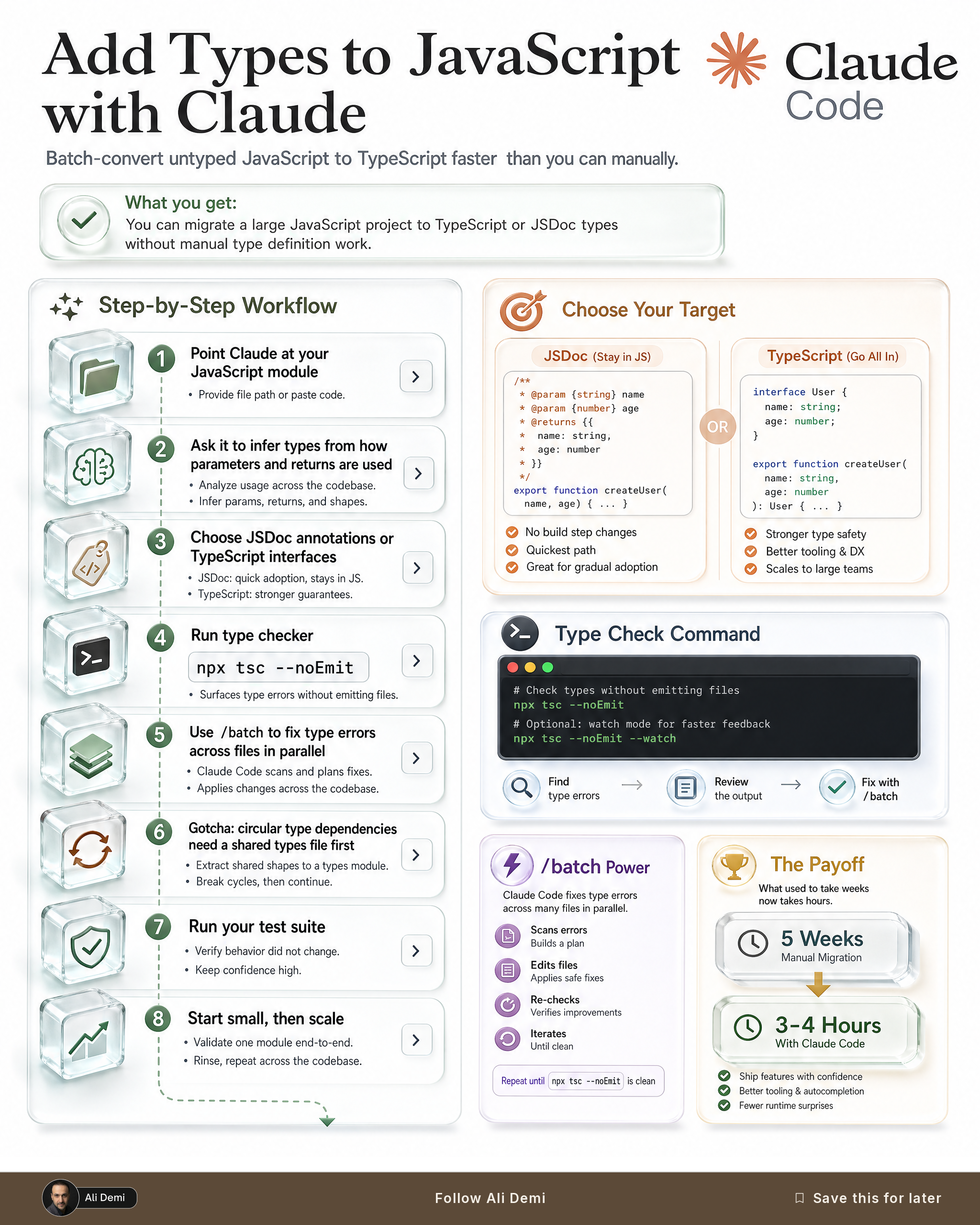
    1. Point Claude at one module. It infers parameter types from usage, return types from actual returns, and generates either JSDoc annotations or TypeScript interfaces.
    2. Run a type checker to surface errors: this shows Claude exactly what it got wrong.
    3. Use /batch to fix type errors across all files in parallel, not one at a time.
    4. Run your test suite. If tests pass, the refactor is done.

    The gotcha: circular types. When Module A uses a type from Module B and vice versa, you need to extract a shared types file first. Claude handles it, but flag it upfront.

    The payoff: A five-week manual migration becomes 3-4 hours of Claude time, with fewer bugs and way less tedium.

    Start with a single module, verify the types are right, then scale to the whole codebase.

    ——

    Book your free AI clarity call, NOW!
    https://buff.ly/TpWy277

    ——

    Repost this. Thanks.