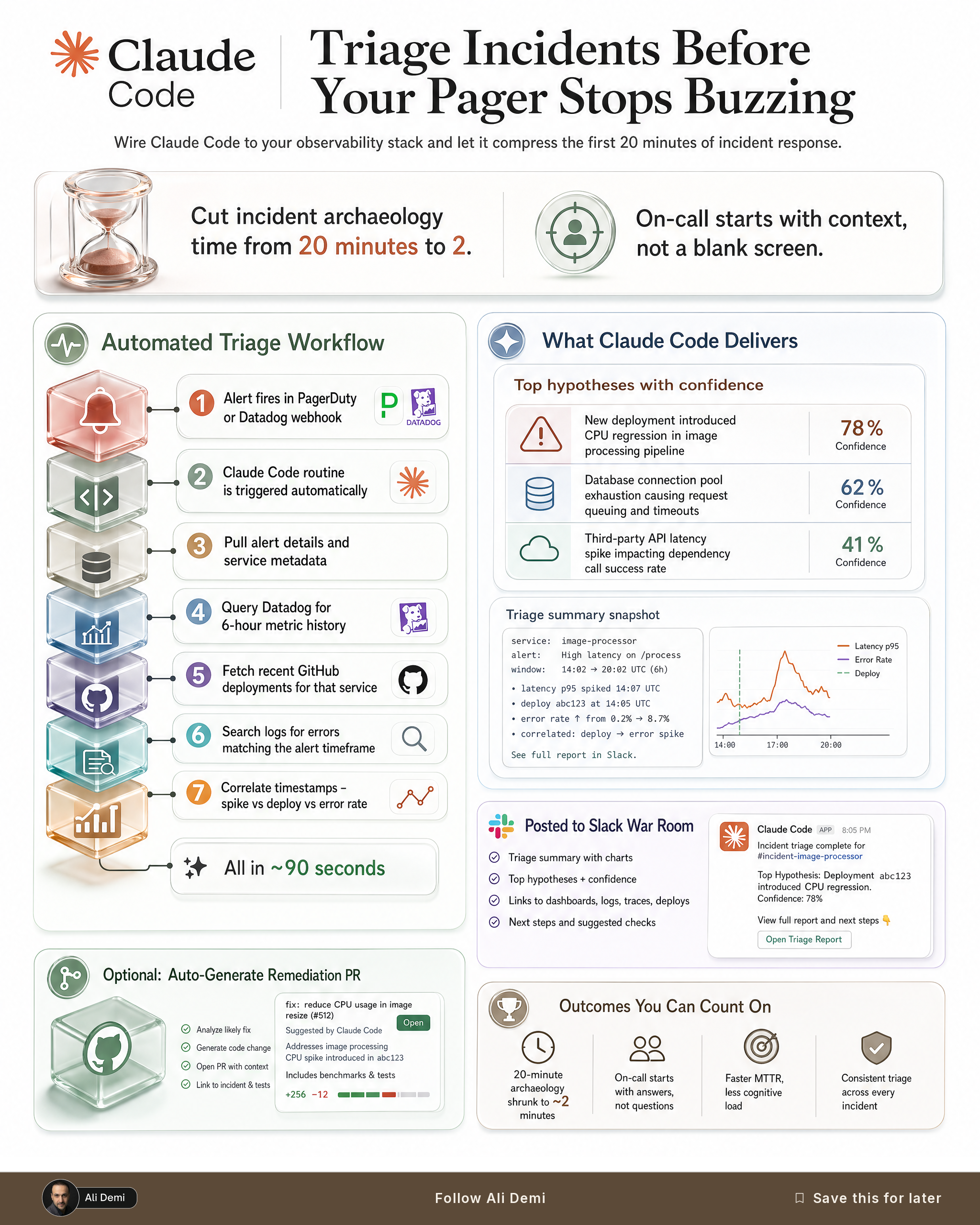
Your alert fires. Your on-call drops everything. Then they spend 20 minutes pulling metrics, checking deploys, reading logs, and hunting for context.
Claude Code can skip that part.
Wire Claude as a routine triggered by PagerDuty or Datadog webhooks. Point it at Datadog metrics, recent GitHub deployments, Slack, and your logs. Give it five minutes and it returns: the alert context, the three most likely root causes, the exact deploy that likely broke it, and a ready-to-post summary for your war room.
The setup:
Create an MCP server for Datadog (pull metrics and events), one for GitHub (deployment history), one for PagerDuty (incident details), and wire Slack for posting. Set Claude Code as a routine triggered by incoming PagerDuty webhooks. The prompt is straightforward: given this alert, gather all relevant signals, correlate them with recent changes, and post a summary.
What it actually does:
Routine fires. Claude pulls the alert severity and service name. Searches Datadog for the last 6 hours of metrics on that service. Grabs the last 5 deployments from GitHub and their timestamps. Checks Slack for any engineer comments in #incidents. Reads the most recent error logs from that service. Builds a timeline: when did the spike start, what deployed right before, did error rates follow the same pattern.
Then it posts to your war room. Something like: Service ABC latency spiked 300% at 14:32 UTC. Deploy 47abc went out at 14:28. Error logs show timeouts in the new DB connection pool. Top hypothesis: the pool size is too small for current traffic. Second: there is an N+1 query in the new code. It posts links to the deploy, the logs, the metrics dashboard. Your on-call has context.
The gotcha:
This works best when your observability stack is wired. If your logs are in one system, metrics in another, and deploys scattered across five repositories, Claude spends time just translating. Pick your most painful incident type first and wire that one fully. Iterate from there.
The payoff:
Real SRE shops using this report MTTR cut from 2 hours to 28 minutes. Your engineer starts with a hypothesis, not a blank screen. Auto-remediation PRs for known fixes go up because Claude can spot the pattern immediately. On-call fatigue drops because triage is no longer a manual archaeology dig. You still need a human to make the call and own the fix, but they do it with full context.
——
Book your free AI clarity call, NOW!
https://buff.ly/TpWy277
——
Repost this. Thanks.
Leave a Reply