Your system is split across 35 repositories.
Portal, API gateway, auth service, billing, event bus, notification workers.
Each team owns their service.
Each deploys independently.
But when a user signs up, the ripple goes through six services and you need them all to work together.
The problem: Claude Code sees one repo at a time.
Ask it to update the auth service, and it has no idea that service-b expects the old schema.
Ask it to trace a data flow, and you only get half the story.
You don’t want a real monorepo-your teams need autonomy, different tech stacks, separate deploy cadences.
The virtual monorepo solves this.
The pattern is simple:
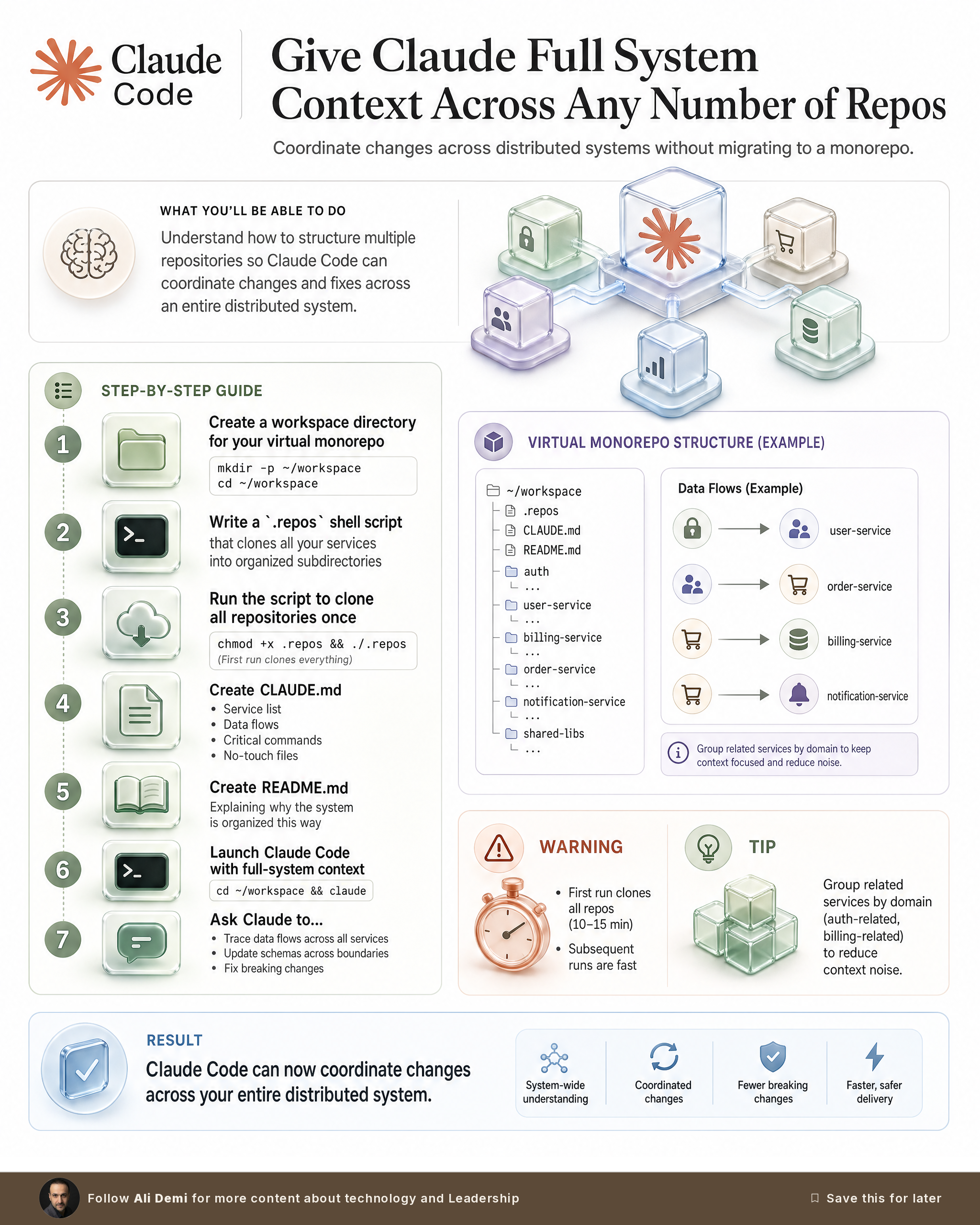
Create a single workspace directory.
Clone all 35 repos into organized subdirectories.
Write two files: a terse CLAUDE.md that documents data flows and critical commands, and a narrative README explaining why the system is organized this way.
Launch Claude Code from the workspace root.
Now Claude sees all repos at once and understands the full system architecture.
You can ask it to trace a signup flow end-to-end, fix breaking changes across service boundaries, or update API contracts and all their callers simultaneously.
The gotchas: disk space (35 repos is 10-50 GB), sync (when repos are added, update your clone script), and context noise (group related services into subdirectories to stay organized).
Your CI/CD unchanged-this is purely a reading layer for Claude Code, not a deployment artifact.
The payoff: Claude can now understand and coordinate changes across your entire distributed system without human handoff between repos.
——
Book your free AI clarity call, NOW!
https://buff.ly/TpWy277
——
Repost this. Thanks.
Leave a Reply