Category: AI Products

  • Stop Reading 20 Hours of Interviews: Synthesize User Research Instantly

    Stop Reading 20 Hours of Interviews: Synthesize User Research Instantly

    You record 50 user interviews. Then you spend a week reading transcripts, highlighting quotes, and writing synthesis notes by hand.

    Claude can do that in minutes.

    The workflow is simple.

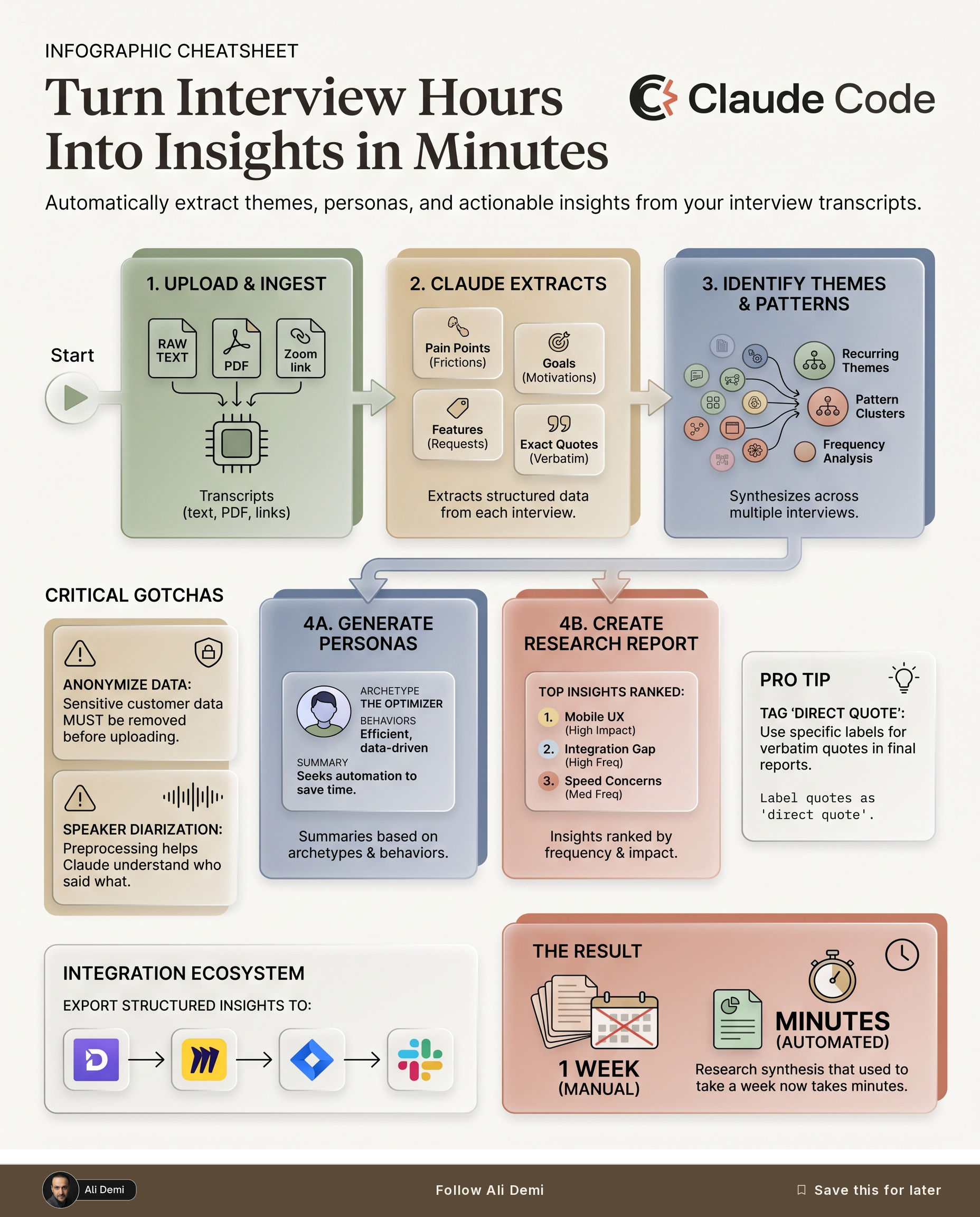
    1. Upload your interview transcripts (paste raw text, upload PDFs, or point at your Zoom recordings)
    2. Claude extracts the meat: pain points, goals, workarounds, feature requests, and exact quotes
    3. Across multiple interviews, Claude clusters themes and identifies patterns
    4. You get: a persona summary, a heat map of problems, and a research report with primary quotes
    5. Export to Dovetail, Miro, or your Jira backlog

    What makes this fast.

    Claude understands context. It knows when someone says their workflow is broken versus when they’re just frustrated. It spots contradictions across interviews (some users want X, others want Y). It finds the real problems buried in rambling conversations.

    Run this at scale: batch process 50 interviews while you sleep, then wake up to themes already clustered and personas already written.

    Where it saves time.

    User researchers spend 80% of their time on synthesis. Claude handles the reading, highlighting, and organizing. You spend your time validating insights and asking follow-up questions, not transcribing pain points.

    Product managers get actionable research reports in hours, not weeks. Teams ship faster because you actually ship what users need, not what your gut says.

    ——
    Book your free AI clarity call, NOW!
    https://buff.ly/TpWy277
    ——

    Repost this. Thanks.
  • Your Code Reviewer Never Sleeps: Auto-Review Every PR

    Your Code Reviewer Never Sleeps: Auto-Review Every PR

    Your PR sits in the queue waiting for review. Two days later, someone finds a bug that would have taken thirty seconds to catch. Claude Code can fix that.

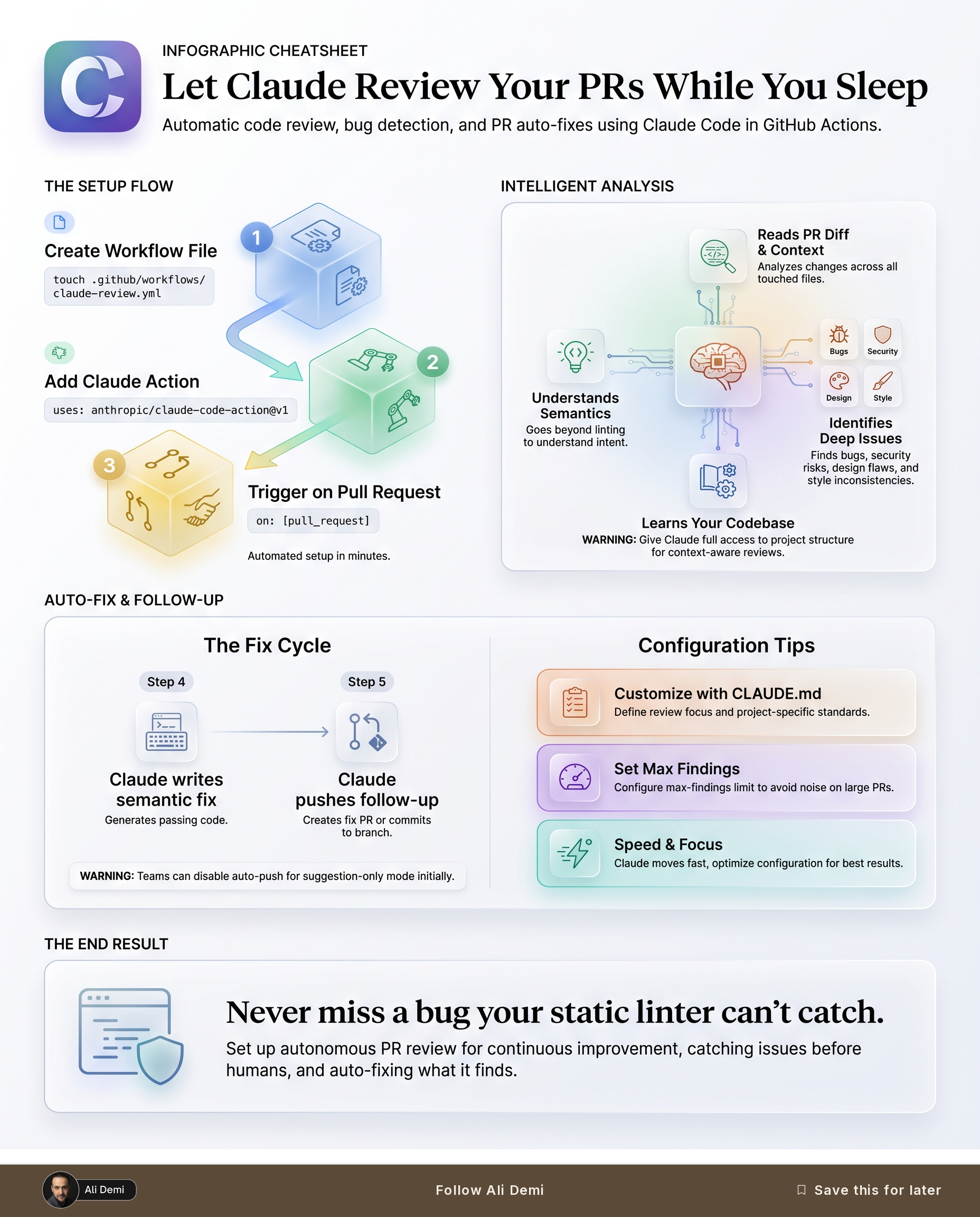
    Set up Claude Code to run on every PR, read the diff, find the bugs, and push fixes before your team even looks at the PR.

    This is the difference between slow code review and continuous verification.

    What Claude can review:

    • Logic errors and edge case bugs in the diff
    • Missing null checks, error handling, off-by-one mistakes
    • Security vulnerabilities (auth bypasses, injection risks, race conditions)
    • Performance issues (N+1 queries, memory leaks, blocking operations)
    • Code style and naming inconsistencies

    When Claude finds a bug, it doesn’t just comment. It runs the test suite, traces the failure across files, writes a fix that actually works, and opens a PR for you to approve.

    Your team reviews better code. Humans stay focused on design and architecture. Claude handles the 80% of review work that’s mechanical.

    ——

    Book your free AI clarity call, NOW!
    https://buff.ly/TpWy277

    ——

    Repost this. Thanks.
  • Your Async Code Has Invisible Bugs: Detect Race Conditions Automatically

    Your Async Code Has Invisible Bugs: Detect Race Conditions Automatically

    Race conditions are the invisible killers of async code. A function that works perfectly in tests fails catastrophically in production under load, with no clear error message.

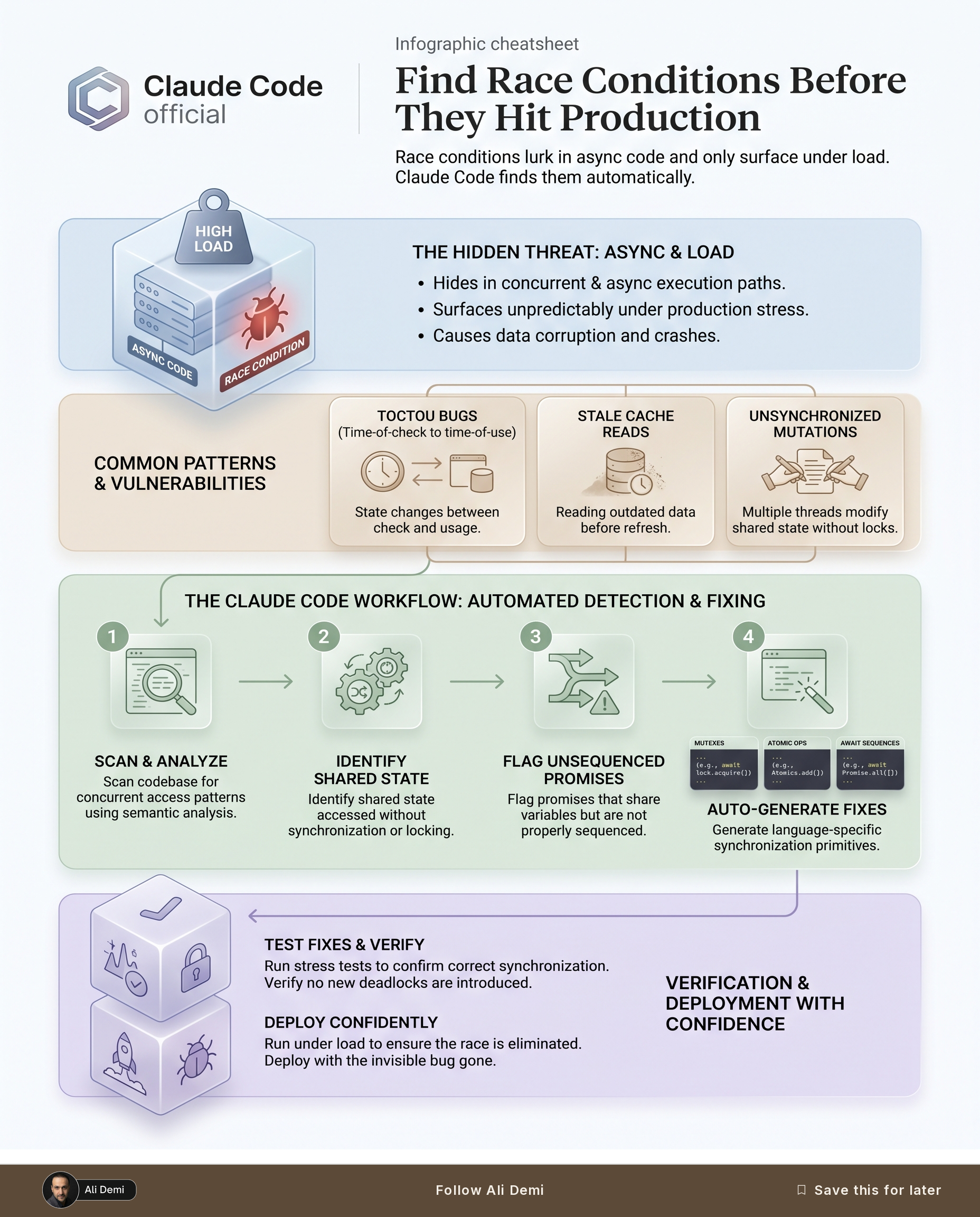
    The problem: shared state accessed without synchronization. A cache read happens, then the source changes, then you use the stale value. Two Promise.alls fight over the same data. A file gets read, modified, and written without coordination.

    These bugs hide for weeks, then destroy your service at 2 AM.

    Claude Code scans your async code and finds them before they ship.

    Run a semantic analysis of your codebase to identify concurrent access patterns. Claude understands data flow and timing, so it spots the gaps that pattern-matching tools miss.

    It detects classic race conditions: time-of-check-time-of-use (TOCTOU) bugs, stale cache reads, unsynchronized shared variables, unsequenced Promise chains, unguarded map/object mutations.

    Then it auto-generates fixes tailored to your language: adds mutex locks in Go, generates proper async sequencing in JavaScript, suggests atomic operations in Java, wraps critical sections in Python.

    The result: your async code stops silently failing.

    ——

    Book your free AI clarity call, NOW!
    https://buff.ly/TpWy277

    ——

    Repost this. Thanks.
  • Stop Hunting Hardcoded Strings: Automate Your i18n Setup

    Stop Hunting Hardcoded Strings: Automate Your i18n Setup

    Your app only works in English right now, but your customers live everywhere.

    Going global means extracting every hardcoded string, creating translation key structures, setting up pluralization rules, wiring in locale selectors, and syncing with a translation service. It’s tedious, error-prone, and it eats weeks of engineering time.

    Claude Code can automate all of it.

    The workflow:

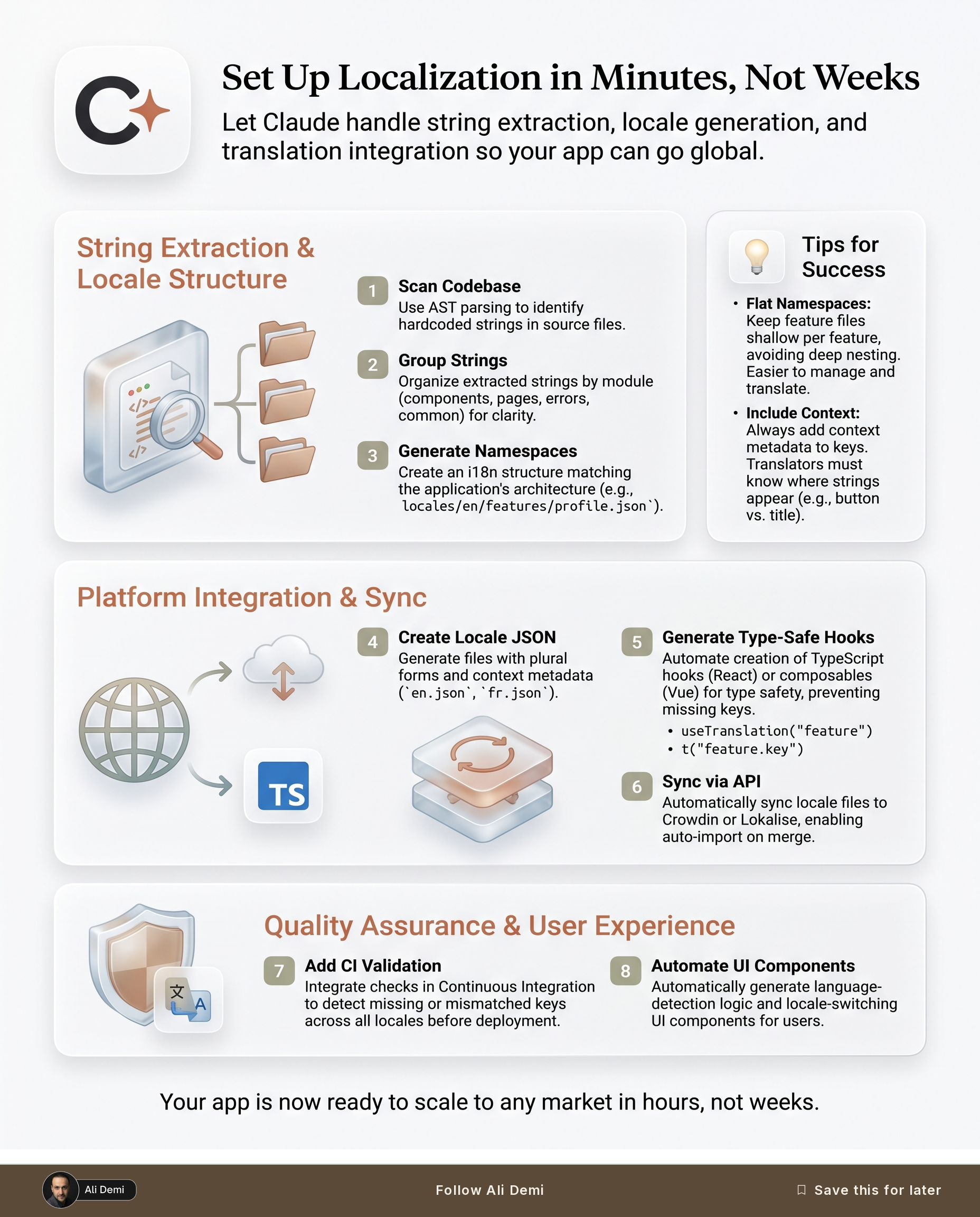
    1. Scan your codebase with Claude to find every hardcoded string and existing i18n calls
    2. Generate a clean namespace structure (common, pages, components, errors) based on where strings live
    3. Create locale files with automatic plural and context rules for each language
    4. Generate type-safe i18n hooks or composables so developers catch missing translations at compile time
    5. Push locale files to Crowdin or Lokalise via their API, wired to auto-sync on merge
    6. Validate all locales have matching keys-no silent missing translations in production

    The result: your codebase speaks 10 languages, your translations stay in sync, and your next hire in Spain gets full type safety in Spanish without touching a config file.

    ——

    Book your free AI clarity call, NOW!
    https://buff.ly/TpWy277

    ——

    Repost this. Thanks.
  • Stop Tracking Competitors By Hand: Automate Competitive Intelligence

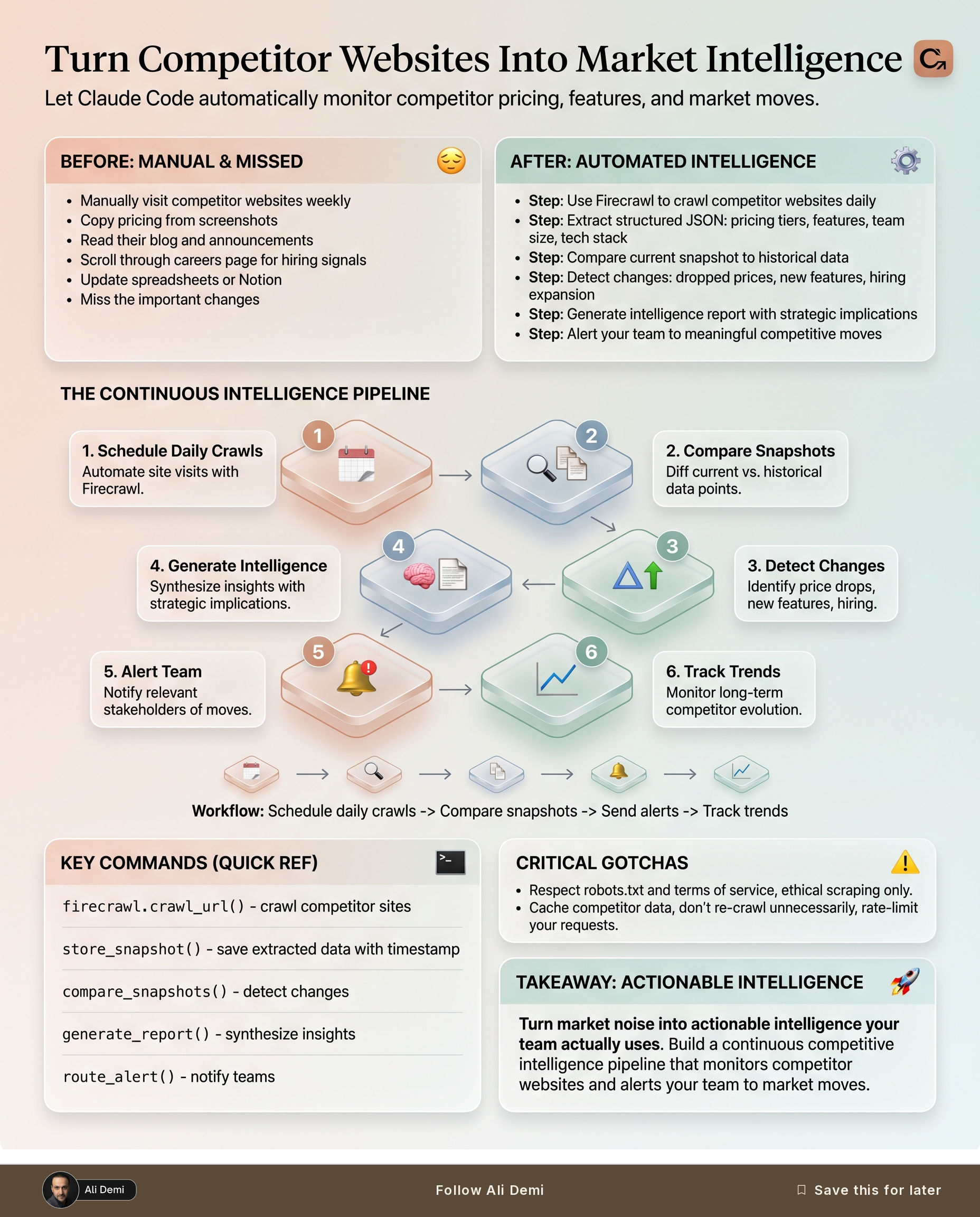
    Stop Tracking Competitors By Hand: Automate Competitive Intelligence

    You’re manually checking competitor websites weekly. Their pricing changes. New features ship. They hire aggressively. You find out late.

    Claude Code plus Firecrawl automate this into a continuous intelligence pipeline that never sleeps.

    Here’s how it works:

    Step 1: Set up Firecrawl MCP. Connect it to Claude Code. Now Claude can crawl websites and extract structured data from any layout.

    Step 2: Define your competitors. Give Claude a list of competitor domains and what to extract: pricing tiers, feature lists, hiring signals, tech stack changes, positioning language.

    Step 3: Let Claude extract to JSON. Each crawl returns structured data, even when competitor sites have totally different designs. Firecrawl handles the messy HTML; Claude understands the business meaning.

    Step 4: Compare snapshots. Claude stores historical data and detects what changed: price drops, feature launches, budget expansions (new careers page listings), technology switches.

    Step 5: Generate intelligence reports. Claude synthesizes raw data into narrative: “Competitor X dropped pricing on enterprise tier, may be targeting mid-market.” Or “Competitor Y is hiring 12 engineers on the platform team.”

    Step 6: Route alerts. Meaningful changes trigger notifications to your product, marketing, and sales teams. No more surprises.

    Run this on a schedule. Daily crawls are cheap with Firecrawl’s batching. You get what normally requires a dedicated analyst, without hiring one.

    The magic: Claude understands context. It knows “new compliance certifications” matter more than “logo was redesigned.” It connects dots (hiring patterns plus feature launches) to infer strategy. It’s not regex pattern matching; it’s actual business intelligence.

    ——

    Book your free AI clarity call, NOW!
    https://buff.ly/TpWy277

    ——

    Repost this. Thanks.
  • Stop Guessing What to Build: Auto-Prioritize Features From Customer Feedback

    Stop Guessing What to Build: Auto-Prioritize Features From Customer Feedback

    Your product team gets 200 support tickets and survey responses this month. Everyone has opinions about what to build next. Nobody agrees.

    By the time you sort through the noise, it’s time for the next planning meeting.

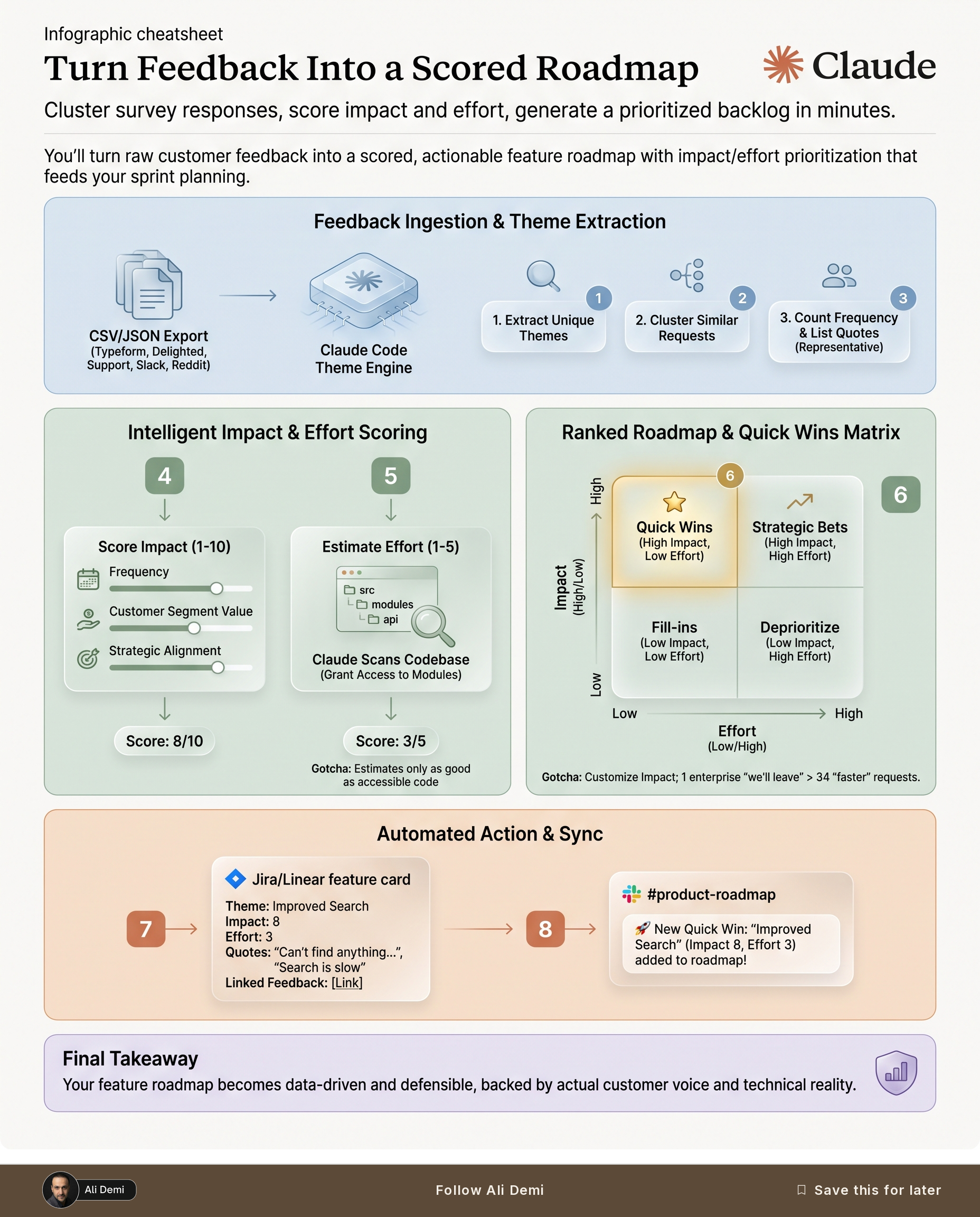
    Claude Code can read all 200 responses, extract what customers actually want, score each idea by impact and effort, and rank them for you. In minutes.

    Here’s the workflow:

    Export your feedback. Typeform surveys, Delighted responses, Slack threads, support tickets, Reddit threads, all of it. Claude reads them all at once and finds the patterns.

    Claude clusters similar requests even when they’re phrased differently. Twenty people say “faster”, “slow”, “performance”, “speed up export”? Claude groups them as one theme: “export performance”. Frequency matters. If 34 people mention export speed and 8 mention bulk operations, the scores start there.

    Then Claude scores impact. It looks at customer segment, complaint frequency, and how hard a customer might leave if you ignore them. It estimates effort by reading your actual codebase. How many files would change? How complex is the module? Would it need database changes, API updates, frontend work? Claude estimates LOC and technical risk (1-5 scale).

    The output is a scored 2×2 matrix: impact on one axis, effort on the other. Quick wins (high impact, low effort) bubble to the top. Your next sprint plans itself.

    Claude generates feature cards in Jira or Linear with the original feedback excerpts, impact score, effort estimate, and customer quotes. Post to Slack when a new Quick Win emerges. Your PM has a fact-based roadmap, not a gut call.

    The gotcha: Claude needs to read your source code to estimate effort accurately. Grant it access to your repo, or at least the modules customers complain about. Generic effort scores are worse than useless.

    ——

    Book your free AI clarity call, NOW!
    https://buff.ly/TpWy277

    ——

    Repost this. Thanks.
  • Stop Lost in Translation: Turn Requirements Into Tests

    Stop Lost in Translation: Turn Requirements Into Tests

    Your product specs live in Slack and your code lives in Git. By the time your feature ships, nobody remembers what was actually promised.

    What if requirements and tests were the same thing?

    This is different from testing what your code does. This is testing that your code does what you said it would.

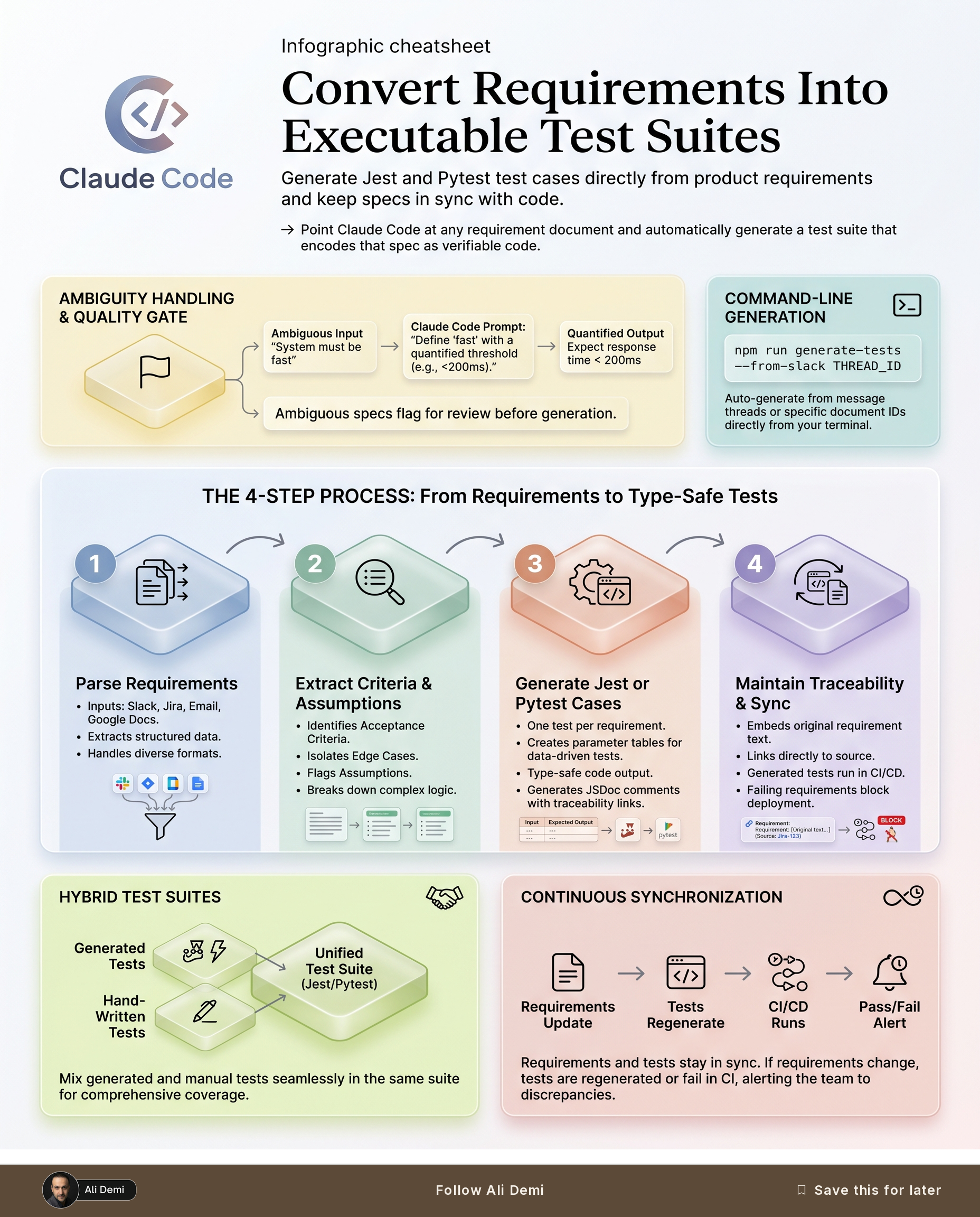
    Point Claude Code at a Slack thread, Jira issue, or email spec. Claude extracts the acceptance criteria, edge cases, and assumptions. Then it generates a full Jest or Pytest test suite where each test case maps back to the original requirement.

    Your workflow becomes:

    1. Product writes a spec (Slack thread, issue description, email)
    2. Run `claude generate-tests –from-slack thread_id` or point Claude at the Jira issue
    3. Claude generates tests with JSDoc comments linking to the original requirement
    4. Tests land in your PR, reviewers can see intent, code review talks about behavior not implementation
    5. Tests run in CI; when product changes spec, test fails, blocking deployment until code matches the new promise

    Claude handles the hardest part: understanding ambiguous English and turning it into precise, executable assertions. Ambiguous specs (say “fast” without defining latency thresholds) are flagged for clarification before code-gen starts.

    The real win: your test suite becomes the contract between product and engineering. When someone says “I don’t remember if we committed to that,” run the tests. The code is the truth.

    ——

    Book your free AI clarity call, NOW!
    https://buff.ly/TpWy277

    ——

    Repost this. Thanks.
  • Stop Shipping Broken Deploys: Automate Pre-Deploy Safety Checks

    Stop Shipping Broken Deploys: Automate Pre-Deploy Safety Checks

    Your deployments are one missed environment variable away from production meltdown.

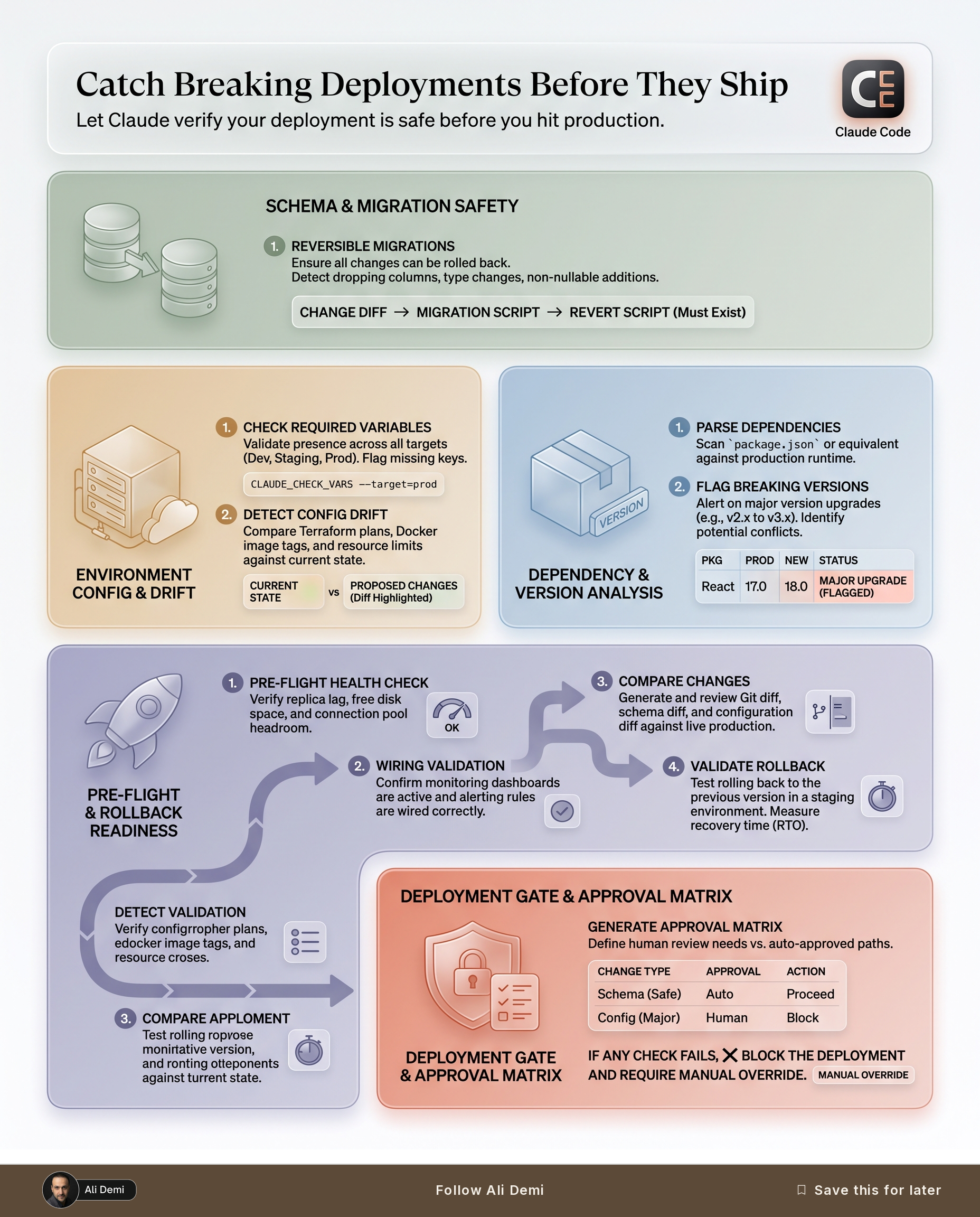
    Most teams catch it after the page is down. Claude Code can catch it before you deploy.

    Here’s what to automate:

    1. Schema compatibility. Parse migrations, detect non-reversible changes (dropping columns, changing types), check against production schema. Flag breaking changes.
    2. Environment validation. Scan code for required env vars, verify they exist in target environment, type-check values, catch typos.
    3. Dependency compatibility. Compare package versions in your change against what’s running in prod. Detect deprecated APIs, breaking dependency updates, missing peer dependencies.
    4. Configuration drift. Compare your deployment config (docker-compose, terraform, helm charts) against what’s actually running. Catch accidental deletions, changed resource limits.
    5. Rollback readiness. Verify previous versions are still available, test the rollback script, confirm you can revert within SLA.
    6. Health checks. Run pre-flight database health checks (replica lag, disk space, connections), verify dependent services are healthy.

    Wire this into your GitHub Actions as a required status check. Block merging if checks fail.

    One deployment without this catches bugs that cost hours. One month without this catches bugs that cost millions.

    ——

    Book your free AI clarity call, NOW!
    https://buff.ly/TpWy277

    ——

    Repost this. Thanks.
  • Stop Drowning in Pipeline Data: Automate RevOps with Claude

    Stop Drowning in Pipeline Data: Automate RevOps with Claude

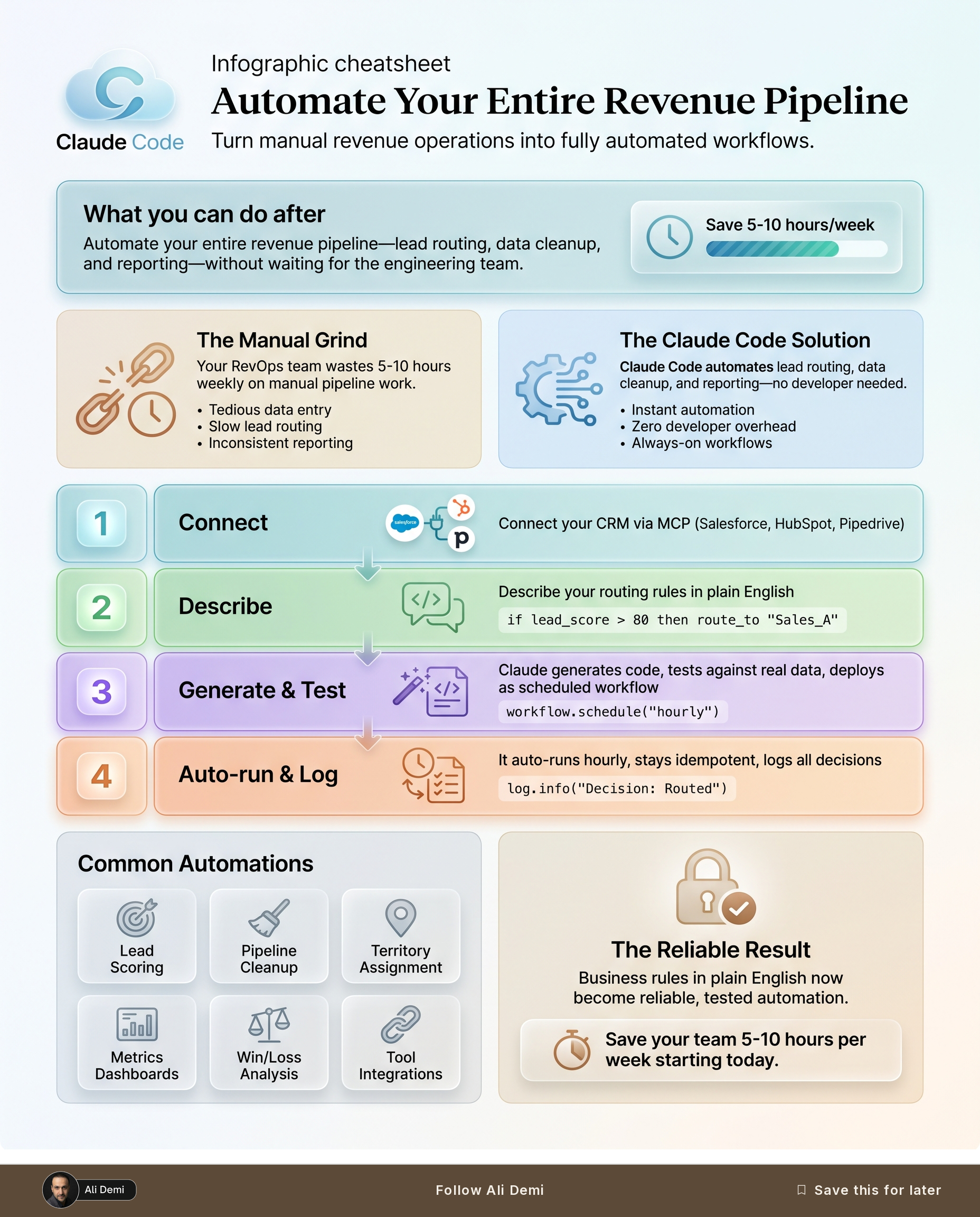
    Your RevOps team spends hours every week on manual work: cleaning messy pipeline data, routing leads by hand, running reports, enriching records. Claude Code changes this.

    You can now build custom CRM automation that rivals enterprise RevOps platforms-in minutes instead of months. No developer required.

    The real advantage: Claude understands business logic. You describe your lead routing rules in plain English. Claude generates the code, tests it against your actual CRM data, and deploys it as a scheduled workflow.

    Start here:

    1. Connect your CRM via MCP (Salesforce, HubSpot, Pipedrive-whatever you use).
    2. Tell Claude what needs to happen. Example: “Route hot leads with deal size over 100k to senior reps, cold outreach to SDRs.”
    3. Claude reads your actual data, writes the routing logic, tests it, then runs it on a schedule.
    4. It auto-logs decisions and skips duplicates so it idempotent-safe to run every hour.

    Common workflows teams build:

    • Lead scoring and auto-routing based on custom rules
    • Pipeline data cleanup (deduping, fixing formats, enriching missing fields)
    • Automatic account hierarchies and territory assignments
    • Custom metrics and health dashboards that update every hour
    • Win/loss analysis and sales cycle metrics
    • Integration glue between tools (sync Slack to CRM, CRM to billing, etc.)

    The workflow: Create a small prompt hook in your CRM that Claude runs on schedule. It takes 15 minutes to set up. The business impact is instant.

    Why this works: Your business rules live in your head and in spreadsheets-they’re rarely in code. Claude can read plain English rules and turn them into reliable automation in one shot. No spec doc. No back-and-forth with engineering.

    ——

    Book your free AI clarity call, NOW!
    https://buff.ly/TpWy277

    ——

    Repost this. Thanks.
  • Stop Making Single API Calls: Find Batching Opportunities Automatically

    Stop Making Single API Calls: Find Batching Opportunities Automatically

    You make a Stripe API call to charge a card.
    Then another to delete a webhook.
    Then three more to sync customer records.

    That’s five separate API calls when Stripe’s batching API could do them in one request.

    Same story everywhere: GitHub’s GraphQL lets you fetch twenty repositories in one call, but your loop hits the REST API twenty times. Slack has a batch endpoint, but you’re calling it once per message. SendGrid supports batch sending, but your code loops and sends individually.

    You’re paying per-request for APIs built to batch.

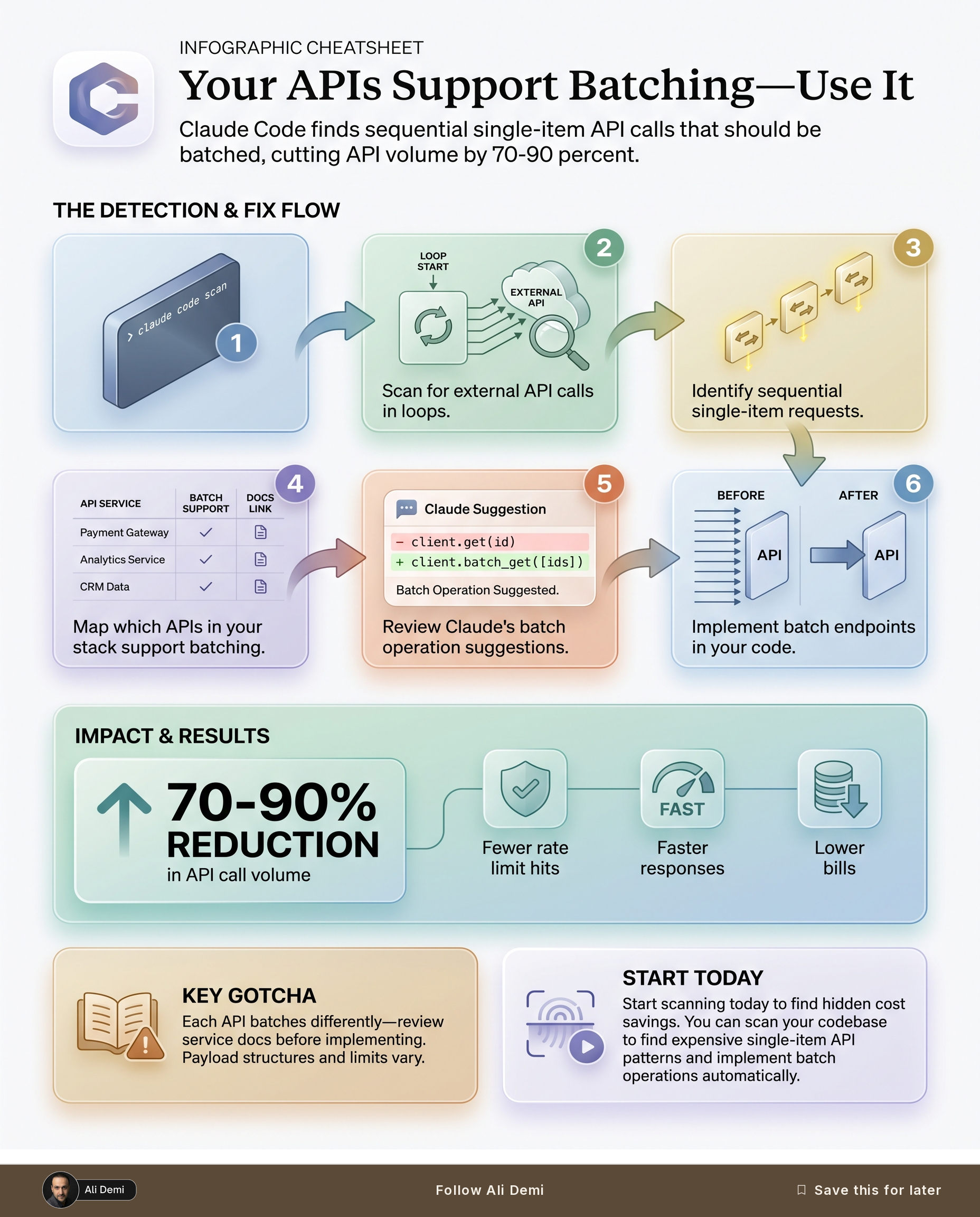
    Claude Code finds these patterns. It scans your codebase, spots loops making single-item API calls, maps which services support batching, and shows you exactly where to batch.

    The result: 70 to 90 percent fewer API calls. Your code gets faster. Your bill gets smaller.

    ——

    Book your free AI clarity call, NOW!
    https://buff.ly/TpWy277

    ——

    Repost this. Thanks.