You’re stuck with legacy Python. You want Go.
You’re on an old Node.js stack. You want Rust.
Rewriting from scratch takes years. Hiring language experts takes months. Manual line-by-line translation is error-prone and tedious.
What if Claude translated your entire codebase automatically, passing every test suite as it goes?
The process:
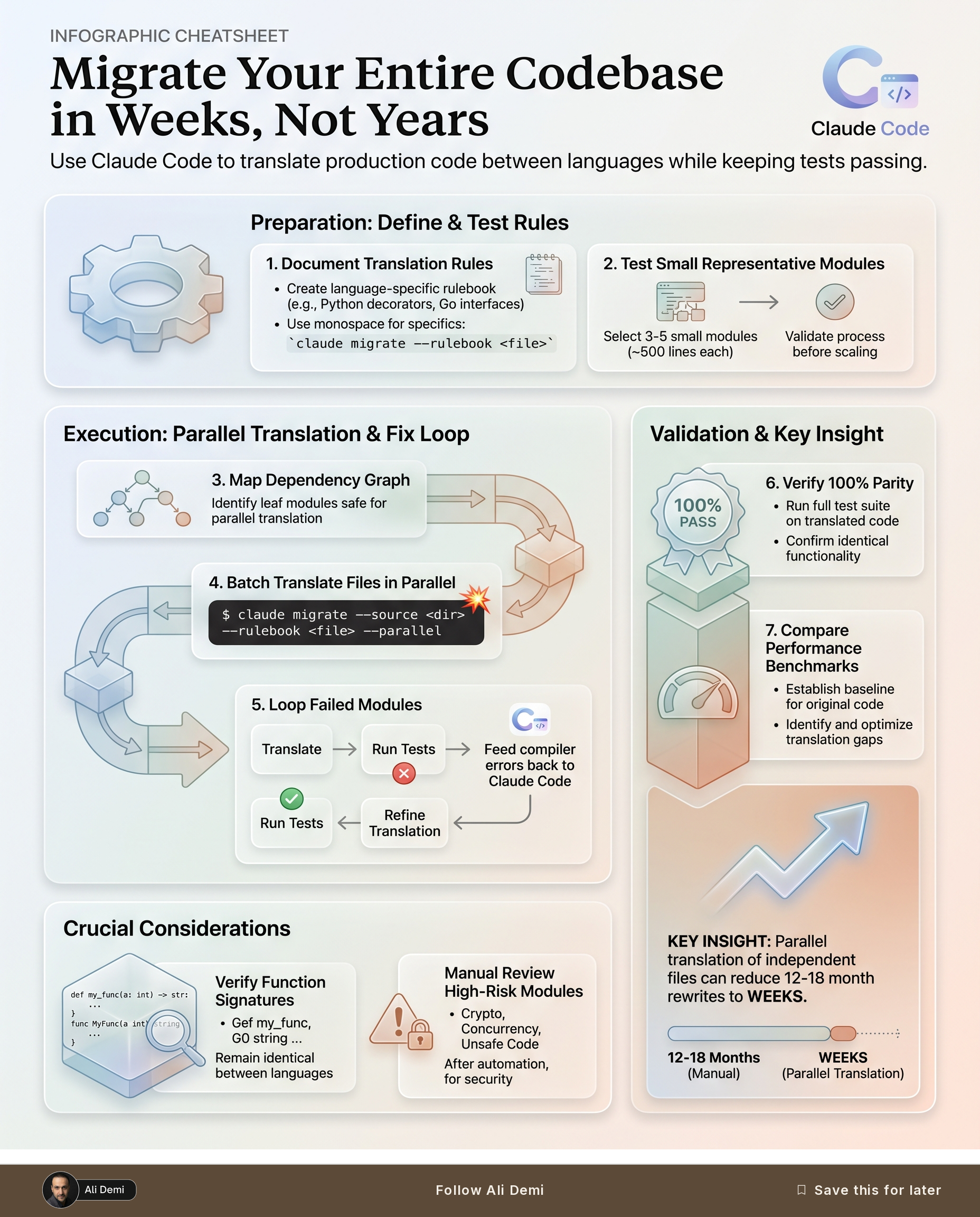
Start by documenting your migration rules in a simple markdown file. Map language-specific patterns: Python decorators to TypeScript hooks, Go interfaces to Rust traits, whatever your translation needs. This becomes your rulebook that Claude follows across the entire migration.
Build a dependency graph of your codebase. Identify leaf modules with zero external dependencies. These become your safe starting points for parallel translation.
Run a mini stress-test first. Pick 3-5 representative small modules (a few hundred lines each). Feed Claude the rulebook plus source code plus tests, and ask it to translate and verify. This validates your process before scaling.
Now parallelize. Feed Claude batches of files with the rulebook and their corresponding tests. Claude translates, you run your test suite automatically. Files that pass move forward. Files that fail loop back to Claude with compiler errors attached.
Claude sees the error, fixes the code, tests again. No human guessing, no manual debugging cycles. The loop runs until green.
After translation, run your full test suite on the new code. Compare performance benchmarks. Manually review the highest-risk modules. Everything else is systematically proven equivalent.
The payoff: Codebases that would take 12-18 months to migrate manually can be translated, tested, and verified in weeks. No rewrites. No losing your architecture. Your tests prove correctness every step.
——
Book your free AI clarity call, NOW!
https://buff.ly/TpWy277
——
Repost this. Thanks.
Leave a Reply