You write 5 test cases for your function and ship it. Then a user hits an edge case you never thought of-and your code crashes.
Manual test writing is exhausting. You list scenarios: empty input, null, negative numbers, Unicode, extremely long strings. You miss half of them.
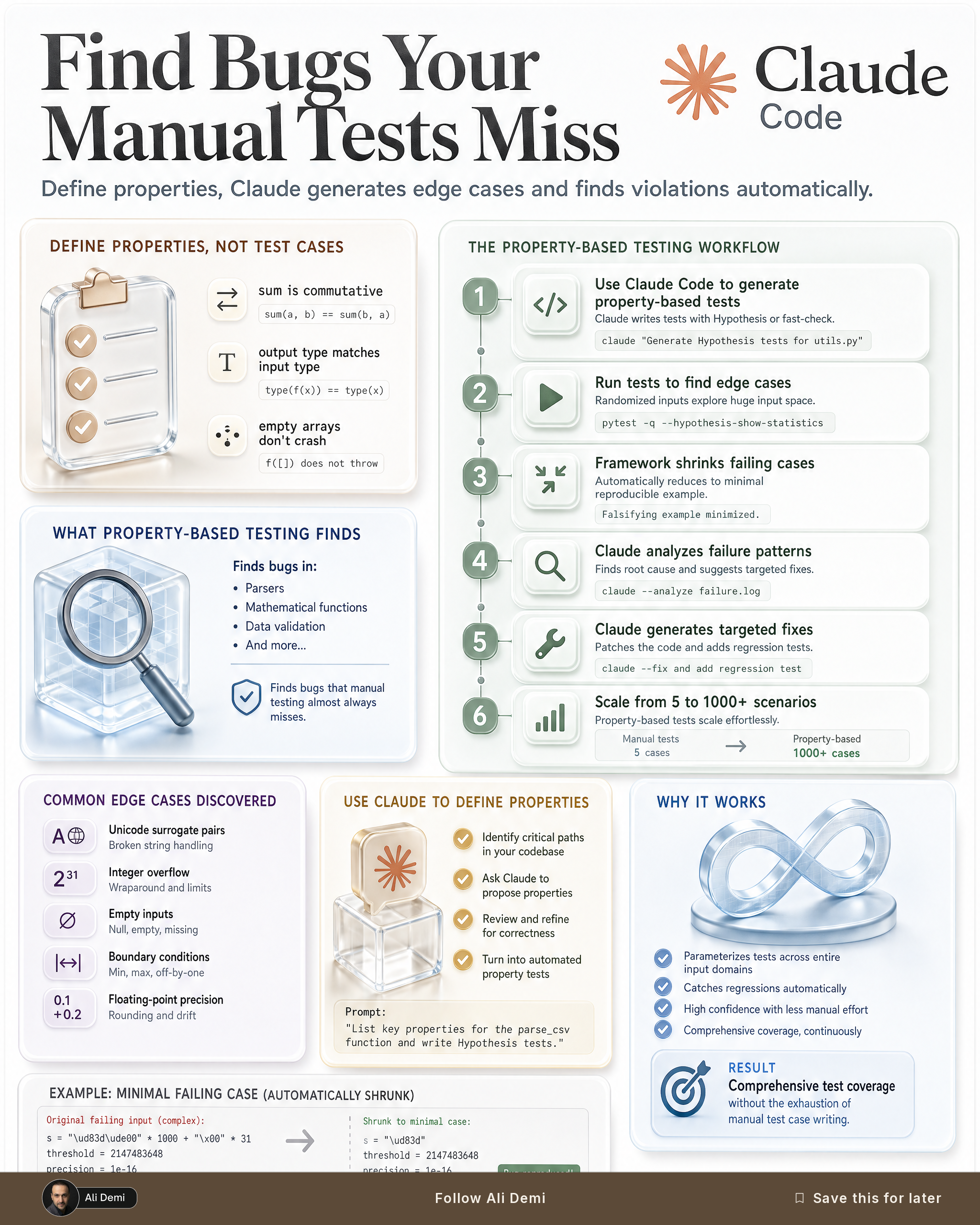
Property-based testing flips this. Instead of writing individual test cases, you define properties-invariants that should always be true. Claude Code generates hundreds of randomized inputs automatically, finds violations, and shrinks failures to the minimal reproducible example.
It’s the difference between testing 5 cases and testing 1000.
Start by defining your properties: “sum is commutative,” “JSON roundtrip equals original,” “parser output length matches input constraint.” Then tell Claude to generate property-based tests using hypothesis or fast-check. Claude writes the test suite. Run it. The framework finds edge cases you wouldn’t discover in months of manual testing.
When a test fails, Claude analyzes the pattern-“your parser fails on surrogate pairs,” “off-by-one in boundary condition”-and generates a targeted fix.
This scales to mathematical functions, parsers, database queries, and data validation. One team found 15+ edge-case bugs in a date parser that manual testing completely missed.
——
Book your free AI clarity call, NOW!
https://buff.ly/TpWy277
——
Repost this. Thanks.
Leave a Reply