Tag: automation

  • Your Storybook Deserves Auto-Generated Stories

    Your Storybook Deserves Auto-Generated Stories

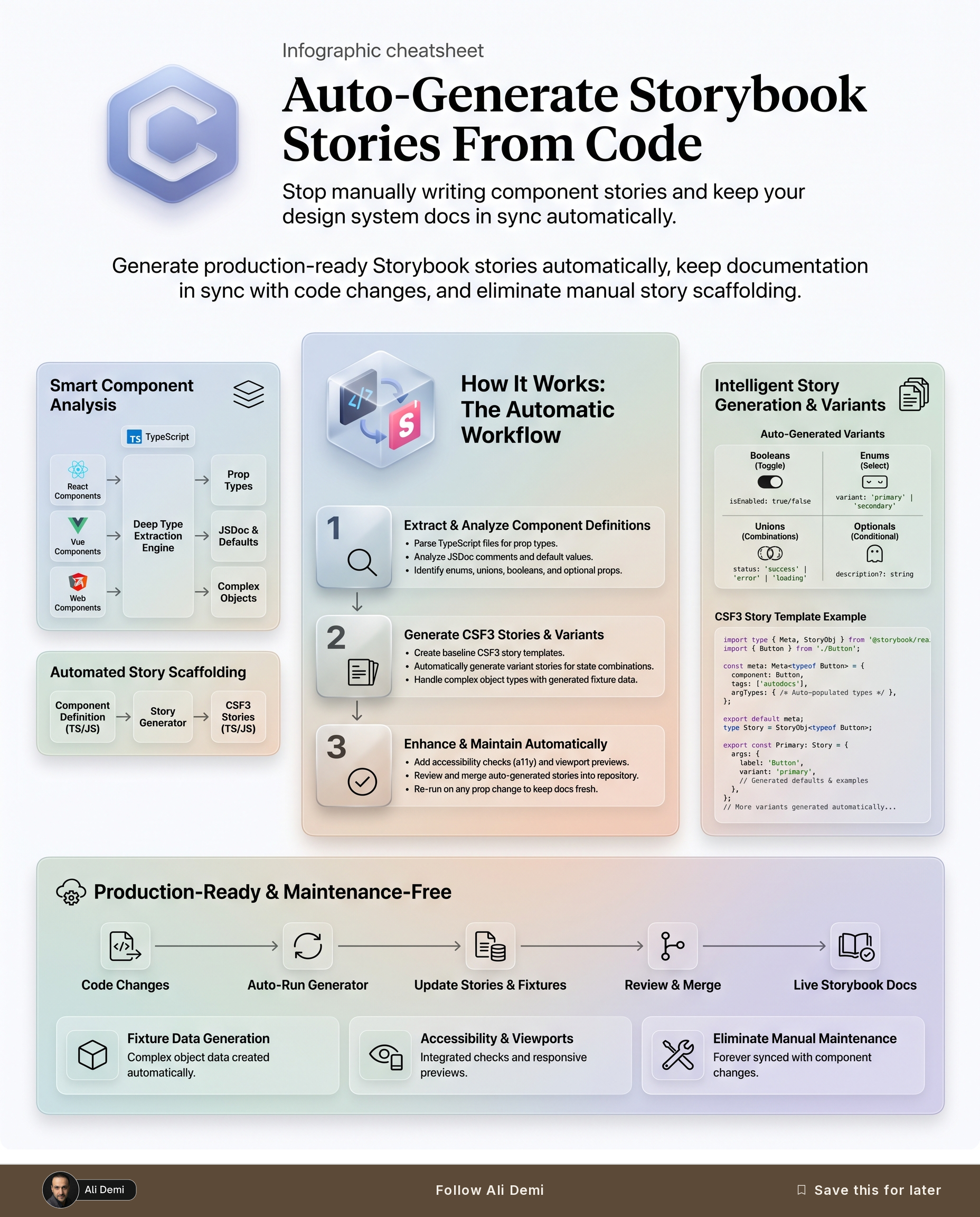
    Your component library is evolving fast. Each time a prop changes, someone updates the component but forgets to update the Storybook story. Now your documentation is out of sync and newer developers can’t find examples of how to use your components correctly.

    Claude Code reads your TypeScript component files, extracts the prop types and defaults, and generates complete, production-ready Storybook stories in CSF3 format. No manual scaffolding. No stale documentation. No hunting for examples.

    The workflow is simple: point Claude Code at your components folder, let it analyze the TypeScript interfaces, and it generates stories with all the prop variants. For enums, it creates separate stories per value. For complex types, it generates realistic fixture data. For optional props, it creates stories showing both states. One PR review instead of dozens of manual story files.

    Every time your component props change, re-run Claude Code and your stories update automatically. Your design system documentation stays fresh without lifting a finger.

    ——
    Book your free AI clarity call, NOW!
    https://buff.ly/TpWy277
    ——

    Repost this. Thanks.
  • Your Coverage Report is Lying: Auto-Fix Test Gaps

    Your Coverage Report is Lying: Auto-Fix Test Gaps

    You run your test suite, coverage report lands, and half your code has no tests.

    You know you should write tests for the gaps. But your coverage report doesn’t tell you WHICH gaps matter, WHICH branches are uncovered, or WHERE the untested paths hide.

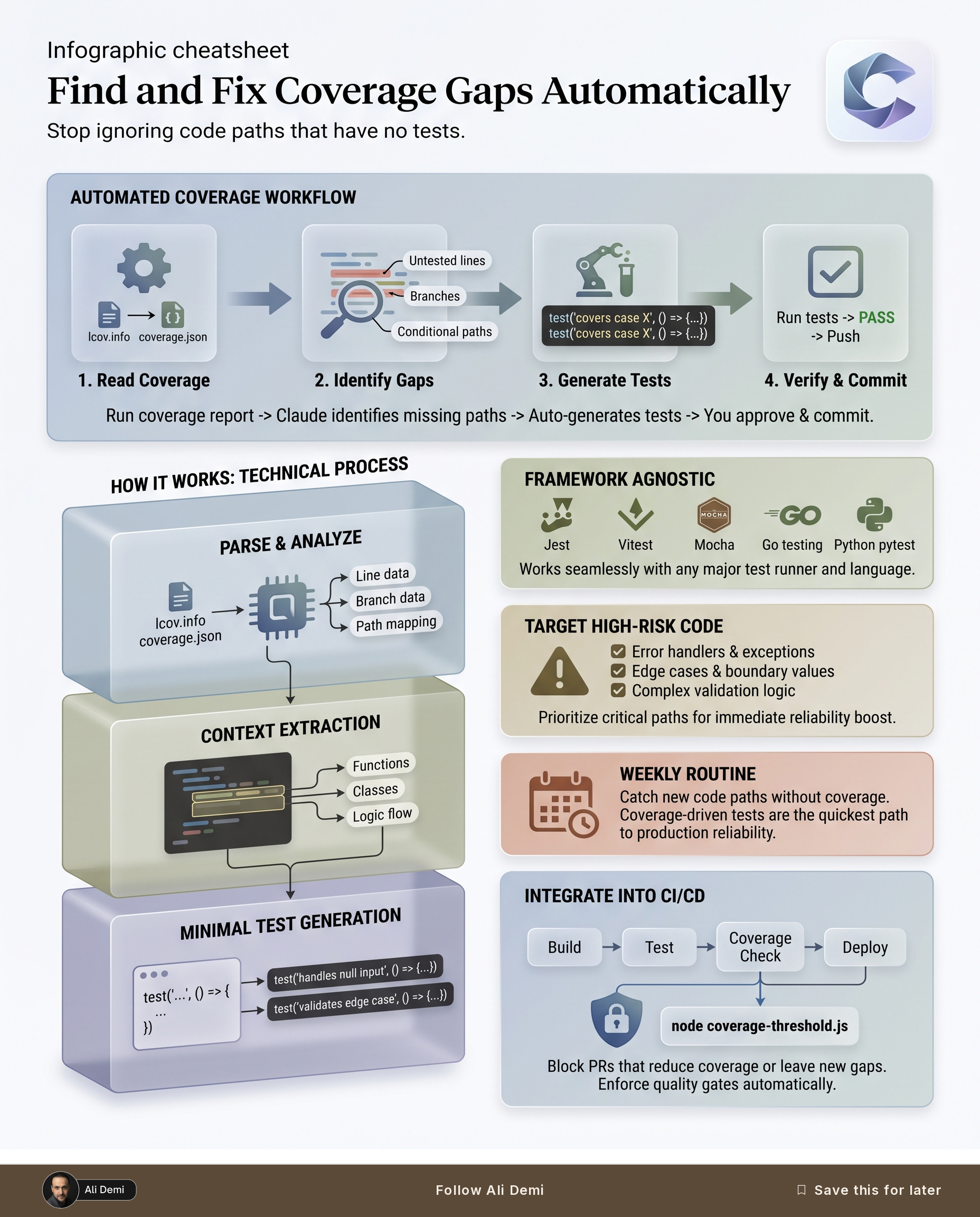
    Claude changes that. It reads your coverage report, finds every untested code path, and generates the minimal test case needed to cover it.

    The workflow:

    1. Run your test suite with coverage instrumentation. Get back lcov.info or coverage.json.
    2. Point Claude at your coverage report and source files. It parses which lines and branches have zero execution.
    3. For each untested path, Claude extracts the code and generates a laser-focused test case that exercises it.
    4. Push the generated tests to your repo, run them to verify coverage goes up.
    5. Set up a GitHub Actions workflow that fails any PR dropping coverage, runs this analysis automatically.

    What you get: no more technically tested code that fails in production. No more guessing which functions matter. No more coverage theater.

    ——

    Book your free AI clarity call, NOW!
    https://buff.ly/TpWy277

    ——

    Repost this. Thanks.
  • Your PRs Deserve Great Announcements: Auto-Generate Them

    Your PRs Deserve Great Announcements: Auto-Generate Them

    Your best features ship quietly. A dev merges a PR. Marketing gets a Slack link. Someone reads tech jargon and thinks: “How do I explain this to customers?” Five emails later, you have a one-liner and no announcement.

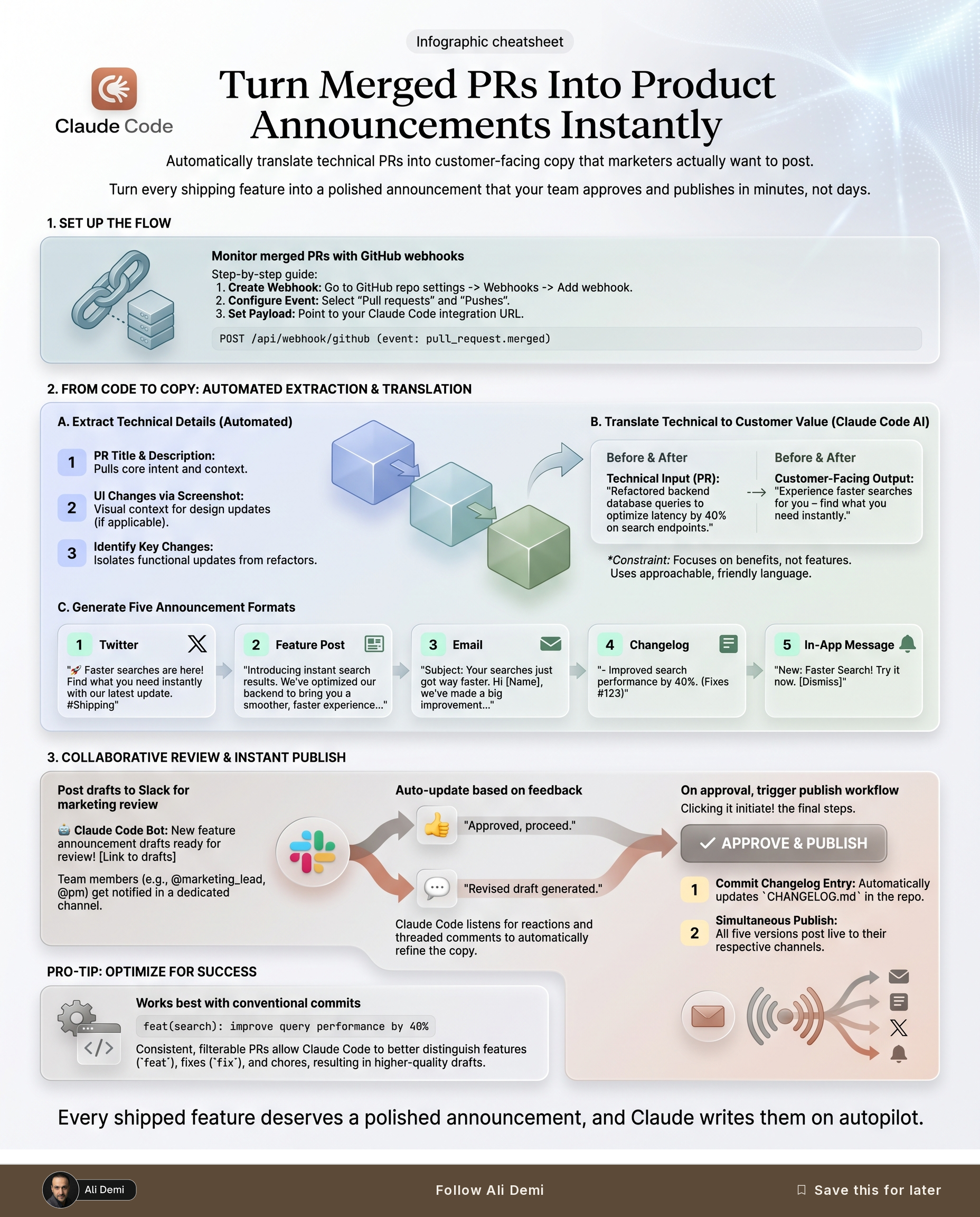
    Claude Code can fix this. Watch your PRs. Extract what changed. Generate the announcement.

    Here’s the workflow:

    Step 1: PR merged. Your GitHub webhook fires Claude Code. Claude reads the PR, PR description, and takes a screenshot of the changed UI.

    Step 2: Claude generates copy. One prompt produces five versions: a Twitter/X post, a feature announcement paragraph, an email subject line, a changelog entry, and an in-app notification. It translates “API response time improved by 40%” to “Faster searches, every time.”

    Step 3: Marketing reviews. Claude posts all five versions to Slack in a thread. Marketing says yes or tweaks them. Claude updates based on feedback.

    Step 4: Everything publishes at once. Claude commits the changelog entry, triggers your announcement service, and posts to email lists. One approval flows everywhere.

    The result: Features announced in minutes. Consistent voice. No missed launches.

    Set it up: Use Claude Code hooks to listen for merged PRs. Call Claude’s Messages API with the PR data and a prompt that asks for five specific announcement formats. Post drafts to Slack, collect reactions, and auto-commit on approval.

    ——
    Book your free AI clarity call, NOW!
    https://buff.ly/TpWy277
    ——

    Repost this. Thanks.
  • Your PR Queue Is Killing Velocity: Automate Code Review Triage

    Your PR Queue Is Killing Velocity: Automate Code Review Triage

    Your team just shipped 50 PRs this week. Three reviewers.

    AI made developers 60% faster in the last year, but your review team didn’t get faster. They got slower. Your backlog isn’t growing because code is broken-it’s growing because nobody can review it fast enough.

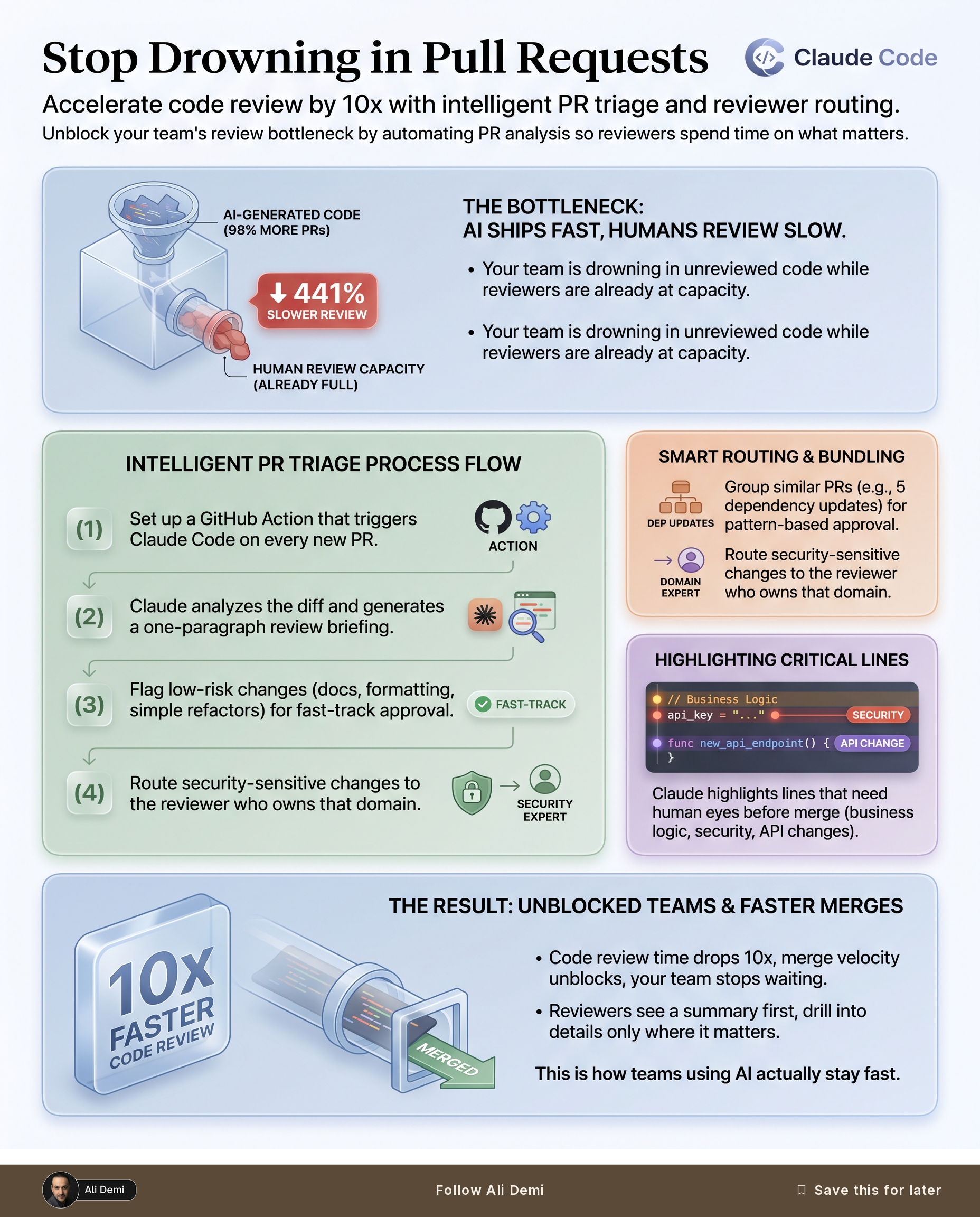
    Here’s what’s changed: teams using Claude and Copilot now merge 98% more PRs, but code review time jumped 441%. The bottleneck moved from coding to reviewing. And reviewing AI-written code is harder-it surfaces 1.7x more issues that need careful eyes.

    Claude Code can fix this. Not by replacing review, but by making it 10x faster.

    Start with a simple GitHub Action that triggers Claude Code on every PR. Claude reads the diff and generates a **review briefing**-one paragraph saying what changed, why, and which lines need human eyes. Flag low-risk changes (docs, formatting, simple refactors) for instant approval. Route complex changes to the engineer who owns that code. Batch five similar PRs together so reviewers spot patterns instead of reading boilerplate ten times.

    The math changes immediately: instead of every reviewer reading every line, they see **only what matters**. Security-sensitive changes get a checklist. Business logic changes surface the exact data flows to verify. Dependency updates get grouped-approve the pattern, not each file.

    Your reviewers actually review again. Developers stop waiting. Merge time drops from three days to three hours.

    This isn’t optional anymore. AI accelerated the generation side. If you don’t accelerate review, you break velocity.

    ——

    Book your free AI clarity call, NOW!
    https://buff.ly/TpWy277

    ——

    Repost this. Thanks.
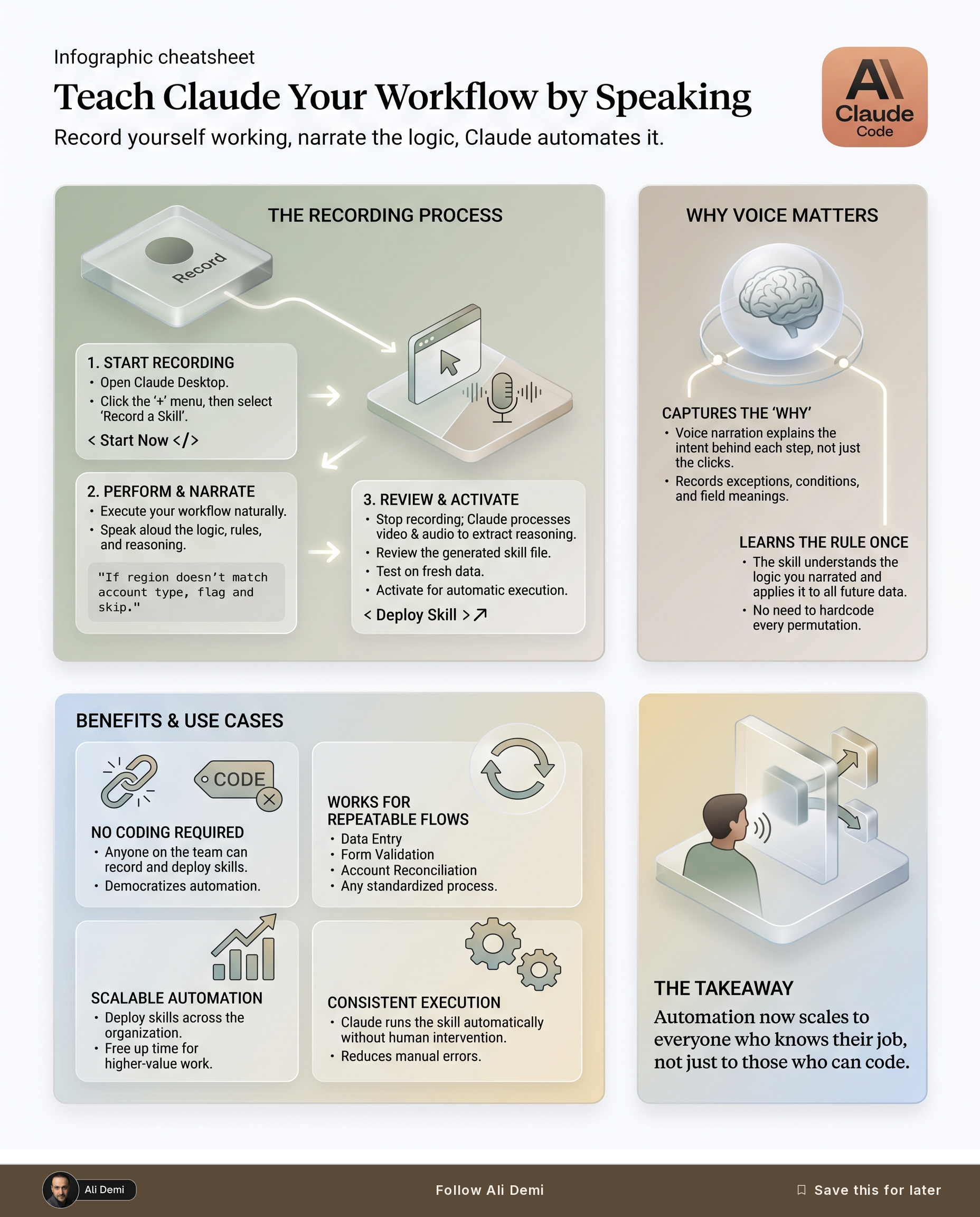
  • Stop Scripting Workflows: Teach Claude by Speaking

    Stop Scripting Workflows: Teach Claude by Speaking

    You know your job inside out. But automation tools ask you to translate that knowledge into prompts, scripts, or rules. That’s the wrong way around.

    Claude’s new Record a Skill feature flips it: you show Claude how you work, narrate the logic as you go, and Claude learns.

    Open the Claude Desktop app (Pro, Max, or Team), hit the plus menu, and pick Record a Skill. Hit record. Do your workflow the way you actually do it. Speak aloud as you work: the rules, the exceptions, what each field means, when to stop and escalate. Let Claude hear your reasoning, not just watch your clicks.

    Stop recording. Claude processes your video plus audio and generates a reusable skill file that captures the logic you narrated, not just the screen movements. Test it on fresh data. When it’s right, activate it and Claude runs it hands-free.

    This changes who can automate. Data entry clerks, operations managers, finance teams, anyone who repeats a workflow can now build automation. No engineers needed. No prompt tuning. Just show, speak, and done.

    The voice narration is the secret. Screen recording alone is brittle: it re-clicks the same buttons on the same screen. But when you speak the logic (“check the branch field matches the account type; if it’s mismatched, flag and skip”), Claude learns the rule, not the click sequence. It generalizes. It handles edge cases you narrate once. It scales to new data without re-recording.

    This is automation for humans, not automation for engineers.

    ——

    Book your free AI clarity call, NOW!
    https://buff.ly/TpWy277

    ——

    Repost this. Thanks.
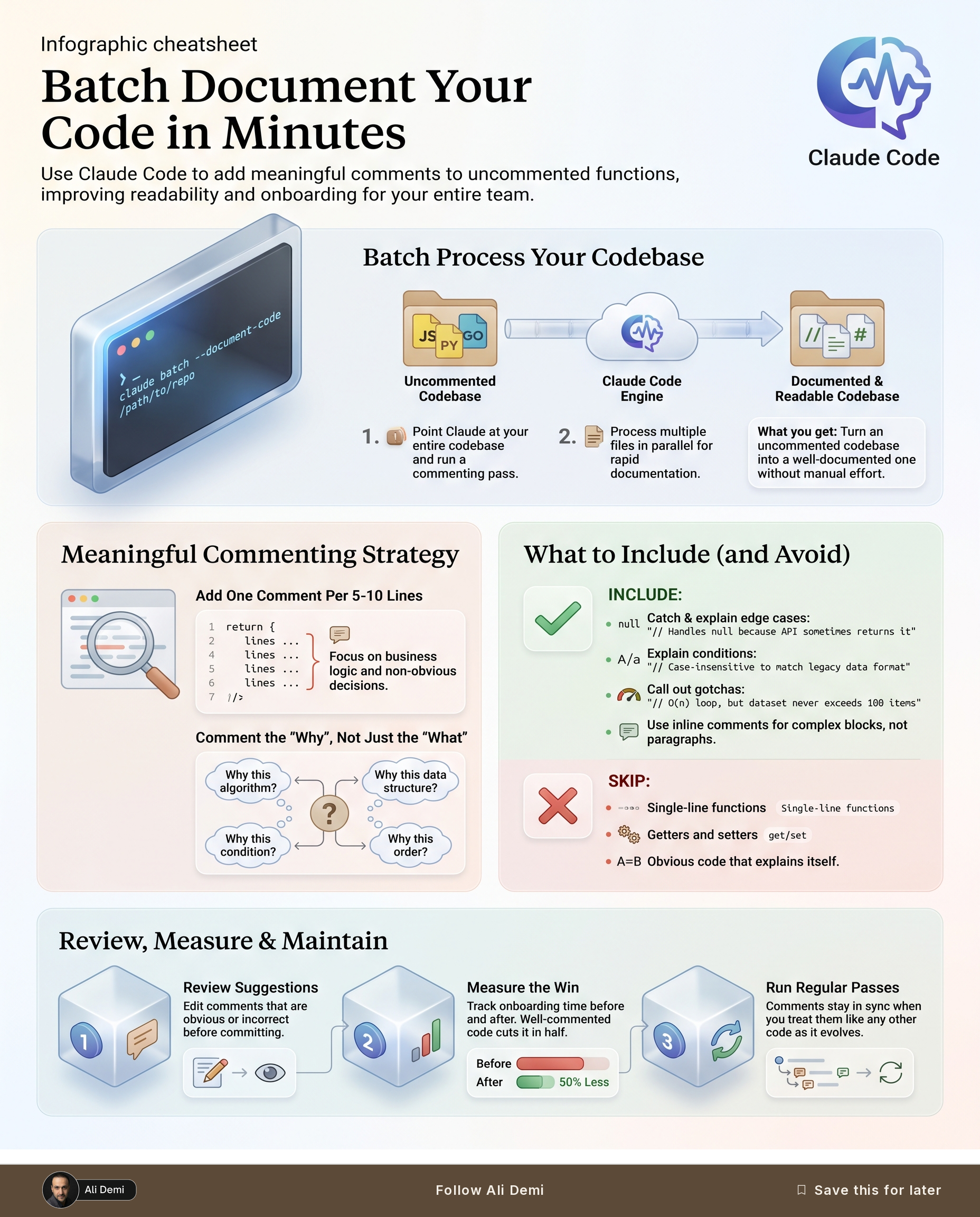
  • Your Code Deserves Comments: Automate Them at Scale

    Your Code Deserves Comments: Automate Them at Scale

    You inherit a 50,000-line codebase with zero comments.

    Nobody remembers why half of it was written. The business logic is implicit. New hires spend weeks reverse-engineering functions that should have taken hours to understand.

    Manual commenting takes forever. AI can help.

    Claude Code can read your functions semantically, understand what they actually do, and add comments that explain the “why,” not the obvious “what.” Then you batch the whole codebase in parallel.

    The workflow:

    1. Point Claude Code at your functions using the batch tool to process multiple files at once.
    2. Ask it to add one meaningful comment per 5-10 lines of code.
    3. Skip trivial single-line functions and getters.
    4. Focus on business logic, non-obvious decisions, and edge cases.
    5. Review the output, refine, and commit.

    The payoff: onboarding drops from weeks to days. Code audits take hours instead of days. Refactoring becomes less risky because the intent is documented.

    Claude doesn’t just comment. It understands the code’s purpose and documents why someone chose this approach over the obvious one.

    ——

    Book your free AI clarity call, NOW!

    https://buff.ly/TpWy277

    ——

    Repost this. Thanks.
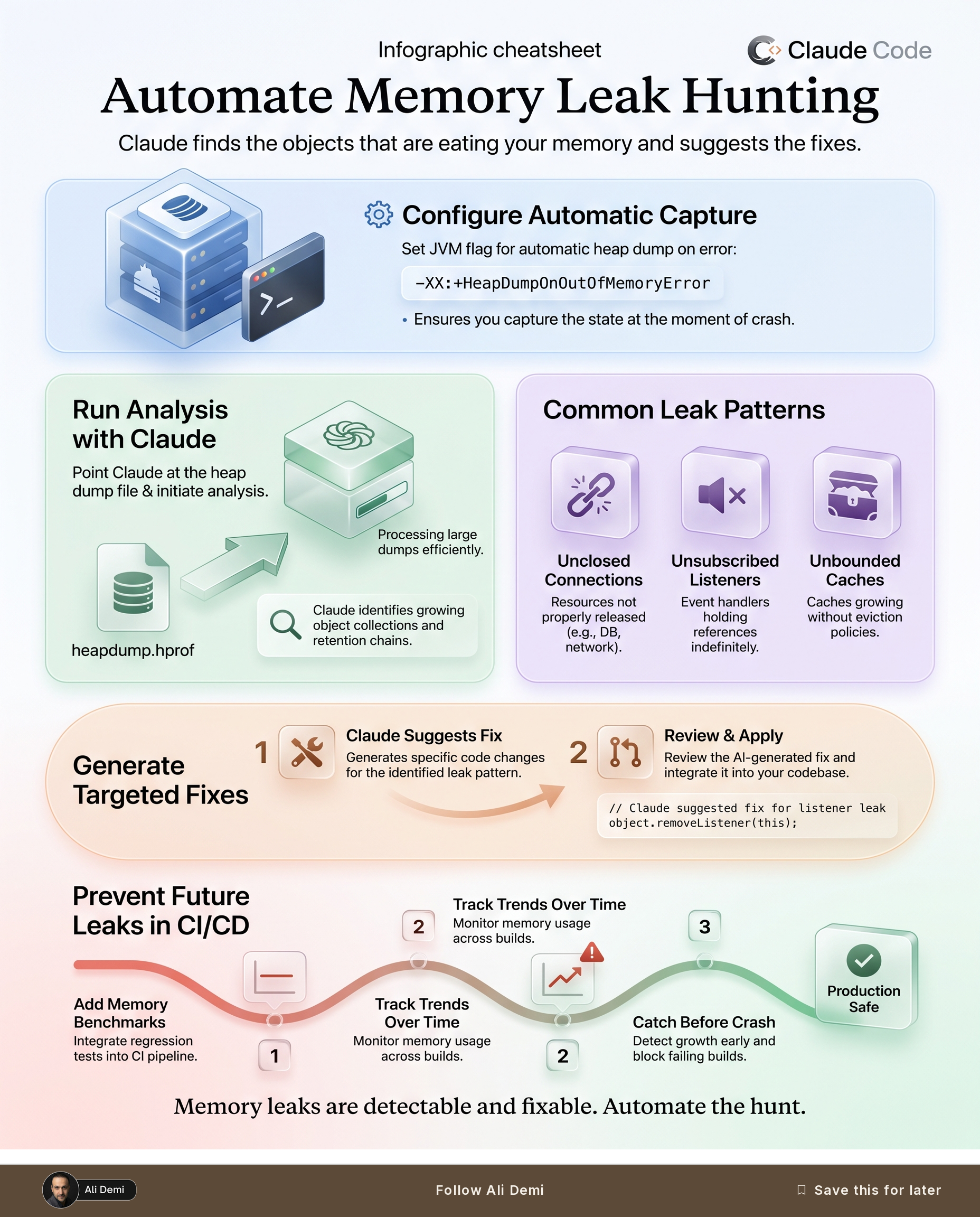
  • Stop Hunting Memory Leaks: Automate Heap Dump Analysis

    Stop Hunting Memory Leaks: Automate Heap Dump Analysis

    Memory leaks kill production at 3am.

    Your app runs fine in dev. Tests pass. Then at 2:47am a heap fills up, OutOfMemoryError fires, and your service goes dark. By morning you’re staring at a 500MB heap dump that won’t open in most tools.

    Manual heap dump analysis is nightmare fuel: you dig through object retention graphs, hunt for growing collections, trace references back to code, and guess which pattern is leaking.

    Claude can automate the whole hunt.

    First, configure your JVM to auto-capture heap dumps when things go wrong. One flag: -XX:+HeapDumpOnOutOfMemoryError. Now every crash leaves evidence.

    Point Claude at the dump file. Claude loads it, finds object collections that have grown since the last dump, and traces retention chains back to your code. The analysis happens in minutes instead of hours.

    Claude identifies the pattern: unclosed database connections, event listeners never unsubscribed, caches with no eviction policy, circular references keeping objects alive. Each pattern maps to a specific fix.

    Then Claude suggests the fix and runs memory benchmarks to verify the leak stops.

    Add this to your CI/CD pipeline as a scheduled job. Every week Claude captures memory profiles under realistic load, detects trends, and flags memory growth before it becomes a crisis.

    ——

    Book your free AI clarity call, NOW!
    https://buff.ly/TpWy277

    ——

    Repost this. Thanks.
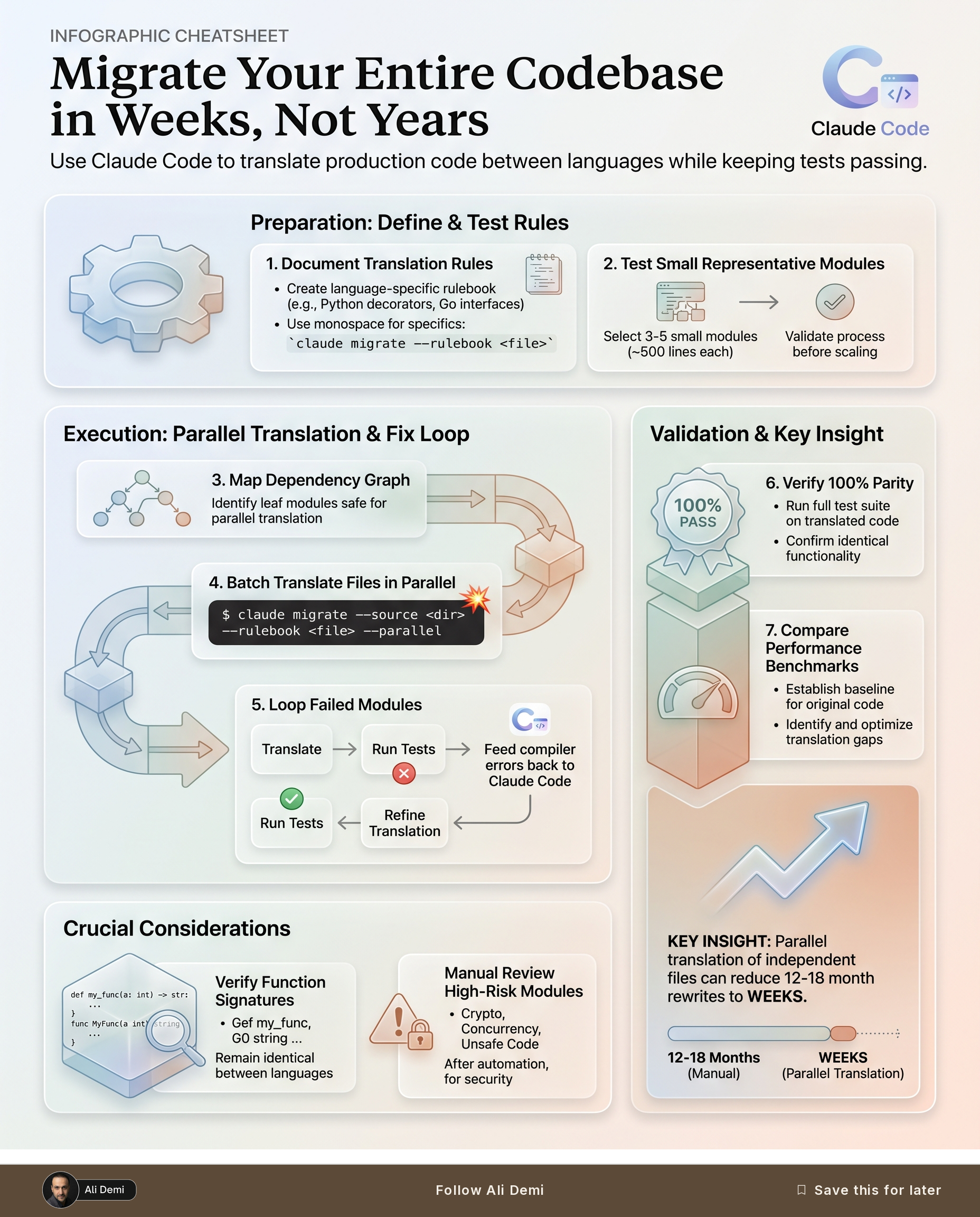
  • Stop Rewriting from Scratch: Migrate Millions of Lines Automatically

    Stop Rewriting from Scratch: Migrate Millions of Lines Automatically

    You’re stuck with legacy Python. You want Go.

    You’re on an old Node.js stack. You want Rust.

    Rewriting from scratch takes years. Hiring language experts takes months. Manual line-by-line translation is error-prone and tedious.

    What if Claude translated your entire codebase automatically, passing every test suite as it goes?

    The process:

    Start by documenting your migration rules in a simple markdown file. Map language-specific patterns: Python decorators to TypeScript hooks, Go interfaces to Rust traits, whatever your translation needs. This becomes your rulebook that Claude follows across the entire migration.

    Build a dependency graph of your codebase. Identify leaf modules with zero external dependencies. These become your safe starting points for parallel translation.

    Run a mini stress-test first. Pick 3-5 representative small modules (a few hundred lines each). Feed Claude the rulebook plus source code plus tests, and ask it to translate and verify. This validates your process before scaling.

    Now parallelize. Feed Claude batches of files with the rulebook and their corresponding tests. Claude translates, you run your test suite automatically. Files that pass move forward. Files that fail loop back to Claude with compiler errors attached.

    Claude sees the error, fixes the code, tests again. No human guessing, no manual debugging cycles. The loop runs until green.

    After translation, run your full test suite on the new code. Compare performance benchmarks. Manually review the highest-risk modules. Everything else is systematically proven equivalent.

    The payoff: Codebases that would take 12-18 months to migrate manually can be translated, tested, and verified in weeks. No rewrites. No losing your architecture. Your tests prove correctness every step.

    ——

    Book your free AI clarity call, NOW!
    https://buff.ly/TpWy277

    ——

    Repost this. Thanks.
  • Your Trading Strategy Should Backtest Itself

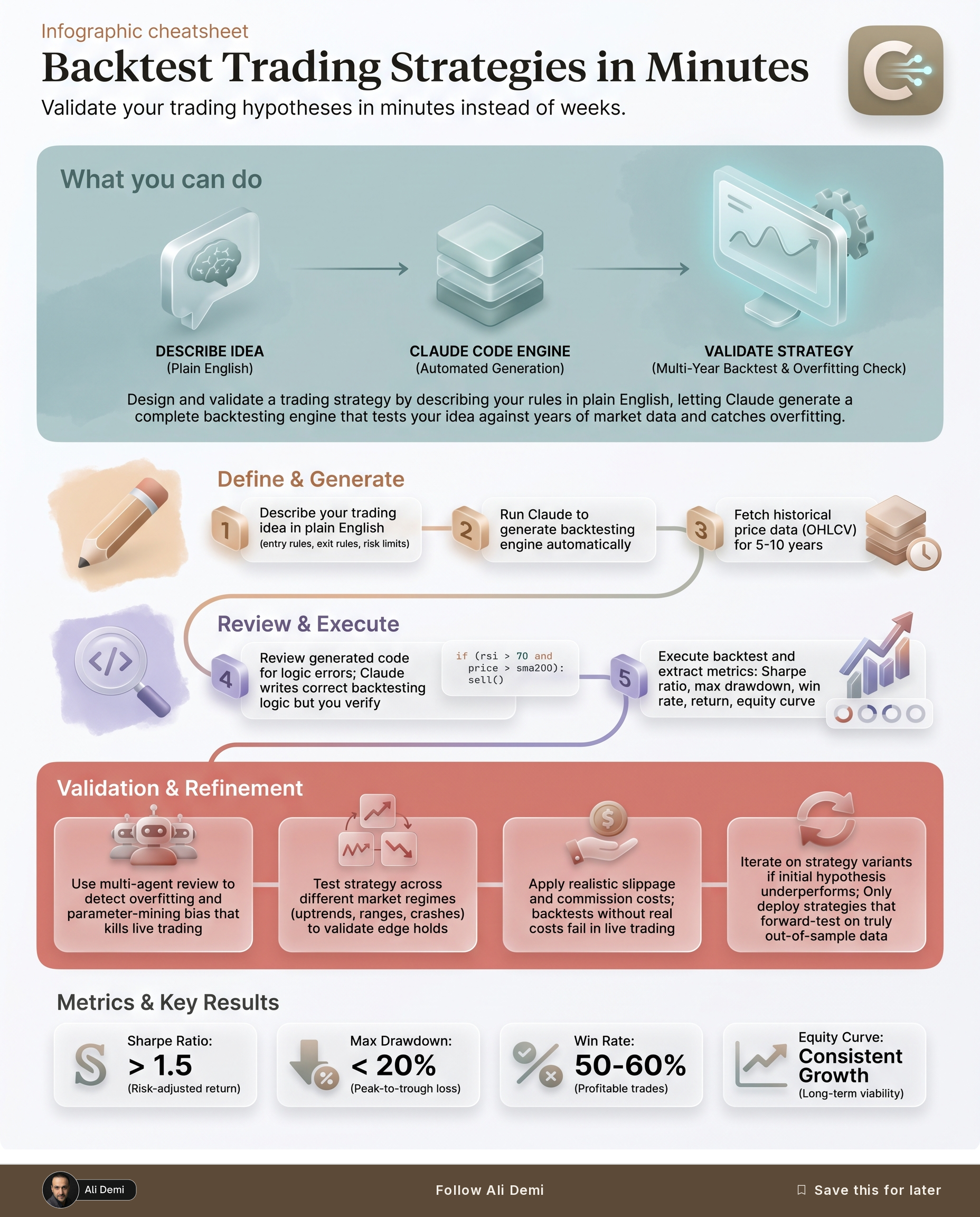
    Your Trading Strategy Should Backtest Itself

    You’ve got a trading idea that feels solid. But how do you know it actually works?

    Most traders spend weeks building backtests in spreadsheets, hunting for bugs, and tweaking parameters endlessly.

    Even then, half your edge is likely just luck: market noise that won’t repeat.

    Claude Code turns this around.

    Describe your trading rules in plain English (when to buy, when to sell, your stop-loss).

    Claude generates a complete backtesting engine.

    It fetches 5-10 years of historical price data automatically.

    Runs your strategy against every price bar.

    Calculates Sharpe ratio, max drawdown, win rate, and risk-adjusted returns.

    All in minutes.

    But here’s the kicker: Claude doesn’t just backtest, it verifies.

    Use multi-agent review to catch overfitting, survivorship bias, and the thousand ways traders fool themselves.

    Test your strategy across different market regimes (uptrends, ranges, crashes) to see where it actually holds up.

    Apply realistic transaction costs (slippage, commissions) so your backtest matches real-world results.

    Iterate fast.

    If your first hypothesis underperforms, generate new strategy variants and backtest them again.

    In a day, you validate 20 hypotheses instead of one.

    The game changes when verification is instant.

    You catch bad strategies in 10 minutes instead of losing real money on them.

    You stop second-guessing and start shipping only validated, forward-tested strategies.

    ——

    Book your free AI clarity call, NOW!
    https://buff.ly/TpWy277

    ——

    Repost this. Thanks.
  • Stop Writing API Tests by Hand: Generate Them from Your OpenAPI Spec

    Stop Writing API Tests by Hand: Generate Them from Your OpenAPI Spec

    You have an OpenAPI spec. You also have a growing list of test cases nobody wants to write.

    API testing is a perfect Claude job: your spec already describes every endpoint, parameter, and error response. Why type them all out again?

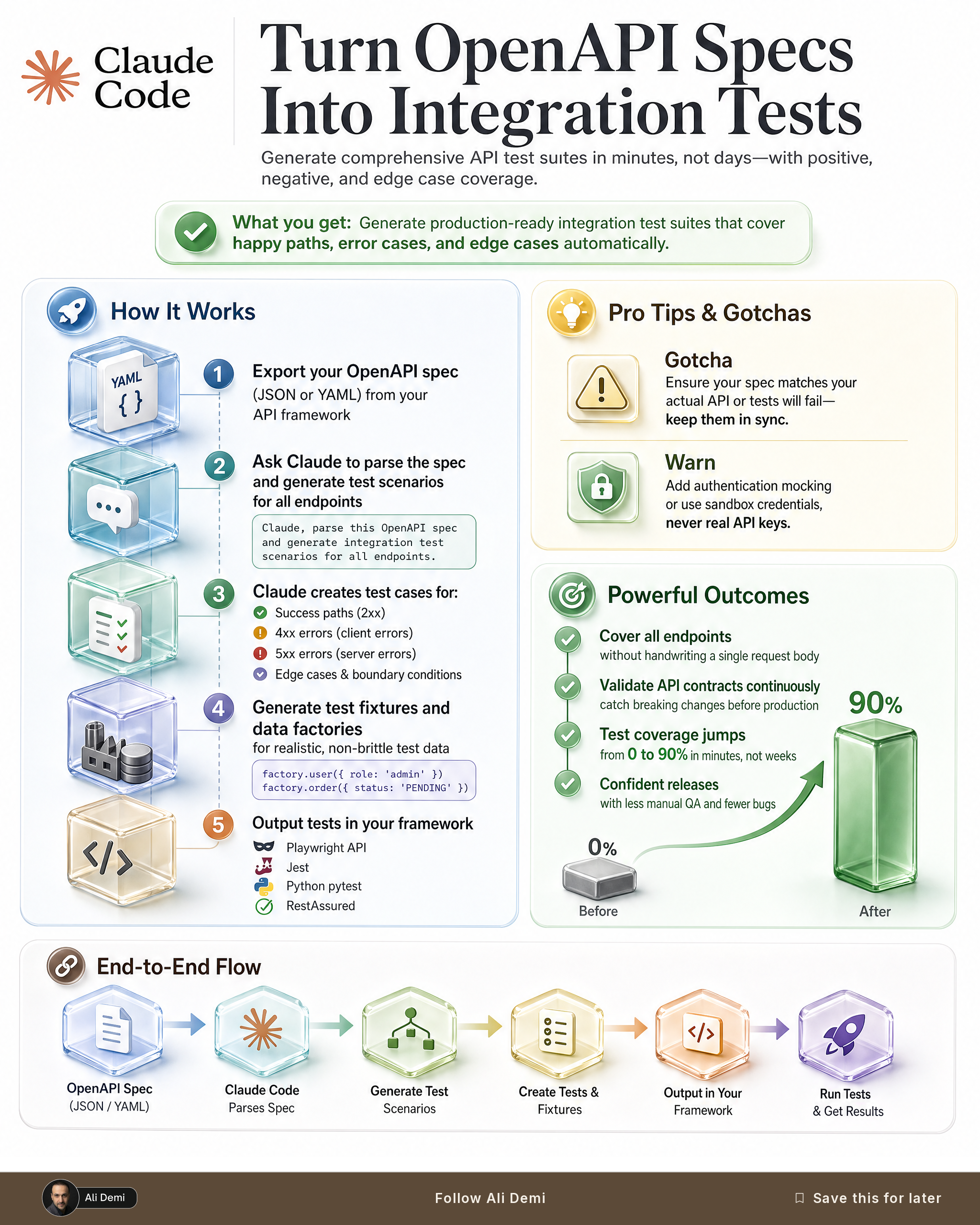
    Point Claude at your OpenAPI 3.0+ spec, and let it generate complete integration test suites-positive flows, error cases, boundary values, security scenarios, all ready to run.

    The workflow looks like this:

    1. Export your OpenAPI spec from your API framework or OpenAPI editor.
    2. Drop the spec into Claude Code and ask it to generate test scenarios.
    3. Claude parses all endpoints, parameters, schemas, and authentication methods.
    4. It generates test cases for success paths, 400/401/403/500 responses, boundary values, and data validation.
    5. It creates test fixtures and realistic data factories so tests aren’t brittle.
    6. Output a ready-to-run test suite in your framework of choice: Playwright API requests, Jest, RestAssured, or curl collections.
    7. Run tests in your CI/CD pipeline. Claude flags any spec-reality mismatches.

    What you get:

    • Full endpoint coverage without manual request building.
    • Tests for happy paths and error scenarios-no guessing which edge cases matter.
    • Data factories that generate realistic test fixtures instead of hardcoded payloads.
    • Spec-driven contract validation: tests catch API changes that break the contract.
    • CI-ready: tests run in your pipeline, report coverage gaps, flag breaking changes before they ship.

    Why this matters: Manual API test writing is boilerplate that delays releases. OpenAPI specs already have all the information Claude needs to generate comprehensive tests. You write the real logic, Claude handles the tedium.

    ——

    Book your free AI clarity call, NOW!
    https://buff.ly/TpWy277

    ——

    Repost this. Thanks.